


Page 135 - Demo
P. 135
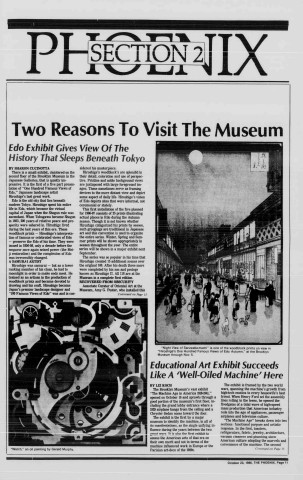
Two Reasons To Visit The MuseumEdo Exhibit Gives View O f TheHistory That Sleeps Beneath TokyoBY SHARON CUCINOTTAThere is a small exhibit, cloistered on the second floor of the Brooklyn Museum in the Japanese Galleries, that is quietly impressive. It is the first of a five part presentation of %u201cOne Hundred Famous Views of Edo,%u201d Japanese landscape artist Hiroshige%u2019s last great work.Edo is the old city that lies beneath modern Tokyo. Hiroshige spent his entire life in Edo, which became the virtual capital of Japan when the Shogun rule was ascendant. When Tokugawa became Shogun in 1603, 200 years of relative peace and prosperity were ushered in. Hiroshige lived during the last years of this era. These woodblock prints %u2014 Hiroshige%u2019s interpretation of famous or celebrated views of Edo %u2014 preserve the Edo of his time. They were issued in 1856-58, only a decade before the emporor once again seized power (the Meiji restoration) and the complexion of Edo was irreversibly changed.A SAMURAI ARTISTHiroshige was samurai %u2014 but as a lower ranking member of his class, he had to moonlight in order to make ends meet. He trained as an artisan in the production of woodblock prints and became devoted to drawing and his craft. Hiroshige became Japan%u2019s premier landscape designer and %u201c100 Famous Views of Edo%u201d was and is considered his masterpiece.Hiroshige%u2019s woodblock%u2019s are splendid in their detail, coloration and use of perspective. Pristine and noble background views are juxtaposed with large foreground images. These sometimes serve as framing devices to the more distant view and depict some aspect of daily life. Hiroshige%u2019s vision of Edo depicts sites that were informal, not ceremonial or stately.This first installation of the five planned for 1986-87 consists of 25 prints illustrating actual places in Edo during the Autumn season. Though it is not known whether Hiroshige categorized his prints by season, such groupings are traditional in Japanese art and this convention is used to organize the entire series. Winter, Spring and Summer prints will be shown appropriately in season throughout the year. The entire series will be shown in a major exhibit next September.The series was so popular in his time that Hiroshige created 15 additional scenes over the original 100. After his death three more were completed by his son and protege known as Hiroshige II. All 118 are at the Museum in a complete first edition. RECOVERED FROM OBSCURITYAssociate Curator of Oriental Art at the Museum, Amy G. Poster, who installed thisContinued on Page IS'W atch,\%u201c N ig h t V iew of S aruw aka-m achi%u201d is o n e of the w o odblock prints on view in\M useu m through Nov. 5.Educational Art Exhibit SucceedsLike A 'Well-Oiled Machine' HereBY LIZ KOCHThe Brooklyn Museum%u2019s vast exhibit %u201cThe Machine Age in America 1918-1941,%u201d opened on October 16 and sprawls through a good portion of the museum%u2019s first floor, including the grand lobby entrance where a 1929 airplane hangs from the ceiling and a Chrysler Sedan noses toward the door.The exhibit is the first by a major museum to identify the machine, in all of its manifestations, as the single unifying influence during the years between the two grezt lc a'cr> thp first pxhihit toassess the American arts of that era on their own merit and not in terms of the machine influenced work in Europe or the Parisian art-deco of the 1920s.The exhibit is framed by the two world wars, spanning the machine%u2019s growth from high-tech exotica to every housewife%u2019s best friend. When Henry Ford set the assembly lines rolling in the teens, he opened the floodgates of a tidal wave of high-speed mass production that American industry rode into the age of appliances, passenger airplanes and television culture.%u201cThe Machine Age%u201d breaks down into two sections: functional purpose and artistic response. In the first, toasters, refrigerators, fabric, jewelry, architecture, vacuum cleaners and plumbing show American culture adopting the marvels and convenience of the machine. The secondContinued on Page 15O ctober 23, 1986, TH E P H O E N IX , Page 11


