


Page 139 - Demo
P. 139
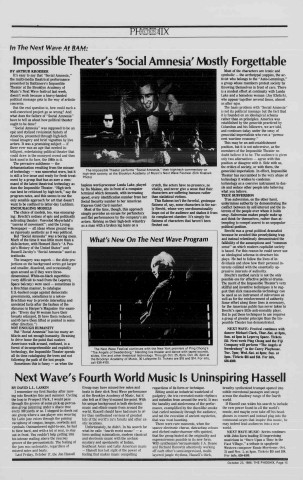
In Tht* \\lt*Yt W ^ i/o A t RAM* m m m m m m TW %u25a0 w Tk, * %u00ab%u2022 W. %u00bb w mm m v # B %u00abk a ^ i m l * m *Impossible Theater's 'Social Amnesia' Mostly ForgettableT h e Im possible T h e ater perform s \high-tech society, at the Brooklyn A cadem y of M u s ic %u2019s N e x t W ave Festival. (Erik KvalsvikPhoto)BY ARTHUR KROEBERIt%u2019s easy to say that %u201cSocial Amnesia,%u201d the multi-media theatrical performance presented by Baltimore%u2019s Impossible Theater at the Brooklyn Academy of Music%u2019s Next Wave festival last week, doesn%u2019t work because a heavy-handed political message gets in the way of artistic concerns.But the real question is, how could such a well-conceived project go so wrong? And what does the failure of %u201cSocial Amnesia%u201d have to tell us about how political theater ought to be done?%u201cSocial Amnesia%u201d was supposed to be an epic and stylized revisionist history of America, presented through high-tech visual imagery and brief vignettes by live actors. It was a promising subject %u2014 if there ever was an age that needed intelligent, entertaining political theater that could draw in the moneyed crowd and then kick sand in its face, the 1980s is it.The pervasive subtheme %u2014 the dehumanization resulting from the misuse of technology %u2014 was somewhat worn, but it is still a live issue and ready for fresh treatment by a group that has as sure a command of the latest theatrical technology as does the Impossible Theater. %u201cHigh tech can best be criticized by high tech,%u201d say the program notes, and this seems to me the only sensible approach for art that doesn%u2019t want to be confined to latter-day Luddism. ENCOURAGING MODELSThe choice of models, too, was encouraging: Brecht%u2019s notions of epic and politically activating theater; Vsevelod Meyerhold%u2019s %u201ccanvas of movement%u201d ; and the Living Newspaper %u2014 all ideas whose ground was as rigorously aesthetic as it was political.But %u201cSocial Amnesia%u201d was a boring mess. Much of the time it was little more than a slide-lecture, with Howard Zinn%u2019s %u201cA People%u2019s History of the United States%u201d and Russell Jacoby%u2019s %u201cSocial Amnesia%u201d used as textbooks.The imagery was superb %u2014 the slide projections on the background scrim got larger and smaller, dissolved, and occasionally spun around as if they were threedimensional. White-on-black supertitles (very difficult to read from the Lepercq Space balcony) were used %u2014 sometimes in a Brechtian manner, to catalogue U.S.-backed coups against democratic governments, sometimes in a not-soBrechtian way to provide interesting and unrelated facts after the fashion of the Almanac in Harper%u2019s Magazine (for example: %u201cEvery day 90 women have their breasts enlarged, 35 have them reduced, and 65 have them lifted or pointed in some other direction.%u201d )NOT ENOUGH HUMANITYBut %u201cSocial Amnesia%u201d has too many artifacts and not enough humanity. Straining to drive home the point that modern Americans walk around, confused, in a forest of incomprehensible and exploitive technology, the Impossible Theater spends all its time cataloguing the trees and not following the path of the lost people.Sometimes this is funny %u2014 as when thehapless word-processor Londa Lake, played by Ro Malone, sits in front of a computer terminal which demands, with increasing speed, every identification number from her Social Security number to her American Express Gold Card number.Most of the time, though, this approach simply provides an excuse for perfunctory and flat performances by the company%u2019s six actors. Relying on their high-tech wizardry as a man with a broken leg leans on acrutch, the actors have no presence, no vitality, and never give a sense that their characters are suffering humans rather than statistical victims.This flatness isn%u2019t the forceful, grotesque flatness of, say, some characters in the early Brecht, whose very one-dimensionality leaps out at the audience and shakes it from its complacent slumber. It%u2019s simply the flatness of characters that haven%u2019t been fleshed out.Most of the characters are iconic and symbolic %u2014 the archetypal yuppies, the activist who belongs to the %u201cAuto-Lemmings,%u201d a group whose members protest society by throwing themselves in front of cars. There is a modest effort at continuity with Londa Lake and a homeless woman (Joy Ehrlich), who appear together several times, almost as alter egos.The basic problem with %u201cSocial Amnesia%u201d is not its political message but the fact that it is founded on an ideological schema rather than on principles. America was established by the genocide practiced by Columbus and his followers, we are told, and continues today under the sway of genocidal imperialists who run a %u201cpermanent wartime economy.%u201dThis may be an anti-establishment position, but it is not subversive, as the members of the Impossible Theater no doubt believe it to be. The audience is given only two alternatives %u2014 agree with this position or disagree with it. Side with us, the critics of society, or with them, the genocidal imperialists. In effect, Impossible Theater has succumbed to the very abuse of technology it wishes to condemn: technology as a coercive instrument to dazzle and seduce other people into believing what you believe.TRUE SUBVERSION True subversion, on the other hand, undermines authority by demonstrating the conflict between its self-interest and the interests of the people over whom it holds sway. Subversion makes people wake up and think for themselves, rather than attempting to compel assent to an unpopular political position.Brecht was a great political dramatist because he avoided this proselytizing trap and instead relentlessly demonstrated the fallibility of the assumptions and %u201ccommon sense%u201d on which modem capitalist society is based. For this reason he could never use an ideological schema to structure his plays. He had to follow the lives of individuals and show how their personal interests collided with the essentially oppressive interests of authority.Brecht%u2019s method surely is not the only possible one for effective political drama. The merit of the Impossible Theater%u2019s very skillful and inventive techniques is to suggest that slick mass-media technology can be used as an instrument of subversion as well as for the reinforcement of authority. Some effort along these lines is necessary, for the American public has never taken to Brecht%u2019s spare little anti-morality plays.But to put these techniques to use requires a group of greater principle than the Impossible Theater has demonstrated.NEXT WAVE: Festival continues with dancer Michael Clark, Thur.-Sat. at 8pm, Sun. at 2pm in Lepercq Space. Tickets $15. Next week Ping Chong and the Fiji Company will perform %u201cThe Angels of Swedenborg%u201d in the Carey Playhouse.Tue. 7pm; Wed.-Sat. at 8pm; Sun. at 2pm. Tickets $18 and $14. For info,636-4100.W hat's N ew O n The N ext Wave ProgramThe N ext W ave Festival continues w ith the N ew York prem iere of Ping C hong's%u201c The A ngels of S w edenborg ,%u201d blending live th eater and dance w ith taped sounds,slides, film and other th eatrical technology. Through Oct. 25, 8pm , O ct. 26, 2pm atthe Brooklyn A cadem y of M usic, 30 Lafayette St. Tickets are $18 and $14. F o r info,call 636-4100.Next Wave's Fourth World Music Is Uninspiring HassellBY DAVID L.L. I.ASKINI remember my first Sunday after moving into Brooklyn this past summer. Cycling the loop in Prospect Park, I would pass through the groove of some pick-up percussion group jamming under a shace tree every 100 yards or so. I stopped to check out one group where a sax player was weaving his Latin jazz colors through the pulsing cacophony of congas, bongos, cowbells and cymbals. Outnumbered eight-to-one, he had to blow hard, and with a lot ot soul, to stay out in front. You couldn%u2019t help getting into his intense wailing above the raucous groove of the percussionists. The feeling of the jam was undeniable, regardless of missed notes and beats.Last Friday, October 17, the Jon HassellGroup may have missed few notes and beats in their slick Next Wave performance at the Brooklyn Academy of Music, but it also felt as if they%u2019d missed the point. With his unique background in both electronic music and ethnic music from around the world, Hassell should have had more to offer than synthesized versions of greatest hits of the world%u2019s ram forests and other exotic locations.Unfortunately, he didn%u2019t. In his search for what he calks \form uniting minimalism, modem classical and electronic music with the archaic mystery and spontaneity of Indian, Southeast Asian and Imtin American music %u2014 Hassell has lost sight of the power of feeling that makes music compellingregardless of its form or technique.Sitting amid an industrial wasteland of gadgetry, the trio recreated exotic rhythms and melodies from around the world. It was the banality and aimlessness of the performance, exemplified by the disco-like smoke that curled noxiously through the audience, and not the evocation of ancient mysteries, that was most haunting.There were rare moments, when the snacev electronic chorus, distracting echoes and cliched snake-charmer riffs quieted, that the group hinted at the originality and expressiveness possible in its new form. With synthesizer/oercussionists J.A. Deane and Richard Horowtiz attentively working off each other%u2019s semi-improvised, multilayered jungle rhythms, Hassell%u2019s thick,breathy synthesized trumpet opened into subtle microtonal passages and swept across the shadowy range of the fourth world.If Hassell can widen his search to include the raw power found in all the world%u2019s music, and maybe even take off his headphones in concert and instead plug into the communal urges that inspire this music, he may indeed lead audiences into a new world.NEXT WAVE MUSIC: Series continues with John Zorn leading 22 improvising musicians in %u201cOnce Upon a Time in the F.ast Village,%u201d a tribute to spaghettiWestern composer Ennio Morricone. Oct. 31 and Nov. 1, at 8pm. Tickets $18 and $14. For info, 636-4100.O cto b er 23, 1986, TH E P H O E N IX , Page 15


