


Page 137 - Demo
P. 137
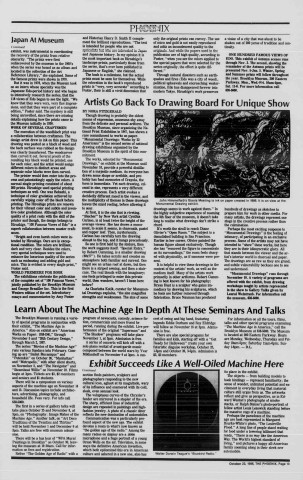
Japan At MuseumContinuedexhibit, was instrumental in coordinating the recovery of the prints from relative obscurity. %u201cThe prints were first rediscovered by the museum in the 1960%u2019s when the series was bound as an album and located in the collection of the Art Reference Library,%u201d she explained. Some of the famous prints were shown in 1970.But it was in 1978, when the Museum took on an intern whose specialty was the Japanese Edo-period history and who began to intensively research the series, that the 118 views of Edo began to see the light. %u201cWe knew that they were very, very fine impressions, and that they were part of a complete edition,%u201d Poster said. The mystery is still being unravelled, since there are missing details explaining how the prints came to the Museum initially in 1930.WORK OF SEVERAL CRAFTSMENThe execution of the woodblock print was a collaboration between craftsmen. The design artist drew in ink on thin paper. This drawing was pasted on a block of wood and the back surface was rubbed so the design was clearly transferred. The woodcarver then carved it out. Several proofs of the resulting key block would be printed, one for each color, and the artist would assign different colors to distinct areas and separate color blocks were then carved.The printer would then enter into the process and painstakingly apply the colors. A normal single printing consisted of about 200 prints. Hiroshige used special printing techniques as well. One was Bokashi, a technique of color gradation achieved by carefully wiping color off the block before printing. The Hiroshige prints are renown for their vibrant color and subtle and inventive color gradations. Although the color quality of a print rests with the skill of the printer and though, the design belongs to Hiroshige, %u201c100 Famous Views of Edo%u201d is a superb collaboration between master craftsmen.%u201cBright and even harsh colors were intended by Hiroshige. Ours are in exceptional condition. The colors are brilliant, dark and very clear. Besides the colors, very special techniques were used to enhance the luxurious quality of the series such as embossing and adding gold and mica. This is evident in every single print,%u201d Poster said.WORLD PREMIERE FOR BOOKThe exhibitions celebrate the publication of the complete set of %u201c100 Famous Views,%u201d jointly published by the Brooklyn Museum and George Braziller Inc. This is the first Western edition of the set. Introductory essays and commentaries by Amy PosterPKOTHIXand Historian Henry D. Smith II complement the brilliant reproductions. %u201cThe text is intended for people who are notn n A in n 1 < < 4 f < . . . U n %u00ab . A J T ___ upvtvtwiuvu w m rvins c u v u u v i vo vvu ua weaponand Japanese history. In my opinion it is the most important book on Hiroshige%u2019s landscape prints, particularly those from the series, that%u2019s ever been published in Japanese or English,%u201d she claimed.The book is a milestone, but the actual prints must be seen for themselves. While the coloration in the book%u2019s reproduced prints is %u201cvery, very accurate%u201d according to Poster, their is still a vivid dimension thatonly the original prints can convey. The use of mica and gold is not easily reproduced and adds an incandescent quality to thei %u201e k ~ au * 4 *ia v %u00ab n o n A n o i i a a / 1 i n f k n m m v m v u u u v u u i m i vpublication are of high quality, according to Poster, %u201cwhen you see the colors applied to the special papers that were selected for the series originally, the effect is quite different.%u201dThrough natural disasters such as earthquakes and fires (Edo was a city of wood), political upheavals and encroaching westernization, Edo has disappeared forever into modem Tokyo. Hiroshige%u2019s work preservesa vision of a city that was about to be shaken out of 200 yeras of tradition and continuity.ONE HUNDRED FAMOUS VIEWS OF EDO. This exhibit of Autumn scenes runs through Nov. 3. The second, showing the remainder of the Autumn prints will be presented Nov. 5-Jan. 5. Winter, Spring and Summer prints will follow throughout the year. Brooklyn Museum, 200 Eastern Parkway. Mon., Wed.-Fri. 10am-5pm,Sat. 11-6. For more information call 638-5000.Artists Go Back To Drawing Board For Unique ShowJohn H im m e lfarb %u2019s G iants M e e tin g is ink on paper c re a te d in 1986. It is on view at theM onu m ental D raw ing exhibit.BY NORA FITZGERALDThough drawing is probably the oldest means of expression, museums shy away from the delicate and personal artform. The Brooklyn Museum, since organizing the National Print Exhibition in 1947, has shown a rare commitment to works on paper. %u201cMonumental Drawings: Works by 22 Americans%u201d is the second series of national drawing exhibitions organized by the Brooklyn Museum in the spirit of this commitment.The works, selected for %u201cMonumental Drawings,%u201d on exhibit at the Museum until November 10, provide a powerful distillation of a majestic medium. As everyone has drawn some shape or scribble, and probably has fond memories of Crayola, the form is immediate. Yet each drawing, colossal in size, represents a very different creative process. Each artist evokes a decidedly different mood in the viewer, and the multiplicity of themes in these drawings leaves the mind reeling, before allowing it to soar.At first, it is the size that is riveting. %u201cBlocher%u201d by New York artist Cynthia Carlson, is at least twice the height of the average viewer. She has drawn a monument, to scale it seems, in charcoals, pastel and copper leaf. Then, mysteriously,Carlson has carefully tom the drawing almost to the top, and it hangs precariously.So one is first held by the stature, then the work suggests itself. %u201cSpecial Entry,%u201d by Robert Cumming, is a smaller drawing (60x77%u201d ). He takes acrylic and creates an atmosphere both familiar and surreal. One might see an urban roof at dawn, but then there is a striped awning, and then a staircase. The real blends with the imaginary; one feels privileged to enter this private world, then wonders, haven%u2019t I been here before?As Charlotta Kotik, curator for Monumental Drawings explains, %u201cthe size magnifies strengths and weaknesses. The size of somedrawings seems to work against them.%u201d In the highly subjective experience of roaming the 5th floor of the museum, it doesn%u2019t take long to realize what drawings don%u2019t strike a chord.It%u2019s worth the stroll to reach Diane Olivier%u2019s %u201cOpen Room.%u201d The subject is a demolished building in San Francisco. Earlier in her career, Olivier painted the human figure almost exclusively. Though she has %u201cremoved the figure to concentrate on its surroundings,%u201d the room feels charged with physicality, as if someone were present.It is helpful to view these drawings in the context of the artists%u2019 work, as well as the medium itself. Many of the artists work primarily in other artforms. Robert Cumming is best known for his photography; Bryan Hunt is a sculptor who gains immediacy by drawing his sculptures, which he feels are further removed through fabrication. Bruce Nauman has producedhundreds of drawings as sketches to prepare him for work in other media. For many artists, the drawings represent one stage in the creative process rather than the culmination.Perhaps the most exciting response to %u201cMonumental Drawings%u201d is the feeling of intimacy, of participating in an exclusive process. Some of the artists may not have intended to %u201cshow%u201d these works, but here they are in their idiosyncratic glory. All that stands between the viewer and the artist%u2019s interior world is charcoal and paper. The drawings are as raw as they are grand, and subtle vulnerability beckons one to see and understand.%u201cMonumental Drawings%u201d runs through November 10. A variety of programs are offered with the exhibit, from drawing workshops taught by artists represented in the show to Gallery Talks given by Laural Weintraub. For information call the museum, 638-5000.Learn About The Machine Age In Depth At These Seminars And TalksThe Brooklyn Museum is running a variety of special programs in conjunction with their exhibit, %u201cThe Machine Age in America.%u201d Also on exhibit are %u201cAmerican Works on Paper: 1918-1941,%u201d through November 5 and %u201c20th Century Design,%u201d through March 2,1987.The series %u201cMovies of the Machine Age%u201d runs various Sundays into February. Coming up are %u201cBallet Mecanique%u201d and %u201c Potemkin%u201d on October 26, %u201cManhattan%u201d and %u201cMetropolis,%u201d with other silent shorts, on November 2, and %u201cThe Navigator%u201d and %u201cSteamboat Willie%u201d on November 23. Films begin at 3pm. Tickets are $3, $2 members and seniors and $1 students.There will be a symposium on various aspects of the machine age on November 14 and 15. Discussion topics include architecture, advertising, photography, and household life. Fees vary. For info call 638-5000.The first in a series of gallery talks will take place October 25 and November 8, at 3pm, on %u201cPhotography: Image Maker of the Machine Age.%u201d Another talk, on %u201cArt Deco Traditions of the Twenties and Thirties%u201d will be held November 1 and December 6 at 3pm. Talks are free with museum admission.There will be a bus tour of %u201cWPA Mural Paintings in Brooklyn%u201d on October 30, leaving the museum at 10:30am. Call for information on fees and registration.Relive %u201cThe Golden Age of Radio%u201d with aprogram of newscasts, comedy, science fiction, commercials and more fromt he period, running during the exhibit. Live performance of the original %u201cSuperman%u201d and %u201cThe Shadow%u201d programs will take place November 1, at 3pm. Admission is free.A series of concerts will kick off with a solo piano recital of avant-garde music composed between the world wars by Yvar Mikhashoff on November 9 at 3pm. A concert of swing and big band, featuring legends Eddie Durham and Roy Eldridge will follow on November 16 at 3pm. Admission is free.There are also special progams for families and kids, starting off with a %u201cGet Ready for Halloween%u201d create your own futuristic disguise workshop, October 25, l-3pm and October 26, 3-5pm. Admission is $3, $2 members.For information on all the tours, films, talks and other special programs examining %u201cThe Machine Age in America,%u201d call the Brooklyn Museum at 638-5000. The Museum is located at 200 Eastern Parkway. Hours are Monday, Wednesday, Thursday and Friday 10am-5pm; Saturday llam-6pm; Sunday l-6pm. %u2014 D.L.Exhibit Succeeds Like A Well-Oiled Machine HereContinuedsection finds painters, sculptors and photographers responding to the new cultural icon, aghast at its magnitude, wary of its influence and enamored with its cold, sleek, even sensual look.The voluptuous curves of the Chrysler%u2019s fender are mirrored in a stapler of the era.The sharp, efficient lines of industrial design are repeated in paintings and highfashion jewelry. A photo of a classic diner reflects the new domination of automobiles.Communication was a particularly profound aspect of the new age. The exhibit devotes a room to what%u2019s now known as %u201cthe golden age of the radio.%u201d Among the many radios on display are a nous microphone and a huge portrait of a young Orson Wells on the air. Television, in some ways the definitive American invention, which both epitomized this era in American culture and ushered in a new one, also has%u25a0 %u25a0 %u25a0 %u25a0 %u25a0 %u25a0 %u25a0 %u25a0 %u25a0 %u25a0 %u25a0 %u25a0 %u25a0 %u25a0 %u25a0 %u25a0 %u25a0 %u25a0 %u25a0 %u25a0 %u25a0 %u25a0 %u25a0 %u25a0 IW alter D orw in Teagu e%u2019s %u201c B luebird R adio.%u201dits place in the exhibit.'Hie objects %u2014 from building models to book bindings %u2014 represent familiarity; the sense of wonder, unlimited potential and excitement in everyday living that material culture still urges from us. The artworks reflect and give us perspective, as in Edward Weston%u2019s photographs of smoke stacks, or Ralph Steiner%u2019s photo-portrait of fellow artist Louis Lozowick standing before the massive cogs of a machine.Perhaps the paradoxes of the machine age are best represented in Margaret Bourke-White%u2019s photo, %u201cThe Louisville Flood.%u201d A long line of people stand waiting for food under a towering billboard that reads, %u201cThere is no way like the American Way. The World%u2019s highest standard of living,%u201d and pictures a happy all-American family zooming along in their sleek new automobile.O c to b e r 23, 1986, TH E P H O E N IX , Page 13


