


Page 417 - Demo
P. 417
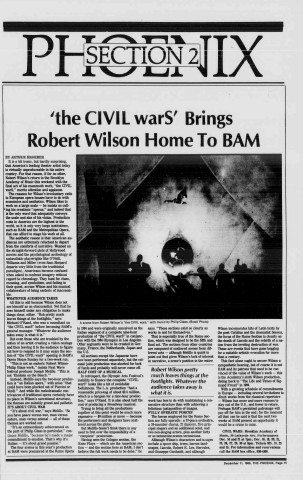
P ] H SECTION 2JIX'the CIVIL warS' BringsRobert Wilson Home To BAMA scene from Robert W ils o n %u2019s %u201cth e C IV IL w ars,%u201d w ith m usic by Philip G lass. (Brazil Photo)BY ARTHUR KROEBERIt is a bit ironic, but hardly surprising,that America%u2019s leading theater artist todayis virtually unproduceable in his nativecountry. For that reason, if for no other,Robert Wilson%u2019s return to the BrooklynAcademy of Music this weekend with thefinal act of his mammoth work, %u201cthe CIVILwarS,%u201d merits attention and applause.The reasons for Wilson%u2019s involuntary exileto European opera houses have to do witheconomics and aesthetics. Wilson likes towork on a large scale %u2014 he insists on calling his creations %u201coperas,%u201d and indeed thatis the only word that adequately conveysthe scale and size of his vision. Productioncosts in America are the highest in theworld, so it is only very large institutions,such as BAM and the Metropolitan Opera,that can afford to stage his work at ail.The aesthetic reason is that American audiences are extremely reluctant to departfrom the comforts of narrative. Weaned onthe straight-forward plots of Hollywoodmovies and the psychological archeology ofnaturalistic playwrights like O%u2019Neill,Williams and Miller (even Sam Sheparddeparts very little from the traditionalparadigm), Americans become confusedwhen asked to confront imagery withoutregard to chronology. They hunt for clues,meaning, and symbolism, and failing intheir quest, accuse Wilson and his musicalcollaborators of being esoteric of inaccessible.WHATEVER AUDIENCE TAKESAll this is odd because Wilson does notsee himself as an obscurantist. Not that hesees himself under any obligation to makethings clear, either. %u201cBob pretty muchleaves things at the footlights,%u201d saysMichael O%u2019Rand, who was a consultant on%u201cthe CIVIL warS%u201d before becoming BAM%u2019sgeneral manager. %u201cWhatever the audiencetakes away is what it is.%u201dBut even those who are troubled by thenotion of an artist creating a vision onstageand then leaving it to the audience to figureout how to respond to it may enjoy the section of %u201cthe CrVIL warS%u201d opening in BAM%u2019sOpera House Sunday for a two-week run.%u201cThis is not an esoteric Robert Wilson1 Philip Glass work,%u201d insists Next Wavefestival producer Joseph Melillo. %u201cThis isnot %u2018Einstein on the Beach.%u2019%u201dInstead, Melillo says the two-hour production is %u201can Italian opera,%u201d with arias %u201cthatcould have been plucked out of Puccini orVerdi.%u201d And while the melodramatic contrivances of traditional opera certainly haveno place in Wilson%u2019s narrational structure,the themes are suitably grand and pathetic.IT%u2019S ABOUT CIVIL WAR%u201cIt%u2019s about civil war,%u201d says Melillo. %u201cSoyou have peace versus war, man versusnature, man versus animal %u2014 all of thesethemes are worked out.%u201cIt%u2019s an extraordinary achievement onthe part of Philip Glass in particular,%u201d conA .!________t f . 1 1 1 1 . %u201c I----------------------- I--------%u00bb ---------------- 1 - -------------i %u2014l i i t u c a m c i a i u , u c v a i u c t i c o t u a u c a m a j u icommitment to emotion. That%u2019s why it%u2019sItalian %u2014 it%u2019s about grand passion.%u201dThe four scenes in this year%u2019s productionat BAM were premiered at the Rome Operain 1984 and were originally conceived as theItalian segment of a complete nine-hourproduction of %u201cthe CIVIL warS%u201d in conjunction with the 1984 Olympics in Los Angeles.Other segments were to be created in Germany, France, the Netherlands, Japan andthe U.S.All sections except the Japanese havenow been performed separately, but the colossal joint production was aborted for lackof funds and probably will never come off.HALF COST OF A MUSICALIn retrospect, the Olympic Arts Festival%u2019sinability to finance the complete %u201cCIVILwarS%u201d looks like a bit of avoidablefoolishness. The L.A. production %u201chad areasonable price-tag of about $2.5 million,which is a bargain for a nine-hour production,%u201d says O%u2019Rand. It is also about half thecost of producing a Broadway musical.Trying to bring all the productionstogether at this point would be much moreexpensive %u2014 $8 million or more %u2014 becausethe performers and designers have scattered across the globe.But Melillo doesn%u2019t think there is anyneed to fret over the impossibility of a\Having seen the Cologne section, theKnee Plays %u2014 which are the American section %u2014 and the section here at BAM, I don%u2019tbelieve the full work needs to be done,%u201d hesays. %u201cThese sections exist so clearly asworks in and for themselves.%u201dThat is especially true of the Rome section, which was designed to be the fifth andfinal act. The sections from other countriesare composed of scattered scenes from different acts %u2014 although Melillo is quick topoint out that given Wilson%u2019s lack of interestin narrative, a scene%u2019s position in the entireRobert Wilson prettymuch leaves things at thefootlights. Whatever theaudience takes away iswhat it is.work has less to do with maintaining a consecutive structure than with achieving afelicitous juxtaposition of images.FULLY OPERATIC FORCESThe forces employed for the Rome Section are fully operatic: a 57-piece orchestra,a 24-member chorus, 21 dancers, five principal singers and an additional octet, andtwo non-singing actors, plus another fortyor so Denma-cne-scenes tecnmcians.Although Wilson%u2019s characters and imagesinclude a space ship, trees, barren landscapes, Lincoln, Robert E. Lee, Hercules,and Giuseppe Garibaldi, and althoughWilson incorporates bits of Latin texts bythe poet Catullus and the dramatist Seneca,the focus of the Rome Section is clearly onthe death of Lincoln and the rebirth of a nation from the ieveiing destruction of war.These are events that have gone beggingfor a suitable artistic evocation for morethan a century.This fact alone ought to secure Wilson asympathetic hearing, but of course it is notBAM and its patrons that need to be convinced of the value of Wilson%u2019s work %u2014 thisis the Academy%u2019s sixth Wilson production,dating back to %u201cThe Life and Times of Sigmund Freud%u201d in 1969.With a growing schedule of commitmentsin Europe %u2014 including several invitations todirect works from the classical repertoire%u2014 Wilson has more and more reasons tostay out of the U.S., and fewer to return.Perhaps BAM%u2019s persistent patronage willpay off for him in the end; for the momentall that can be said is that the next twoweeks at BAM present an opportunity itwould be a crime to miss.CIVIL WARS: Brooklyn Academy ofmusic, 5v Laiayeue Ave. PerformancesDec. 14 and 21 at 7pm; Dec. 16,18, 20, 21,23, 26, 27, 29, 30 at 8pm. Tickets $35, 30, 25and 15. For information and reservationscall the BAM box office, 6364100.D ecem ber 11, 1986, TH E P H O E N IX , Page 15


