


Page 419 - Demo
P. 419
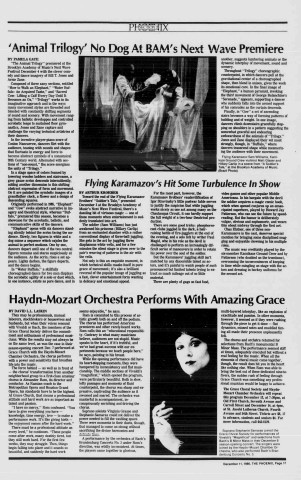
PjHSE%u00a3TION2 f ix# A n i m a l T r i l n a v ' M n f l n o A t R A M ^ c M o v f W a i / P P r P v n ip K P ' %u00ab%u25a0%u25a0%u25a0%u25a0%u25a0**%u25a0 - %u25a0 mm^gyj . , v r U / ml VS 5 ! ^ J v /V l V V w V C m I t .1 ! IltT l VFlying Karamazov's Hit Some Turbulence In ShowBY PAMELA GAYE%u201cThe Animal Trilogy%u201d premiered at theBrooklyn Academy of Music%u2019s Next WaveFestival December 4 with the clever comedy and dance imagery of Bill T. Jones andAmie Zane.Composed of three zany sections, entitled%u201cHow to Walk an Elephant,%u201d %u201cWater Buffalo: An Acquired Taste,%u201d and %u201cSacredCo Lifting a Calf Every Day Until ItBecomes an Ox,%u201d %u201cTrilogy%u201d works in itsimaginative approach and in the waysmany movement styles are threaded andblended with constantly shifting segmentsof sound and scenery. With movement ranging from balletic developpes and controlledacrobatic leaps to sustained floor gymnastics, Jones and Zane capture andchallenge the varying technical artistries oftheir dancers.In the inventive player-piano score ofConlon Nancarrow, dancers flirt with theaudience, teasing with sounds and shapesthat fluctuate in energy and force tobecome abstract symbols of a nonsensical20th Century world. Alternated with sections of %u201cnon-sound,%u201d the score energizesthe unity of %u201cTrilogy.%u201dIn a stage space of colors framed bytowering wooden ladders and staircases, agrey gauze scrim descends intermittently,adding another dimension to this shiftingabstract expression of form and movement.On it are painted the symbolic images of agrandfather clock, a flower and a design ofdescending squares.Originally performed in 1985, %u201cElephant%u201dand %u201cCow%u201d evoke abstract narrative in imagery and theatrical style, whereas %u201cBuffalo,%u201d premiered this season, becomes ashowcase for the acrobatic, balletic, andcommunicative skills of the dancers.%u201cElephant%u201d opens with six dancers standing silently behind the scrim facing the audience. Slowly, two figures in white and adog mime a sequence which cajoles theanimal to perfect motions. One by one,dancers depart until one of the two centralfigures remains and stares suspiciously atthe audience. As the serin, rises a set appears. Lights darken, the figure departs,and the dance begins.In %u201cWater Buffalo,%u201d a skillfullychoreographed dance for two men displaysthe acrobatic agility of a solo or duet which,in one instance, exists as pure dance, and inBY ARTHUR KROEBERToward the end of the Flying KaramazovBrothers%u2019 %u201cSoldier%u2019s Tale,%u201d presentedDecember 3 at the Brooklyn Academy ofMusic%u2019s Next Wave Festival, there%u2019s adazzling bit of virtuoso magic %u2014 one ofthose moments when entertainment is suddenly translated into art.The soldier (Sam Williams) has justawakened his princess (Hillary Carlip)from an enchanted slumber with a rattierconventional display of three-ball juggling.She gets in the act by juggling threediaphanous white veils, and for a fewminutes the silent stage is given over to thepair%u2019s weaving of patterns in the air withthe veils.Not only is this an exquisite moment, inwhich technical skills masks itself in puregrace of movement; it%u2019s also a brilliantreversal of the popular image of juggling asa fast, clever entertainment form wantingin delicacy and emotional appeal.For the most part, however, theKaramazov Brothers%u2019 vaudevilification ofIgor Stravinsky%u2019s little postwar fable servesto justify the suspicion that while jugglingworks niceiy as one act among many on theChautauqua Circuit, it can hardly supportthe full weight of a two-hour theatrical production.There are some good tricks: phosphorescent clubs juggled in the dark, a hairraising battle of fire-jugglers at the end ofthe evening, and a solo lick by writer PaulMagid, who in his role as the devil ischallenged to perform an increasingly difficult series of maneuvers in order to retainhis power over the soul of the soldier.But the Karamzovs%u2019 juggling skill isn%u2019tmatched by any discernible talent as actors, and it%u2019s painful to watch people of suchpronounced but limited talents trying to extract so much mileage out of so littlematerial.There are plenty of gags on fast food,another, suggests lumbering animals or thedynamic interplay of movement, sound andscenery.Throughout %u201cTrilogy%u201d choreographiccounterpoint, in which dancers pull at thegravitational center of a choreographedshape, then blend in unison, gives the workits emotional core. In the final image of%u201cElephant,%u201d a human pyramid, invokingthe third movement of George Balanchine%u2019s%u201cSerenade,%u201d appears, supporting a dancerwho suddenly falls into the armed supportof his comrades as the curtain descends.Finally, in %u201cCow%u201d a set of ascendingstairs becomes a way of forming patterns ofbuilding and of weight. In one image,dancers climb downstairs gracefully stepping on shoulders in a pattern suggesting thesomewhat graceful and endearingawkwardness of the animals of %u201cTrilogy.%u201dJones and Zane displayed their wit moststrongly, though, in %u201cBuffalo,%u201d wheredancers transcend shape while mesmerizing the audience with their movement.Flying K aram azov Sam W illiam s, K am ikaze G round C rew violinist M a tt G laser andHillary C arlip in a scene from %u201cA S o ld ier%u2019sTale,%u201d a t th e Brooklyn A cadem y o f M usic.(Brazil Photo)video games and other popular MiddleAmericana. In his bargain with the devilthe soldier acquires a magic comic book,which when opened conjures up an emancipated superhero, played by Howard JayPatterson, who can see the future by speedreading. But the humor is deliberatelyvulgar, obvious and sophomoric, and wearsthin about midway through the first act.Chas Elstner, one of three nonKaramazovs in the cast, deserves specialmention for bringing some disciplined mugging and enjoyable clowning in his multipleroles.The music was creditably played by thesix-member Kamikaze Ground Crew and byPatterson (who doubled on the trombone),overcoming the inconveniences of keepingin time while mingling on stage with the actors and dressing in hockey uniforms forthe second act.Haydn-Mozart Orchestra Performs With Amazing GraceBY DAVID L.L. LASKINThey may be professionals, manuallaborers, stockbrokers or housewives andhusbands, but when their voices resoundwith Vivaldi or Bach, the members of theGrace Choral Society deliver the commitment and enthusiasm of professional musicians. While the results may not always beon the same level, as was the case in theirseason-opening concert Dec. 7 performed atGrace Church with the Haydn-MozartChamber Orchestra, the chorus performswith a power and sensitivity that breatheslife into the music.The force behind %u2014 as well as in front of%u2014 the chorus%u2019 transformation from anotherneighborhood group to a first-class amateurchorus is Alexander Rom, its director andconductor. As Russian coach to theMetropolitan Opera and Houston GrandOpera, his standards have to be the highest.At Grace Church, that means a professionalattitude and hard work are as important astalent and passion.%u201cI have no mercy,%u201d Rom confessed. %u201cYouhave to give everything you have %u2014knowledge, time energy, love %u2014 to make aperformance work. It%u2019s like giving birth %u2014the enjoyment comes after the hard work.%u201dThere must be a professional attitude onevery level,%u201d he continues. %u201cThese peoplecome after work, many deathly tired, butthey still work hard. For the first fewweeks, they may struggle. Then, thingsbegin falling into place and it sounds sobeautiful, and suddenly the hard workseems enjoyable,%u201d he says.Rom is commited to this process of artistic growth both on and off the podium.The chorus has performed Americanpremieres and other rarely-heard works.Rom calls this an %u201ceducational responsiblity. Contrary to what many musiciansbelieve, audiences are not stupid. Musicspeaks to the heart, if it%u2019s truthful, andwe%u2019ve had great success with our experiments because we touch people here,%u201dhe says, pointing to his breast.While the opening performance did haveits heart-stopping moments, they werehampered by inconsistency and flat musicianship. The middle sections of Vivaldi%u2019s%u201cmagnificat,%u201d which opened the program,were particularly beautiful. Both in slow,lofty passages and moments of fluidcounterpoint, the chorus was sharp and expressive, captivating the audience as itswooned and soared. The orchestra wasmasterful in accompaniment, inconspicuously enriching and driving thechorus.Soprano soloists Virginia Grasso andStephanie Samaras could not deliver thepower needed to fill the vaulting space.There were moments in their duets, though,that managed to come on strong withoutsacrificing the divine harmonies andj ~i : %u2014 i ; MAnu v /u c u b v a i i w >A performance by the orchestra of Bach%u2019sBrandenburg Concerto No. 3 under Rom%u2019sdirection, was wildly inconsistent. At times,the players came together in glorious,multi-layered interplay, like an explosion ofexactitude and passion. In other moments,however, it seemed as if they were rushingthrough the piece to get it done %u2014 flatdynamics, missed notes and muddled timing all made their presence unpleasantlyfelt.The chorus and orchstra returned forselections from Bach%u2019s monumental BMinor Mass. The performance seemed stiffat times, adequately executed but without areal feeling for the music. When all theelements of choral music come together,though, the result does hit you in the heartlike nothing else. When Rom was able tobring the best out of these dedicated nine-tofivers, the sudden rush of feeling throughGrace Church was something any professional musician would be happy to achieve.The Grace Choral Society and HaydnMozart Chamber Orchestra will repeatthis program December 13, at 7:30pm, atOld First Church, Seventh Avenue andCarroll Street and December 14, at 4pm,at St. Jacobi Lutheran Church, FourthAvenue and 54th Street. Tickets are $8,17in advance, students and seniors $4- Formore information, call 643-8129.Soprano Stephanie Sam aras joined theCrane Choral S ociety for perform ances ofVivaldi%u2019s \B ach%u2019s B M inor M ass in their D ecem ber 6season-opening concert. The singers w erejoined by the H ay d n -M o za rt C ham ber O rchestra, who also perform ed B ach's Brandenburg C oncerto No. 3.D ecem ber 11, 1986, TH E P H O E N IX , Page 17


