


Page 450 - Demo
P. 450
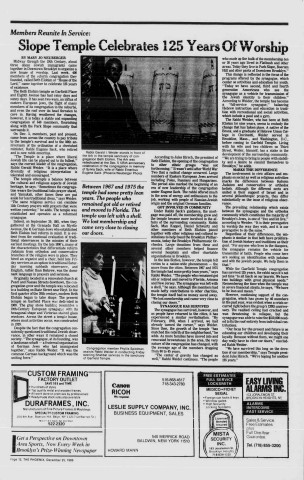
BY MARY JO NEUBERGERMidway through the 19th Century, about three dozen Jewish immigrants came together in Downtown Brooklyn to organize a new house of worship. Last week, 400 members of the reform congregation th e yfounded, called Beth Elohim or %u201cHouse of the Lord,%u201d came together to celebrate 125 years of existence.The Beth Elohim temple on Garfield Place and Eighth Avenue has had rainy days and sunny days. It has seen two wars, an influx of eastern European jews, the flight of many members of its congregation to the suburbs, and even the roof over its head threaten to cave in. Having weathered the changes, however, it is today a stable and expanding congregation of 540 members, flourishing along with the Park Slope community that surrounds it.On Dec. 5, members, past and present, came from across the country to pay tribute to the temple%u2019s survival and to the 50th anniversary of the ordination of a cherished minister, Rabbi Eugene Sack, who retired and is now rabbi emeritus.%u201cThe Temple is a place where liberal Jewish life can be played out to its fullest,%u201d says the current leader of the congregation, Rabbi Gerald Weider. %u201cIt is a place where diversity of religious interpretation is tolerated and encouraged.%u201dThe temple attempts a balance between the cultural and religious aspects of Jewish heritage, he says. %u201cSometimes the congregation wears the traditional tolis prayer shawl, and Yamukah, other times these are put aside for less traditional dress,%u201d says Weider. %u201cThe same religious service can combine 11th Century prayers with prayers that were written yesterday,%u201d he adds. The temple was established and operates as a reformed synagogue.Indeed, on September 29, 1861, when they gathered at the Granada Hall on Myrtle Avenue, the 41 German Jews who established Beth Elohim had reform in mind. It is evident from the continual evaluation of traditional observances in the minutes of their earliest meetings. By the late 1800%u2019s, many of the characteristics that differentiate reform Judaism from orthodox and conservative branches of the religion were in place. They hired an organist and a choir, held late Friday services as an option to traditional Saturday morning sabbath observance, and English, rather than Hebrew, was the dominant language in prayers and sermons.Originally located in a renovated church at Pearl and Nassau Streets downtown, the congregation grew and the temple was relocated to a building on State Street near Hoyt. In the first quarter of the 20th century, modem Beth Elohim began to take shape. The present temple on Garfield Place was dedicated in 1909. The gray stone building resembles a 19th-Century European synagogue with its hexagonal shape and Victorian stained glass windows. Across the street a temple house, where most activities occur, was constructed in 1929.Despite the fact that the congregation consistently questioned traditional Jewish observance, in other ways it remained a closed society. %u201cThe synagogue, at its founding, was a landsman schaft %u2014 a fraternal organization of German Jews who had immigrated together,%u201d says Rabbi Weider. %u201cIt was the common German background which was the uniting force.%u201dRabbi Gerald I. Weider stands in front ofthe Ark in the temple sanctuary of congregation Beth Elohim. The Ark wasrededicated at the Dec. 5 125th anniversarycelebration of the congregation in memoryof Sylvia Sack, wife of Rabbi EmeritusEugene Sack. (Phoenix/Neuberger Photo)Between 1967 and 1975 thetemple had some pretty leanyears. The people whoremained got old or retiredand moved to Florida. Thetemple was left with a shell.W e lost membership andcame very close to closingour doors.Congregation member Phyllis Spielmanassists Rabbi Weider in conducting Fridayevening Shabbat services in the sanctuaryof Garfield Temple.According to Jules Hirsch, the president of Beth Elohim, the opening of the congregation to other ethnic groups %u201cwas not forthcoming.%u201d It wasn%u2019t until after World War Two that a radical change occurred. Large numbers of Eastern European Jews arrived including Poles, Russians and Hungarians. The period also marked the beginning of an era of new leadership of the congregation under Eugene Sack. The rabbi offered much in the area of energy and enthusiasm to the job, working with people of Russian-Jewish origin and the original German families.GOT INVOLVED IN COMMUNITYUnder Rabbi Sack%u2019s guidance, the mortgage was paid off, the membership grew and the temple became more involved in the affairs of the surrounding community. Rabbi Sack, Max Koppel, Daniel Schwartz and other members of Beth Elohim joined together with other religious and cultural institutions to help found the Brooklyn Philharmonia, today the Brooklyn Philharmonic Orchestra. Large donations from these and several other members helped finance several hospitals and other charitable organizations in Brooklyn.In the late Sixties, however, the temple fell victim to a nation-wide phenomenon %u2014 the move from the cities. Between 1967 and 1975 the temple had some pretty lean years,%u201d says Rabbi Weider. %u201cThe people who remained got old or retired and moved to Florida, Arizona and New Jersey. The synagogue was left with a shell,%u201d he says. Although the members had made hefty contributions to other charities, the temple itself had no money saved away. %u201cWe lost membership and came very close to closing our doors.%u201dSYNAGOGUE HAS SURVIVEDThe synagogue has survived, however, and as people have returned to the cities, it has experienced a similar revitalization. %u201cBy February, 1978, when I arrived, we had already turned the comer,%u201d says Weider. Since then, the growth of the temple %u201chas matched the rebirth of the neighborhood,%u201d he adds. As more families have moved into and renovated brownstones in the area, the very nature of the congregation has changed, with the average age of the members dropping from 60 to 45 years.%u201cThe center of gravity has changed as well,%u201d Rabbi Weider continues. %u201cThe peoplewho made up the bulk of the membership ten or 20 years ago lived in Flatbush and other areas. Today they live in Park Slope, Boerum Hill and other parts of Downtown Brooklyn.%u201dThis change is reflected in the focus of the programs offered by the synagogue, which center on activities and education for youth. %u201c Today we have second, third and fourth generation Americans who see the synagogue as a vehicle for transmission of the Jewish identity to their children.%u201d According to Weider, the temple has become a %u201cfull-service synagogue,%u201d balancing Hebrew instruction and education in tradition with recreational and social activities, which include a pool and a gym.The Rabbi Weider, who has been at Beth Elohim for nine years, seems to embody the change that has taken place. A native of the Bronx, and a graduate of Hebrew Union College in Cincinatti, Weider served in Brookline, Mass., and Washington, D.C., before coming to Garfield Temple. Living with his wife and two children on Third Street, Weider, himself, has a stake in the development of the surrounding community. %u201c We are trying to bring in people with stability and a desire to commit themselves to Brooklyn,%u201d he adds.MARKS THE DIFFERENCEThe involvement in civic affairs and emphasis on social as well as religious activities marks the difference between Reform Judaism and conservative or orthodox beliefs. Although the different sects are united in their support of Israel and in several philanthropic projects, they differ substantially on the issue of religious observance.The prevailing relationship which exists between the synagogue and the orthodox community which constitutes the majority of Brooklyn%u2019s Jews, is one of %u201clive and let live,%u201d according to Weider. %u201cIt is their prerogative to worship the way they wish, and it is our prerogative to do the same.%u201dRegardless of their differences, the emphasis is similar in that both have proliferation of Jewish history and traditions as their goal. %u201cFor anyone who lives in the diaspora, the synagogue remains the vehicle for transmittal of faith. People who come here are seeking an identification with judaism and with the jewish people. We help them in that.%u201dWhile the Garfield Temple congregation has survived 125 years, the rabbi says it%u2019s not yet time %u201cto sit hack on our laurels. We have two buildings with great physical needs.%u201d Remembering the time when the temple was in severe financial straits, he says, %u201cWe have to be lean and m ean.%u201dHowever, continuing support of the congregation, which has grown by 40 members in the past year, was evident when a crisis occurred right before the group%u2019s 120th anniversary. The vaulted ceiling had cracked and was threatening to collapse, but the synagogue was able to raise the $150,000 needed to fix the roof entirely from individual contributions.%u201cOur focus for the present and future is on educating our children and developing their loyalty. Because without them, we might one day really have to close our doors,%u201d concluded Rabbi Weider.%u201cWe have survived this long on the devotion of our membership,%u201d says Temple president Jules Hirsch. %u201cWe%u2019re hoping for another 125 years.%u201dCUSTOM F R A M IN G ^FACTORY OUTLETSAVE $$ and TIME%u2022 H un dred s of styles%u2022 Top q u a lity m etal and wooden fram es%u2022 All w o rk done on prem ises by professionals%u2022 Readym ade stock sizes also availableDURAFRAM ES, INC.M anufacturers of Fine Picture Fram es & M ouldings SPECIALTY CUSTOM FRAMING104 4th Ave , B oerum H ill Bklyn. NY 1 1217 (at W arren St.)Mon Fn 8 b 30pm Sat 8 4 30pm522 2320I Get a Perspective on DowntownArea Sports, Now Every Week inBrooklyn 's Prize- Winning NewspaperC a n o nRICOHW%u00ab rttpond.516-868-4617718-343-2780L E S L IE S U P P L Y C O M P A N Y , IN C .BUSINESS EQUIPMENT, SALES540 M ERRICK ROADBALDW IN, NEW YORK 11510HOWARD M A N NFREE ESTIMATESFULL SERVICELOCKSMITHMEDICO%u2018 FICHETSEGAL%u2022 Foreign car locks & keys* Window gates%u25a0 High SecurityLocking SystemsMISTASECURITYINC.163 Joralem on St.Brooklyn Heights 718-834-1530EASY LIVINGALARMS INC.163 JORALEMON ST.BROOKLYN HEIGHTS, NYALARMSINTERCOMSFAST SERVICESales & Service. Free Estimateso h i oFull One-Year Guarantee.Tel. (718) 8 5 5 -3 2 0 0Page 12, THE PHOENIX, December 25, 1986


