


Page 88 - Demo
P. 88
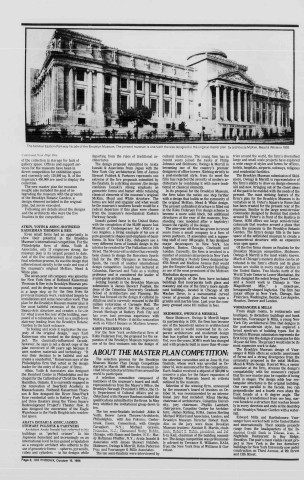
T h e fa m ilia r E as te rn P ark w a y fa c a d e o f th e B ro o klyn M u s e u m . T h e p re s e n t m u s e u m is o n e -s ix th th e s ize d es ig n e d in th e o rig in al m a s te r plan by a rc h ite c ts M c K im , M e a d & W h ite in 1893.Continued from Page Oneof the collection in storage for lack of gallery space. Offices and support services for the museum have been in direct competition for exhibition space and currently only 120,000 sq. ft. of the museum%u2019s 450,000 are used to display the collection.The new master plan the museum sought also included the goal of integrating the museum with the grounds of the Brooklyn Botanic Garden, a design element included in the original plan, but never executed.Following are details about the designs and the architects who were the five finalists in the competition:ATKIN, VOITH & ASSOC./ROTHZEID KAISERMAN THOMSON & BEEEven small firms had an opportunity to show their potential in the Brooklyn Museum%u2019s international competition. For the Philadelphia firm of Atkin, Voith & Associates, only 13 employees strong, the museum plan is its largest project to date. And of the five submissions that made the final selection process, its was the design that adhered most strictly to the scale and tone of the museum%u2019s original McKim, Mead & White plan.The seven-year old company was joined by the New York firm of Rothzeid Kaiserman Thomson & Bee in its Brooklyn Museum proposal, and its design for museum expansion is a large step up for the firm from its previous museum work, restricted largely to installations and some renovation work. This plan for the Brooklyn Museum master plan is the most faithful extension of the current Beaux-Arts structure and creates a facade for what is now the rear of the building, composed of a colonnade as well as a multi-level stairway leading from the Brooklyn Botanic Garden to the back entrance.%u201cIn feeling and scale it replicates the m ajesty of the original design,%u201d says Karl Kaiserman who worked on the design project. The classically-influenced facade, however, he says is not a direct copy of the plan conceived of 100 years ago because it uses modem materials and technology. %u201cIt was their decision to be faithful and not create a counterfoil,%u201d Kaiserman says of the Philadelphia firm that acted as the design leader for the entry of this pair of firms.Atkin, Voith & Associates also designed the Remford Center in Philadelphia and the chapel for the Cathedral of Christ the King in Hamilton, Ontario. It is currently engaged in the renovation of Deerfield Academy in Massachussets. Rothzeid Kaiserman Thomson & Bee designed the River Rose/Park Rose residential units in Battery Park City, and three theaters along the Times Square Redevelopment Project%u2019s Theater Row. It also designed the conversion of the Eagle Warehouse in the North Heights into residential space.ARATA ISOZAKI & ASSOC./JAMES STEWART POLSHEK & PARTNERSArchitect ^ro^%u00b0 TcaioH V%u00bboc* roforroH fn hiebuildings as %u201cperfect crimes%u201d. In his Japanese homeland and increasingly on an international level he has gained a reputation as a renegade architect who adheres to the use of geometric forms %u2014 spheres, pyramids, cubes and cylinders %u2014 in his designs whiledeparting from the rules of traditional architectures.The design proposal submitted by Arata Isozaki & Associates from Japan with the New York City architectural firm of James Stewart Polshek & Partners represents one extreme of the five proposals submitted by the finalists. In a striking manner, the design combines Isozaki%u2019s strong emphasis on geometric forms and humor while retaining classical elements of the museum%u2019s original McKim, Mead and White structure. The forms are bold and singular and what would be the museum%u2019s southern facade would be a radical departure if this plan were chosen from the museum%u2019s neo-classical Eastern Parkway facade.Isozaki gained fame in the United States with the completion of the 98,000 square foot Museum of Contemporary Art (MOCA) in Los Angeles, a living example of his use of pure geometric shapes and emphasis of basic forms. In New York City, club-goers see a very different form of Isozaki design in the interior he created for The Palladium on 14th Street. The 55-year-old architect has recently been chosen to design the Barcelona Sports Hall for the 1992 Olympics in Barcelona, Spain, the result of another international design competition. Isozaki has lectured at Columbia, Harvard and Yale as a visiting professor and is considered the leader of avant-garde architects in Japan.Joining Isozaki in the Brooklyn Museum submission is James Stewart Polshek, the dean of the Columbia University Graduate School of Architecture and Planning. His firm has focused on the design of cultural institutions and is currently engaged in the $32 million restoration of Carnegie Hall. The firm is also architect for the Museum of Jewish Heritage at Battery Park City and has even had previous experience with McKim, Mead & White: it did the restoration work on Villard Houses on Madison Avenue.KOHN PEDERSEN FOXFor the New York architectural firm of Kohn Pedersen Fox, the proposal for the expansion of the Brooklyn Museum represents one of its first ventures into the design ofThe selection process for the Brooklyn Museum Master Plan Design Competition started in March 1986 when the museum invited 103 architectural firms from around the world to participate.A selection committee composed of members of the museum%u2019s board and staff, representatives from the Mayor%u2019s Office, the Brooklyn Borough President%u2019s Office, the City Department of Cultural Affairs and architectural critic Reyner Banham studied the qualifications submitted by the firms. In May they whittled the invitational group down to ten.The ten semi-finalists included: Atkin & Voith; Bower Lewis Thrower/Architects, Philadelphia, with Jan Pokomy; Centerbrook, Essex, Connecticut, with Giorgio Cavaglieri, N.Y.; Michael Graves,r%u00bb-:----A.-- XT T . TT------------- - D o U L a1 * , i l i U i ) A i U l l U lt V / l I V i K J J A J U i K/IIlU ,Chicago, with Russo and Sonder, N.Y.; Hardy Holtzman Pfeiffer, N.Y.; Arata Isozaki & Associates with James Stewart Polshek; Skidmore, Owings & Merrill; Kohn Pederson Fox; and Voorsanger & Mills Associates.The ten semi-finalists were interviewed bycultural institutions. The young firm has in recent years joined the ranks of Philip Johnson and Skidmore, Owings & Merrill in becoming one of the country%u2019s premier designers of office towers. Sticking strictly to a post-modernist style, from its onset the firm has rejected the severity of modern architecture by combining it with more traditional or classical elements.In its proposal for the Brooklyn Museum, the firm takes the notion one step further with a design that builds on the symmetry of the original McKim, Mead & White design. The present unfinished structure is filled out in the Kohn Pedersen Fox design scheme to become a more solid block, but additional structures at the rear of the museum, freestanding (one modeled after a baptistry) lessen the rigidity of the design.The nine-year old firm has grown in recent years from a small company to a firm of seven partners, 12 associates and a supporting staff of over 180 people. It has designed major skyscrapers in New York, Los Angeles, Boston, Chicago, Cincinatti and London. Currently, the firm is involved in a number of commercial projects in New York City, including a 74-story tower designed for 47th Street and Madison Avenue that would join the Empire State and Chrysler Buildings as one of the most prominent of the Midtown Manhattan skyscrapers.Past projects of the firm have included buildings that incorporate both glass and masonry and one of the firm%u2019s more significant buildings, located in Chicago at 333 Wacker Drive, is a monumental curved tower of greenish glass that rests upon a granite and marble base. Last year the company grossed some $11 million in fees.SKIDMORE, OWINGS & MERRILLSince Skidmore, Owings & Merrill began its partnership in 1936, the firm has become one of the household names in architectural design and is world renowned for its corporate architecture and modernist design that has typified its work for many years. Yet, over the years, SOM%u2019s work has changed and with projects built in more than 40 counthe selection committee and on June 20, five finalists, whose work was unveiled on October 16, were announced for the competition. Each finalist received a stipend of $50,000 to conceive a plan for the future expansion of the Brooklyn Museum based on criteria outlined by the museum.Selection of the winning firm, announced by the museum%u2019s board of trustees on October 16, was recommended by an international jury that included: Klaus Herdeg, chairman of architecture, Columbia University, jury chairman; Phyllis Lambert, chairperson, Canadian Center for Architecture; James Stirling, RIBA, James Sterling Michael Wilford and Associates, London; and Brooklyn Museum Director Robert Buck. Also on the jury were these Brooklyn Museum trustees: Alastair B. Martin, chair--------------r > l n -----------: j %u2014 4 . 1 T ~ r iiioui, nuuvH u. ivuuui, pi vomeuw, uuu uvifi ey Keil, chairman of the building committee. The design competition was professionally advised by Terrance R. Williams, RAIA, from the New York firm of Williams & Garretson.tries around the world, the firm%u2019s diversified large and small scale projects have explored a wide range of styles and forms for offices, hotels, hospitals, airports, subways, religious and residential facilities.The Brooklyn Museum submission of Skidmore, Owings & Merrill is representative of the firm%u2019s ability to draw on design elements old and new, bringing out of the closet ideas of the past to be melded with the needs of the present. The most striking feature of the firm%u2019s plan for the Brooklyn Museum is its variation on St. Peter%u2019s Square in Rome that has been created for the present rear of the museum. Similar to the large semi-circular colonnades designed by Bernini that stretch around St. Peter%u2019s in front of the Basilica in Rome, SOM offers one large semi-circular colonnade that reaches around a plaza that joins the museum to the Brooklyn Botanic Garden. The firm%u2019s design fills in the bare space of the unfinished museum to create a symmetrical structure with an expansive rear open space.Of the five firms chosen as finalists for the Brooklyn Museum competition, Skidmore, Owings & Merrill is the most widely known. Much of Chicago%u2019s modern skyline can be attributed to the firm%u2019s efforts and its glass boxes are visible in every major skyline in the United States. Two blocks north of the World Trade Center in Lower Manhattan, the firm designed the noted Irving Trust Center, and a recent work in Chicago is %u201cOne Magnificent Mile,%u201d a mixed-use, hexagonally-shaped high-rise. The firm has major offices in New York, Chicago, San Francisco, Washington, Boston, Los Angeles, Houston, Denver and London.VOORSANGER & MILLSFrom single rooms, to restaurants and boutiques, to dormitory buildings and bank branches, Voorsanger & Mills, a young New York City architectural firm that designs in the post-modernist style, has explored a broad spectrum of building types. But its Brooklyn Museum submission represents the first foray into the design of museums for this 10-year old firm. The project would also be its most expensive work to date.The Brooklyn Museum design of Voorsanger & Mills offers an eclectic assortment of forms and a strong divergence from the symmetry proposed in the inital McKim, Mead & White design. Konrad Wes, a senior associate at the firm, stresses the design%u2019s compatability with the museum%u2019s request that the new master plan be capable of being built in stages. The design adds four rectangular structures to the original building. One runs parallel to the facade, two run perpendicular and a fourth even abuts the front facade at a 45 degree angle. The building is transformed from one long, narrow facade to a structure that reaches broadly in every direction and ends at the doorstep of the Brooklyn Botanic Garden with a waterfall.Edward Mills and Bartholomew Voorsanger have worked both in the United States and internationally. Their notable projects range from the headquarters of the Inuuauicti 'oicuil octuk ui Tehran, Ira n , luNightfalls Restaurant in Bay Ridge, Brooklyn. The pair%u2019s most visible recent project in New York is the two dormitory buildings for New York University now under construction on Third Avenue, at 9th Street and 12th Street.Page 8, THE P H O E N IX , O c to b e r 16, 1986 %u25a0


