


Page 91 - Demo
P. 91
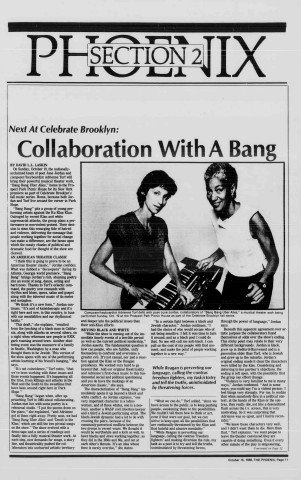
Next At Celebrate Brooklyn:Collaboration With A BangBY DAVID L.L. LASKINOn Sunday, October 19, the nationallyacclaimed team of poet June Jordan and composer/keyboardist Adrienne Torf will bring their powerful musical theater work, %u201cBang Bang Uber Alles,%u201d home to the Prospect Park Picnic House for its New York premiere as part of Celebrate Brooklyn%u2019s fall music series. Home, because both Jordan and Torf live around the comer in Park . Slope.%u201cBang Bang%u201d pits a group of young performing artists against the Ku Klux Klan. Outraged by recent Klan and white supremacist attacks, the group plans a performance in non-violent protest. Their decision to stem this resurging tide of hatred and violence, delivering the message that people working together for social change can make a difference, are the bones upon which the meaty chunks of political and dramatic food for thought of the show are cleaved.AN AMERICAN THEATER CLASSIC%u201cI think this is going to prove to be an American theater classic,%u201d Jordan confides. What was dubbed a %u201cdocu-opera%u201d during its Atlanta, Georgia world premiere, %u201cBang Bang%u201d brings Jordan%u2019s rich, stunning poetry into an event of song, dance, acting and hard news. Thanks to Torf%u2019s eclectic command, the poetry now resounds with rhythm and blues, opera, salsa and gospel along with the inherent music of its meter and metaphor.%u201cWe think it%u2019s a new form,%u201d Jordan continues. %u201cIt%u2019s sort of kaleidoscopic and it%u2019s right here and now, in this country, in tune with our sensibilities and our rhythmical habits.%u201d%u201cThis draft,%u201d she explains, %u201cresulted from the lynching of a black man in California, along with attacks on several others, on a night when witnesses saw people in KKK garb roaming around town. Another shattering event was the massacre of a family in Seattle, Washington by a man who thought them to be Jewish. This version of the show opens with one of the performing artists learning of his friend%u2019s hanging,%u201d she says.%u201cIt%u2019s not coincidence,%u201d Torf notes, %u201cthat we%u2019ve been working with these issues and these events happened. It%u2019s happening all the time, from killings and attacks in the West and the South to the swastikas that have been around right here in Park Slope.%u201d%u201cBang Bang%u201d began when, after approaching Torf in 1983 about collaborating, Jordan met her with some poetry in a rehearsal studio. %u201cI put the poems down on the piano,%u201d she explained, %u201cand Adrienne got at them right away. Pretty soon, we had %u2018Bang Bang Ubcr AUes%u2019 and %u2018Death to the Klan,%u2019 which are still the two pivotal songs on the show.%u201d The show evolved with a demo tape and a series of readings and finally into a fully musical theater work. At each step, new demands for songs, a story line, and theatricality pushed the collaborators into uncharted artistic territoryC o m poser/keyboardist A drienne Torf (left) w ith poet June Jordan, collaborators of %u201c Bang Bang U ber A lles,%u201d a m usical th e a te r work beingperform ed Sunday, O ct. 19 at the Prospect Park P icnic H ouse as part of the C eleb rate Brooklyn fall series.and deeper into the political issues than their anti-Klan efforts.BEYOND BLACK AND WHITE%u201cWhile the show is coming out of the immediate timely events of a terrible period as well as the current political leadership,%u201d Jordan asserts. The fundamental question is how can people, who are fallible, unify themselves to confront and overcome a greater evil. It%u2019s not casual, nor just a reaction against the Klan or the Reagan presidency. We worked very hard to go beyond that. Add our original theatricality and Adrienne%u2019s first-class music to this fundamental social and political questioning and you do have the makings of an American classic,%u201d she says.The characterization of %u201cBang Bang%u201d immediately opens it up beyond a black and white conflict. As Jordan explains, %u201cone very important character is a latino woman, and of three whites, one is a neoNazi, another a WASP civil liberties lawyer and a third a Jewish performing artist. The black-Jewish dynamic had a lot to do with creating the piece, because of the commonly-perceived conflicts between the two erouDS in recent years. We thought it would be worthwhile and a kick as well, to have blacks and Jews working together, as they did in the 1950s and 60s, and not at each other%u2019s throats. It%u2019s an idea whose time is surely overdue,%u201d she states.%u201cIn a certain fight between a black and Jewish character,%u201d Jordan continues, %u201cI had the choice of who would accuse who of not being sensitive. I felt it was time to turn it around, and as a black poet I could do that. No one will call me anti-black. I can pull on the coat of my people with that moment, and make the point of people working together in a new way.%u201dW hile Reagan is perverting o urlanguage, calling the contrasfreedom fighters, m y task is to tryan d tell the truths, unintim idatedby threatening forces.%u201cWhat we can do,%u201d Torf added, %u201csince we have access to the public, is to keep pushing people, awakening them to the possibilities. We couldn%u2019t tell them how to think or act, even if that were our goal, but we can strive to keep open all the possibilities that are continually threatened by the Klan and that hateful and abusive mentality.%u201d%u201cWhile Reagan is perverting our language, calling the contras %u2018freedom fighters%u2019 and making diversion the rule, my task as a poet is to try and tell the truths, unintimidated by threatening forces,through the power of language,%u201d Jordan says.Beneath this apparent agreement over artistic purpose the collaborators found themselves at odds over the show%u2019s ending. This sticky point may relate to their verydifferent backgrounds: Jordan is black, grew up in Bedford-Stuyvesant and is a generation older than Torf, who is Jewish and grew up in the suburbs. Jordan%u2019s original ending made it clear the characters were killed by the klan. Considering and deferring to her partner%u2019s objections, the ending is left open, with the possibility that the group can effect change.%u201cViolence is very familiar to me in many ways,%u201d Jordan confessed. %u201cAnd in some ways, you could say I%u2019m a violent person: I feel things very strongly. For me, to realize that when somebody dies in a political context, at the hands of the Klan or the contras, they really die, not like a desensitized flash across the t.v. screen, this is very motivating. So it was surprising that Adrienne was so upset, and I had to reconsider.%u201d%u201cWe knew these characters very well, and I didn%u2019t want them to die. More than that,%u201d Torf explains, \leave the theater convinced they are capable of doing something. Even if every other minute of the play is empowering,C o n tin u e d on Page !2O ctober 16, 1986, T H E P H O E N IX , Page 11


