


Page 95 - Demo
P. 95
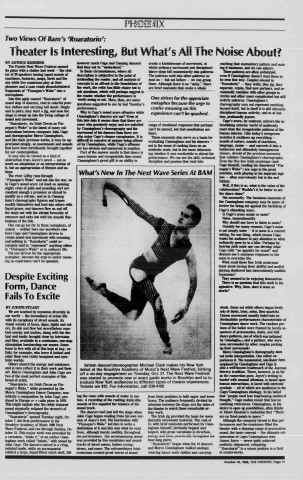
PH[SKCTION 2 \Two Views O f Barn's'Roaratorio':I h e a t e r i s i n t e r e s t i n g , B u t W h a t ' s A i i I h e N o i s e A b o u t ?BY ARTHUR KROEBERHie Fourth Next Wave Festival openedits gates with a clatter last week %u2014 the clatter of 30 speakers issuing taped sounds ofmachines, fact cries, songs, lards and diesea while five musicians play at thenpleasure and a man reads dicambobulatedfragments of %u201cFinnegan%u2019s Wake%u201d into amicrophone.Into this aptly named %u201cRoaratorio%u201d erfsound step 15 dancers, clad in colorful practice clothes and carrying tall stools. Singlyand in pairs, they start a jig, and soon thestage is swept up into the living collage ofsound and movement.%u201cRoaratorio: An Irish Circus on Finnegan%u2019s Wake%u201d is the latest of many collaborations between composer John Cageand choreographer Merce Cunningham,and like their previous works, it may be appreciated simply, as movements and soundsthat have been fortuitously brought togetherfor our contemplation.It may also be viewed as a kind ofabstraction from Joyce%u2019s novel %u2014 not somuch an adaptation or an interpretation ofit, but an appropriation erf themes and notions.The river Iiffey runs through%u201cFinnegan%u2019s Wake%u201d and out into the sea; soin Cage%u2019s sound score (at least on openingnight) cries of gulls and pounding surf areconstant enough a presence as almost toqualify as a refrain; and so in Cunningham%u2019s choreography figures and tropesmodify themselves and lead into others withliquid grace, and dancers flow on and offthe stage not with the abrupt formality ofentrance and exits but with the smooth fluctuations of the tide.One can go toe far in these metaphors, ofcourse %u2014 neither here nor anywhere elsehave Cage and Cunningham striven tocreate sound and movement with meaning,and nothing in %u201cRoaratorio%u201d could accurately said to %u201crepresent%u201d anything eitherin %u201cFinnegan%u2019s Wake%u201d or in ordinary life.But one strives for the appropriatemetaphor, because the urge to confer meaning mi experience can%u2019t be quashed,Despite ExcitingForm, DanceFails To ExciteBY JUDITH STUARTWe are touched by immense diversity inour world %u2014 the immediacy of urban lifewith its cacophony of street sounds, itsvisual variety of faces, signs, lights and colors, its ebb and flow but nevertheless constant energy and motion, along with the distant and exotic brought dose by televisionand film, available in a continuum, non-stopstimulation bombarding our senses. Someleant to live with all of this kept at bay; artists, for example, who leave it behind andenter their own richly imagined and symbolic worlds.Others absorb the energy and substanceand in turn reflect it in their work and thenart. Merce Cunningham and John Cage aretwo of the most perfect examples of thistweed of artist.%u201cRoaratorio: An Irish Circus on Finnegan%u2019s Wake,%u201d while presented by theMerce Cunningham Dance Company, wasinitially a composition by John Cage, produced in Europe as a radio piece in 1979.This might explam why the richly texturedsound atypically eclipsed the strength ofCunningham%u2019s choreography.%u201cRoaratorio%u201d opened Tuesday night, October 7, the first performance in theBrooklyn Academy of Music 1236 NextWave Festival, and ran through Sunday, October 12. This major work was preceded bya variation, %u201cInlets 2,%u201d of an earlier Cunningham work called %u201cInlets,%u201d with sound byJohn Cage. The dancers moved in a crisp,isolated mode, while an accompanistrotated a large, liquid-filled conch shell, fillhowe ver much Cage and Cuming demandOut they not lie %u201cunderstood.%u201dIn these circumstances, where alldescription is subjective to the point ofnrisfeadfeg the reader, and aD analysis ofconcepts is an affront to the foundations ofthe work, the critic has little choice b(* toask questions, which will perhaps suggest tothe reader whether tbe performance isworth seeing or not. Here, then, are somequestions suggested to me by last Tuesday%u2019sperformance.Why is Cage%u2019s sound score offensive whileCunningham%u2019s dancers are not? Even atthis late date it seems dear that there aremore who genuinely enjoy and are satisfiedby Cummgham%u2019s choreography and themovement of his dancers than there arewho enjoy Cage%u2019s chance cacophonies. It isdifficult to conceive of anyone being offended by Cunningham, addle Cage%u2019s offensesare too obvious and numerous to mention.Part of the answer surdy is that dance ismore human and recognizable than sound.Cunningham%u2019s great gift is an ability toing the room with sounds of water in motion. A recording of the rustling static-likesounds of fire studied the balance of thesoundtrack.The dancers had just left the stage whenJoin Cage began reading from his own version of Joyce%u2019s text. His fascination with%u201cFinnegan%u2019s Wake%u201d led him to write adistillation of it and this was what he readfrom, although hardy audibly, throughouttne performance, m e accompanying soundwas provided by live musicians and soundtracks of street noises, babies crying,sirens, and more. The extraordinary Irishmusicians created great waves of soundcreate a kaleidoscope of movement, inwhich ordinary movement and disciplineddance steps fall momentarily into patterns.The patterns melt into other patterns assoon as %u2014 but not before %u2014 we can graspthem. Although there is no %u201cunity,%u201d thereare brief moments that evoke a wholeOne strives fo r th e approriatem etap hor because the urge toco nfer m eaning on thisexperience c a n 't be quashed.range of emotional responses that perhapscan%u2019t be named, but that nonetheless arethere.These moments also serve as a basis forevaluating Cunningham and his dancers %u2014not in the sense of ranking them on anaesthetic scale, but in tbe sense determining whether it was worthwhile to attend theperformance. We can see the skill, technicaldiscipline and passion that went intofrom their positions in both upper and lowerboxes. The audience frequently divided itsattention between the stage and the sides ofthe theater to watch these remarkable artists work.The Irish jig provided the basis for somethematic movement material. The cast of14, with brief moments performed by Cunningham himself, tirelessly hopped andleaped, with great variations in direction,energy anil form, piacueally iiiru u g iiu u i iiiehour-long piece.%u201cRoaratorio%u201d began when the 14 dancersand Merce Cunningham walked onstage,wearing dance work clothes and carryingcatching that momentary pattern and making it luminous, and we can admire.These patterns are often archetypal,even if Cunningham doesn%u2019t want them tobe seen this way. Couples abound in%u201cRoaratorio%u201d %u2014 they waltz, they jig, theyseparate, rejoin, find new partners, and occasanaDy combine with other groups incircles and other more complicated but stillorderly patterns. Cunningham%u2019schoreography may not represent anythingbeyond itself, but in itself it is still intenselydisciplined human activity, and so at bottom, profoundly joyous.Cage%u2019s score, by contrast, mirrors the intimidating exterior world of modernitymore than the recognizable patterns of thehuman interior. Lake today%u2019s overgrownsocieties it swallows q> everything %u2014sounds of nature, sounds of machines,language, music %u2014 and converts it into aboisterous and uitimaiely homogeneousclamor, devoid of the precious momentsthat validate Cunningham%u2019s choreography.Even the five live Irish musicians (andCage himself, reading his disordered %u201cFinnegan%u2019s Wake%u201d ) are cogs in the greatmachine, each playing in his separate logebox %u2014 often marvelously but in the aidfiftfidy.Wed, if this is so, what is the value of thecollaboration? Woukkrt it be better to seethe dance alone?Not necesarily. The luminous moments ofthe Cunningham company may be more effective for being set against the backdrop ofCage%u2019s alienating score.Is Cage%u2019s score music or noise?Noise, unquestionably.Why should one have to listen to noise?Possibly for many reasons. Cage%u2019s noiseis not simply noise %u2014 ft is noise in a concertsetting, for one thing, which means Cagewants the audience to pay attention to whatordinarily goes by in a blur. Perhaps byhearing such noise one can develop whatCage calls %u201can appetite for sound%u201d andsharpen one%u2019s sensuous responses to thenoise in everyday life.What must these fine Irish musiciansthink about having their skillful and soulfulplaying shattered into intermittently-audiblefrgaments?They seemed to be enjoying themselves.There is no question that this work is imaginative. Why, then, does it seem sosterile?stools. Some sat while others began livelysets of duets, trios, solos, then quartets.Unison movement usually faded into individualistic performances characteristic ofCunningham dance work. The random portions of the ballet were framed by lovely sequences of promenades, duets, and folkdance pattens, one of which was initiatedby Qgmingha.n aid a partner, who weresoon surrounded by other couples pickingqp then* movementsMerce Cbmtngham%u2019s choreography doesnot invite interpretation. Okie rather experiences ft. The nonsensical, non-linear formemployed by Q%u2014iingham and Cage isalso a well-known trademark of the Joyceanliterary tradftion. There, however, is as faras the connection goes. Joyce%u2019s writing isloaded with sensual allusions, is based uponhuman interactions, is iaced with intricatesymbols %u2014 aD of which are anathema to theCage/Cunningham ideology. In his beliefthat %u201cpeople need less imprisoning modes ofthought,%u201d Cage makes music that has noconfining references . Cunningham, in hisdesire to open op possibilities, often thinksof Albert Einstein%u2019s contention that %u201cThereare no fixed points in space.%u201dAlthough the company turned in fine performances and the musicians filled thetheater with a dizzying range of provocativesound, the basic concept %u2014 the ultimate collaboration ot cage/ummngnam withJames Joyce %u2014 never quite achievedaesthetic alignment, relegating%u201cRoaratorio%u201d to a minor position in a fieldof masterworks.What's New In The Next Wave Series At BAMBritish dancer/choreographer Michael Clark makes his New Yorkdebut at the Brooklyn Academy of Music%u2019s Next Wave Festival, kickingoff a six-day engagement on Tuesday, Oct. 21. The Next Wave Festivalwas started to promote new or avant garde works in Brooklyn and to introduce New York audiences to different types of theater experiences.Tickets are $15. For information, call 638-4100.O cto ber 16, 1986, T H E P H O E N IX , Page 15


