


Page 75 - Demo
P. 75
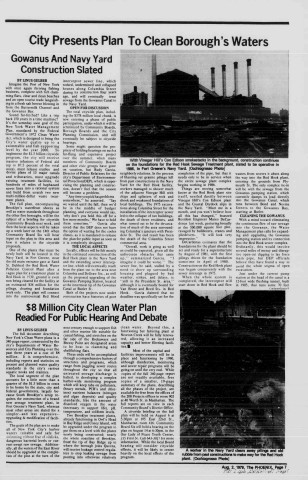
City Presents Plan To Clean Borough%u2019s WatersGowanus And Navy Yard Construction SlatedBY LINUS GELBERImagine the Port of New York with once again thriving fishing business, complete with rich clamming flats, clear and clean beaches and an open tourist trade languishing in a fresh salt breeze blowing in from the Buttermilk Channel and the Gowanus Bay.Sound far-fetched? Like a trip back 150 years in a time machine? It%u2019s the someday soon goal of the New York Water Management Plan, mandated by the Federal Government%u2019s 1972 Clean Water Act, which is designed to bring the City%u2019s water quality up to a swimmable and fish-supporting level by the year 2000. To implement the $1.5 billion citywide program, the city will receive massive infusions of Federal aid (up to 87.5 percent of the total costs), must release studies and devise plans of 13 major canals and tributaries, must upgrade existing treatment facilities, tie hundreds of miles of haphazard sewer lines into a rational system and build from scratch two new multi-million-dollar waste treatment plants.The full plan, encompassing Brooklyn%u2019s waterfront shores as well as water standards throughout the other five boroughs, will be the subject of a briefing for citywide Community Boards next week, and then the local aspects will be taken up a week later on the 14th when Community Board Six will hear input on the plan in this area and how it relates to the citywide proposals.One of the plants that must be newly built will be located in the Navy Yard in Fort Greene, near the old main entrance gate at Sand St. Dubbed the Red Hook Water Pollution Control Plant after a vague plan for a treatment plant in Red Hook in 1939, ground is even now being cleared for the facility at an estimated $34 million for the pilings, clearing and foundation work only. The plant will connect into the controversial Red Hoodinterceptor sewer line, which rocked, undermined and collapsed houses along Columbia Street during its construction four years ago, and will eventually treat sewage from the Gowanus Canal to the Navy Yard.OPEN FOR DISCUSSIONThe total citywide plan, including the $378 million local chunk, is now entering a phase of public participation, under which it will be scrutinized by Community Boards, Borough Boards and the City Planning Commission, and will eventually be subject to citywide hearings.Some might question the propriety of holding hearings on such a far-flung and expensive project over the summer, when manv members of Community Boards and other civic groups have gone on vacation, but Rudy Garcia, Director of Public Relations for the city%u2019s Department of Environmental Protection(DEP), which is supervising the planning and construction, doesn%u2019t feel that the season will become a problem.%u201c Any time you pick hasproblems somewhere,%u2019%u2019 he asserted. %u201c Say we waited until the fall, then we%u2019d be in the middle of budget planning, and everyone would say, %u2018why don%u2019t you hold this off for a few more months.%u2019 We have to hold them sometime.%u201d Garcia also noted that the DEP does not have the option of waiting for the cooler climes, as it is mandated to release the plan for public input as soon as it is completely designed.THE LOCAL ASPECTSLocally, effects will be felt mostly in the continued construction of the Red Hook plant in the Navy Yard and the extending sewer interceptor line, which will eventually reach from the plant out to the area near Columbia and DeGraw Sts., as well as the proposed upgrading of the Gowanus Pumping Station, located at the innermost tip of the Gowanus Canal at Butler St.Both of the projects now under construction have histories of poorBY LINUS GELBERThe full document describing New York's Clean Water plans is a 340-page report, constructed by the city%u2019s Departments of Water Resources and City Planning over the past three years at a cost of $8 million. It is comprehensive, including reports and statistics on present and planned water quality standards in the city%u2019s various aquatic nooks and crannies.The local segment of the plan accounts for a little more than a quarter of the $1.5 billion in costs to be borne by the state, city and federal governments, largely because South Brooklyn%u2019s setup requires the construction of a brand new sewage treatment plant, in Fort Greene%u2019s Navy Yard, whereas most other areas are slated for a simpler--and less expensive-- upgrading <5t modification of facilities.The goals of the plan are to make all of New York City%u2019s harbor waters suitable and safe for----:%u2014 c--- 0*> U llI t liilg i; im v/M i *VU i W* V IU llV IV i])dangerous bacterial levels or current-swept raw sewage. Additionally, all the waters of the East River should be upgraded at the completion of the plan at the turn of thenext century enough to support fish and other marine life suitable for casual fishing, and stretches on the far side of the Rockaways and Breezy Point are designated areas to be host to clamming and shellfishing flats.These ends will be accomplished through a comprehensive battery of structures and programs, which range from juggling sewer routes throughout the city so that all untreated sewage discharge is halted, to developing a complex harbor-wide monitoring program which will keep tabs on pollutants, (heavy metals, PCB%u2019s and chlorines) nutrient balances (nitrogen and algae deposits) and quality standards, like the amount of dissolved oxygen in the water (necessary to support life), pH, temperature, and coliform levels.Two Brooklyn treatment plants, already functioning in Owl%u2019s Head in Bay Ridge and Coney Island, will be upgraded under the program to put them on a level with the plants newly being constructed; nearly tne whole coastline of Brooklyn, fronf the tip of Bay Ridge up to where the borough joins Queens, will receive leakage control regulators to stop leaking sewage from pouring into otherwise relativelyW ith Vinegar H ill's Con Edison smokestacks in the background, construction continueson the foundations for the Red Hook Sewage Treatment plant, slated to be operative in1986, in Fort Greene%u2019s Navy Yard. [Occhiogrosso Photo]neighborly relations. In the process of blasting out granite pilings left from past constructions in the Navy Yard for the Red Hook facility, workers managed to shower much of the adjacent Vinegar Hill with chips and splinters of rock and shook and weakened foundations of local buildings. The 1975 excavations along Columbia Street for the installation of the interceptor sewer led to the collapse of two buildings, the death of three residents, and what turned out to be the devastation of much of the area surrounding Columbia%u2019s juncture with President St. The end result has been the death of the Columbia Street commercial area.%u201c Overall, work is going as well as could be expected, given all the unforeseen obstacles that came u p ,%u2019%u2019 summarized Garcia. %u201c I imagine it could be worse.%u201d The sewer line, he said, stalled by a need to shore up surrounding housing and plagued bv bad weather, strikes, and delays, is %u201c still in the President St. area,%u201d although it is eventually bound for Van Brunt and Reed Sts. in Red Hook. Garcia claimed that no deadline was specifically set for thecompletion of the pipe, but that it needs only to be in service when the entire sewage plant complex begins working in 1986.Things are moving somewhat faster at the Red Hook plant site itself, nestled dustily between Vinegar Hill%u2019s Con Edison plant and the Coastal Drydock slips in the Navy Yard. %u201c Meet me in a month, and you won%u2019t believe how all this has changed,%u201d boasted Resident Engineer Mateo DeCardenas last week, gesturing broadly at the 500,000 square foot plot, ravaged by bulldozers, cranes and piledrivers. %u201c It will look very impressive.%u201dDeCardenas estimates that the foundations for the plant should be set and ready for a superstructure by August of 1981, with the first pilings driven for the foundation sometime in April of 1980. Construction on the Red Hook plant was begun concurrently with the sewer intercept in 1975.When the whole system is completed, the interceptor will start down in Red Hook and flowwastes from sewers it abuts along the way into the Red Hook plant, entering the grounds from Plymouth St. The only complex tie-in will be with the sewage from the Gowanus pumping station, which currently dumps its load directly into the Gowanus Canal, which runs between Bond and Nevins Streets to the Gowanus Bay, starting at Butler.CLEANING THE GOWANUSWith a mind toward eliminating the continuous flow of raw sewage into the Gowanus, the Water Management plan calls for expanding and upgrading the Gowanus pumping station and its connection into the Red Hook sewer complex. Ordinarily, this would involve several miles of messy and disruptive open-cut digging to lay force main pipe, but DEP officials believe they have found a way to avoid the whole stigma of open excavation.Just under the current pump station at the head of the canal is a 12-foot wide flushing tunnel, built in 1905, that runs some 70 feetContinued n;u>i%u2018 8clean water. Beyond this, a functioning but faltering plant at Newton Creek will be fully renovated, allowing it an increased capacity and better filtering facilities.SMost of the capital and facilities improvements will be in place and functioning by 1990, although disinfection, monitoring and sewer repair programs will be going on unfit the very end. While copies of the full 340-page report are not readily available, free copies of a smaller, 19-page summary of the plans, describing all the phases of the project, are available for free from the offices of the 208 Projects offices in room 902 at 40 Worth St. in Manhattan. The full reports are on view in each Community Board%u2019s District Office.A citywide briefing on the full plan will be held on August 6 at 5:30pm at 105 East 22nd St., Manhattan, room 416. Community Board Six will hold a hearing on the plan on August 14 at 6:30pm, in the Our Lady of Peace Youth Center,information. While the local Board hearing will consider citywide effects, it will be likely to center heavily on the local effects of the program.$8 Million City Clean Water Plan Readied For Public Hearing And Debate


