


Page 491 - Demo
P. 491
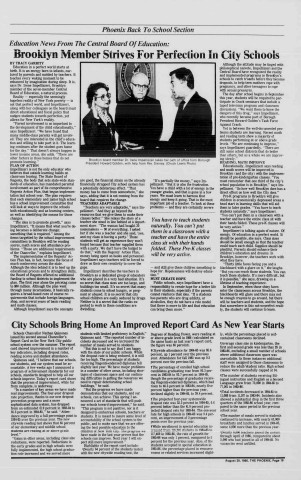
Phoenix Back To School SectionEducation News From The Central Board Of Education:Brooklyn Member Strives For Perfection InBrooklyn board m em ber Dr. Irene Impellizzeri takes her oath of office from BoroughPresident Howard Golden, with help from Rev. Diviney. (Chuck Lewis Photo)BY TRACY GARRITYEducation in a perfect world starts at birth. It is an energy bom to infants, nurtured by parents and molded by teachers. It touches every waking moment to be enhanced by imagination during sleep. It is, says Dr. Irene Impellizzeri, Brooklyn member of the seven-member Central Board of Education, a natural process.Reality %u2014 especially the seemingly hopeless reality of New York poverty %u2014 is not that perfect world, and Impellizzeri, along with her colleagues on the board must direct educational and fiscal policy that nudges students towards perfection, yet allows for New York%u2019s reality.%u201cParent involvement is so important to the development of the child educationally,%u201d says Impellizzeri. %u201cWe have found that many middle-class parents will get involved. They are interested in the child%u2019s education and willing to take part in it. The learning continues after the student goes home for the day.%u201d That doesn%u2019t always happen in lower income areas, she adds. %u201cThere are other factors in those homes that do not promote learning.%u201dPLAN OF ACTIONImpellizzeri is not the only educator who believes that outside learning builds on classroom learing. The State Board of Regents, the body that sets state-wide standards of education, has mandated parental involvement as part of its comprehensive Regents Action Plan, that began implementation last school year. The plan requires that each elementary and junior high school has a school improvement committee that will look at ways to improve the schools both educationally and as learning centers, as well as identifying the means for those changes.%u201cThe idea is to promote growth,%u201d says Impellizzeri, %u201cIt means that what you%u2019re doing becomes a deliberate change; something that is required.%u201d Among the items targetted by the school improvement committees in Brooklyn will be reading scores, math scores and attendance problems. %u201cThose are additional requirements of the Chancellor,%u201d explains Impellizzeri.The implementation of the Regents%u2019 Action Plan has, in fact, become the focus of much controversy across the state.Although the idea behind it is to beef up the educational process and to strengthen skills, the Board of Regents offered no additional funding to school districts to implement the plan. The first year alone the pricetag came to $60 million. Although the plan went through many incarnations, it basically requires a broad-based core of course requirements that include foreign languages, shop, and several years of basic reading and math classes.Although Impellizzeri says the conceptsare good, the financial strain on the already financially strapped City school system has a potentially deleterious effect. %u201cThat money has to come from somewhere,%u201d she says, adding that it is not coming from the board that requires the change.TEACHERS ADAPTABLE%u201cTeachers are very adaptable,%u201d says Impellizzeri. %u201cAnd they go beyond the resources that we give them to make their classes better.%u201d She relays the story of a teacher she stood in line behind at a department store: %u201cTne woman had bought 30 noisemakers %u2014 30 of everything. I asked her if she was a teacher and she said, %u2018yes, and my class is having a party.%u2019 Those students will get an experience they won%u2019t forget becuase that teacher supplied them with a party. We don%u2019t have the budget to do that,%u201d with the Regents%u2019 Action Plan, money being spent on books and personnel. Impellizzeri says teachers will be forced to draw on their own creativity to cover the gaps.Impellizzeri describes the teachers in Brooklyn as a dedicated group of educators who are placed in a very bad situation. It%u2019s no secret that class sizes are too large, and buildings too small. It%u2019s no secret that many students come to school hungry, or pregnant or abused. It is no secret that city school children are easily seduced by drugs. Neither is it a secret that the ranks expected to work in these conditions are dwindling.%u201cIt%u2019s partially the money,%u201d says Impellizzeri. %u201cBut it is also the frustration. You have a child with a lot of energy in the younger grades, and that is gone in a few years. We must learn to harness that energy and keep it going. That is the most important job of a teacher. To look at these problems %u2014 and they are certaintly severeYou have to teach studentsnaturally. You can V putthem in a classroom with ateacher and have the entireclass sit with their handsfolded. These Pre-K classeswill be very active.%u2014 and still give these children something to hope for. Hopelessness will destroy education.%u201dMUST CREATE HOPEPublic schools, says Impellizzeri have a responsibility to create hope for a better life in their students, especially if the parents cannot reinforce that idea. %u201cIf a students has parents who are drug addicts, or alcoholics, they do not have a role model that there is more to life and that education can bring them more.%u201dn _ i ________i _ u iy acnuuisAlthough the attitude may be tinged with philosophical naivete, Impellizzeri and the Central Board have recognized the reality and implemented programs in Brooklyn%u2019s schools to catch truants before they become dropouts, to help teen mothers cope with pregnancy, and other teenagers to cope with sexual pressures.The day after school begins in September this year, students will be required to participate in Crack seminars that include a taped television program and classroom discussions. %u201cWe want them to know the dangers of this drug,%u201d says Impellizzeri, who recently became part of Borough President Howard Golden%u2019s Task Force Against Crack.Yet in between the well-documented problems students are learning. Recent math and reading tests show a majority of students performing at or above grade levels. %u201cWe are continuing to improve,%u201d says Impellizzeri guardedly. %u201cThere are still some school districts that do better than others, but as a whole we are improving slowly.%u201dREADING, MATH IMPROVEEducationally, Impellizzeri says reading and math scores will be improved in Brooklyn (and the city) with the implementation of pre-kindergarten classes. %u201cYou must remember that one third of the city%u2019s school population is in Brooklyn,%u201d says Impellizzeri. %u201cSo how well Brooklyn does has a direct effect on how well the City does.%u201dPre-K programs in Brooklyn will give children in economically depressed areas a head start in learning skills that will aid them in later grades. %u201cYou have to teach students naturally,%u201d says Impellizzeri.%u201cYou can%u2019t put them in a classroom with a teacher and have the entire class sit with their hands folded. These pre-K classes will be very active.%u201dImpellizzeri is talking again of nature. Of energy. Of education in a perfect world. It should be possible, she says. Class sizes should be small enough so that the teacher could touch each child. Supplies should be plentiful. Parents should enhance their children%u2019s education and dreams. In Brooklyn, however, the teachers work with what they have.%u201cThirty little faces facing you and a blackboard with a glare on it,%u201d she laughs. %u201cBut you can reach those students. You can touch those students. It%u2019s more difficult, but it is possible,%u201d she says, drawing on a lifetime of teaching experience.In September, when those shiny faces enter the classrooms across Brooklyn, the blackboards will glare and there may not be enough crayons to go around, but there will be teachers and students, and the hope that somewhere in this not-so-perfect reality, the students will continue to learn.City Schools Bring Home An Improved Report Card As New Year StartsSchools Chancellor Nathan Quinones issued his second annual Chancellor%u2019s Report Card on the New York City public school system over the summer. The report card showed improvement in a number of key indicators, including dropout rates, reading scores and student attendance.Quinones said, %u201cI believe that our schools, our students, and our system must be accountable. A few weeks ago I announced a program of achievement standards for our schools, standards designed to help all our schools improve. Today%u2019s report card shows that the process of improvement, while far from complete, is underway.%u201cIn a number of key areas we have made real improvements. The four-year dropout rate projection, thanks to our new dropout prevention programs and a more sophisticated data system, has dropped from an estimated 41.9 percent in 1983-84 to 35.3 percent in 1984-85,%u201d he said. %u201cAttendance improved by a full percentage point in 1984-85 over the previous year. The new citywide reading test shows that 65 percent of our elementary and middle school students are reading ai or above grade level.%u201d%u201cGains in other areas, including class size reductions, were reported. Reductions in the early grades and in high schools were fully implemented, the high school graduation rate increased and we served morestudents with limited proficiency in English,%u201d Quinones said. %u201cThe reported number of incidents decreased and we increased the number of meals served to students.%u201cBut this is not to say that I am happy with the state of our public schools. While the dropout rate is being reduced, it is still far too high. The percentage of students receiving Regents-endorsed diplomas fell slightly last year. We have major problems in a number of other areas, including shortages of classroom space and our continuing difficulties in getting the resources we need to repair deteriorating school buildings,%u201d he said.%u201cBut the progress we have made demonstrates that our students, and our schools, can achieve. This spring I announced a set of standards that will push our schools toward improvement,%u201d he said. %u201cThis program is not punitive, nor is it designed to embarrass schools, teachers or students. It is meant to insure some level of accountability of the school system to the public, and to make sure that we are offering the best possible education to the cnuaren or New York Ciiy. m e piugiess wehave made in the last year proves that the schools can improve. Next year I will expect still more improvement.%u201dHighlights of the report card include: ^Nearly 64 percent of the students tested with the new city wide reading test, theDegrees of Reading Power, were reading at or above grade level in 1986 (calculated on the same basis as last year%u2019s report card, the figure was 65 percent).1 City wide attendance for 1984-85 was 85.6 percent, up 1 percent over the previous year. Attendance for fall 1985 was up 0.2 percent over the previous fall.1The percentage of enrolled high school candidates graduating rose from 92.3 percent in 1983-84 to 93.7 percent in 1984-85, though the percentage of graduates receiving Regents-endorsed diplomas, which had risen to 40.5 percent in 1983-84, nearly five percent higher than the previous year, declined slightly in 1984-85, to 39.4 percent.iThe projected four-year systemwide dropout rate was 35.3 percent in 1984-85, 6.6 percent better than the 41.9 percent projected dropout rate for 1983-84. The one-year rate for high schools in 1984-85 was 9.4 percent, an improvement of 2 percentage points over the previous year.1 While enrollment in special education inC r C d S S d f r o m 116 ?01 c tu H p n tc s i n 1Q R 4-A 5 t o117,469 in 1985-86, the rate of growth for 1985-86 was only 1 percent, compared to 5 percent for the previous year. Also, of the students accepted in special education in 1985-86, the percentage placed in resource rooms or related services increased slightly, while the percentage placed in selfcontained classrooms declined.1 Average class size in kindergarten, the first and second grade was less than 25 in 198586, excluding a small number of schools where additional classroom space was unavailable. In these instances additional staff were assigned to those classrooms to reduce the adult/student ratio. High school classes were successfully capped at 34.1The number of students receiving Bilingual instruction and English as a Second Language grew from 73,000 in 1984-85 to 77,561 in 198586.1 Total incidents decreased in 198485 to 11,088 from 11,187 in 198384. Incidents also showed a substantial drop in the first three quarters of the 198586 school year, compared to the same period in the previous school year.IThe number of meals served to students continued to increase, with nearly 63,000 breakfasts and lunches served m 198485, some 4,000 more than the previous year.iNeariy 6,000 teachers joined die system through April of 1986, compared to about 5,000 who had joined in all of 198485. No vacancies went unfilled.August 28, 1986, THE PHOENIX, Page 19


