


Page 58 - Demo
P. 58
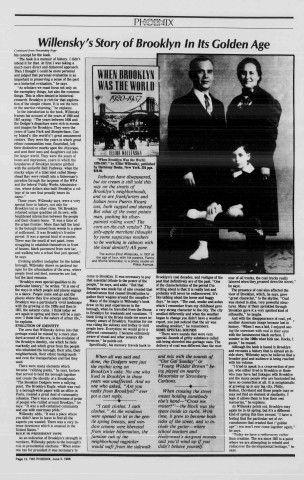
T ~ \\T|J h SECTION 2 1 A %u2014 IXWillensky's Story of Brooklyn In Its Golden Age r nnriniiffi frnm Proceeding Paeehis concept for the book.%u201cThe book is a memoir of history. I didn%u2019t intend it for that. At first I was taking a much more direct and distanced approach. Then I thought I could be more personal and judged that personal evaluation is as important in preserving a sense of the past as a historical evaluation,%u2019%u2019 he says.%u201cAs scholars we must focus not only on the exemplary things, but also the common things. This is often denied in historical research. Brooklyn is rich for that exploration of the simple citizen. It is not the hero or the warrior returning,%u201d he explains.In the introduction to the book, Willensky frames his account of the years of 1920 and 1957 saying: %u201cThe years between 1920 and the Dodger%u2019s departure were rich in events and images for Brooklyn. They were the years of Luna Park and Steeplechase, Coney Island%u2019s (the world%u2019s?) great amusement centers. They were the years in which great ethnic communities rose, flourished, left their distinctive marks upon the cityscape, and sent their sons and daughters out into the larger world. They were the years of boom and depression, years in which the boundaries of Brooklyn became girdled with the amberlit Belt Parkway, when the mucky edges of a tidal inlet called Sheepshead Bay were rebuilt into a fisherman%u2019s paradise through the largesse of the WPA and the federal Public Works Administration, whose dollars also built Brooklyn a college of its own that proudly bears its name.%u201dThose years, Willensky says, were a very special time in history, not only for Brooklyn but in other cities. Yet Brooklyn retained unique qualities all its own, with heightened interaction between the people and their chosen home. %u201cIt was a time of the urban frontier. More than half the land in the borough turned from weeds to a place of settlement. It was Brooklyn%u2019s frontier period. It was a special kind of occasion. There was the smell of wet paint, trees struggling to establish themselves in front of houses, black pavement from new tar, and walking into a school that just opened,%u201d he says.Evoking another metaphor for the fabled borough, Willensky draws on pastoral images for the urbanization of the area, where people lived and died, memories are lost, but the land remains.%u201cBrooklyn owes special qualities to its particular history,%u201d he writes. %u201cIt is one of the ways in which people and places engage in a dance. People come and go and the places where they live emerge and flower. Brooklyn was a particularly vivid landscape with the growing in the 1920s and then in 1957, the autumn came. I think today we are again in spring and there will be a summer. I think that%u2019s the nature of urban life,%u201d he explains.EVOLUTION OF IDENTITYThe area that Willensky delves into that perhaps would be missed by a more standard account of the era, is the evolution of the Brooklyn identity, one which he feels markedly and which grew from the people who inhabited the borough, their jobs, their neighborhoods, their ethnic backgrounds - and even the transportation and fuel they used.There were many elements which became %u201crallying points,%u201d he says, factors that served to hold the borough together and create the identity of a Brooklynite. %u201cThe Brooklyn Dodgers were a rallying point. The Brooklyn Eagle, which was really a borough-wide paper with an office in Paris, created a great deal of community cohesion. There was a cohesiveness of pride of people who rallied around Brooklyn,%u201d he says. %u201cIt was a self-contained community and one with enormous pride.%u201dWillensky adds, %u201cIt was a place where you didn%u2019t have to leave to find all the aspects you wanted. There was a very intense downtown which is unusual in the United States.%u201dR rtl.F . IN P R F .S m F .N T V O T FAs an indication of Brooklyn%u2019s strength in numbers, Willensky points to the borough%u2019s role in presidential elections. %u201cWhen someone ran for president it was necessary to%u201cWhen Brooklyn Was the World: 1920-1957,%u201d by Elliot Willensky, pablished by Harmony Books, New York. 224 pps. $19.95.Iceboxes have disappeared,but ice cream is still sold thisway on the streets ofBrooklyn%u2019s neighborhoods,and so are frankfurters andItalian fnow Puerto Rican)ices, both cupped and shaved.But what of the sweet potatoman, pushing his silverpainted rolling oven? Thecorn-on the-cob vendor? Thejelly-apple merchant (thoughtby some suspicious mothersto be working in cahoots withthe local dentist?) All gone.The author,E lliot W illensky, in 1937 atthe age o f four, w ith his parents, Fannyand M orris W illensky, in a photo s tudio onPitkin Avenue.come to Brooklyn. It was necessary to pay that essential tribute to the power of the people,%u201d he says, and adds: %u201cBut that Brooklyn was made fun of also created that defensiveness that caused Brooklynites to gather their wagons around the campfire.%u201dMany of the images in Willensky%u2019s book draw on his past experiences in the borough, when he travelled from the Bronx to Brooklyn for weekends and vacations. %u201cI think living in the Bronx made me more intensely aware of Brooklyn. Vacation for me was riding the subway and trolley to visit people here. Everytime we would go to a different community. I became extremely aware of visual and other sensory differences,%u201d he points out.Specifically, his memory travels back toBrooklyn%u2019s coal decades, and vestiges of the past that definitively are of the past. %u201cOne of the characteristics of the period I%u2019m writing about is that it is really lost and probably will never be rediscovered. It%u2019s like talking about the horse and buggy days,%u201d he says. %u201cThe coal, smoke and ashes which I remember from my childhood gave a very strong character to the city. The city smelled differently and when the weather began to change you didn%u2019t have a weather report, you just noticed that the air was smelling smokier,%u201d he remembers.SOME SPECIAL SOUNDS %u201cThere were sounds that were very special. Sounds of gritty substance called ash being shoveled into garbage cans. The delivery of coal was different than the murWhen all was said anddone, the Dodgers were justthe mythic icing onBrooklyn%u2019s cake. No one wholived in Brooklyn in thoseyears was unaffected. And noone who asked, %u201cAre youreally from Brooklyn?%u201d evergot a curt reply.------------ %u2666 -------------%u201cI cash clothes. I cashclothes. %u201d As the windowswere opened to let in the gentle spring breezes, and window screens were liberatedfrom winter hibernation, thefamiliar can of theneighborhood ragpickerwould waft from the sidewalkand mix with the sounds of%u201cOur Gal Sunday %u201d or%u201c Young Widder Brown%u201d being played on nearbyMotorolas or StrombergCarlsons.----------- ----------------When crossing the streetmeant holding somebodyelse%u2019s hand%u2014 %u201cCross me,mister?%u201d%u2014the block was thespace inside its curbs. Withtime, it grew to become bothsides o f the street, and to include the gutter%u2014whereschool teachers andHollywood's ao-good moviessaid you *d wind up if youdidn *t behave yourself.mur of oil trucks, the coal trucks really labored when they groaned down the street,%u201d he says.The presence of coal also affected the view of Brooklyn, which, he says, gave %u201cgreat character,%u201d to the skyline. %u201cCoal was stored in silos, very powerful structures. Many of them sprinkled through Brooklyn gave it a very spirited kind of silhouette,%u201d he laughs.And with the disappearance of coal, yet another American image became lost in %u2019 history. %u201cWhen I was a kid, I enjoyed seeing the snowmen with coal in their eyes with the luminescent black surface. I wonder in the 1980s what kids use. Rocks, I guess,%u201d he mused.Although the book is based in Brooklyn and recounts a history that is almost an inside story, Willensky says he believes that a broader goal and audience is being reached with his volume.%u201cI tried to speak to a cross-section of people, who either lived in Brooklyn or those who may have had linkages with Brooklyn and the many people who are fascinated but have no connection at all. It is symptomatic of growing up in any big city, Philly,Boston, Cleveland and those people may or may not find an element of similarity. I hope it allows them to free their own memories,%u201d he explains.As Willensky points out, Brooklyn may again be in its spring, but it%u2019s a different kind of spring this time around. %u201cI have a feeling that the particular set of circumstances that created that (%u201cgolden age%u201d ) era won%u2019t ever come together again,%u201d he says.%u201cToday we have a redisenverv ratherthan creation. The era since 1957 is a point where we are attempting to rebuild and rediscover the developmental heritage,%u201d he says.Page 12, T H E P H O E N IX , June 5, 1986


