


Page 57 - Demo
P. 57
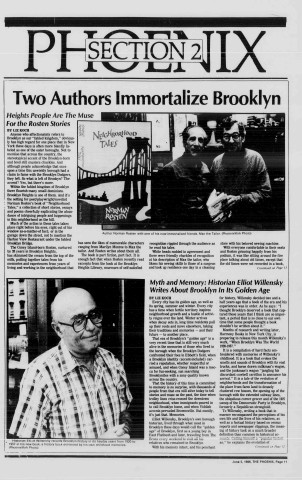
Tw o Authors Im m ortalize BrooklynHeights People Are The MuseFor the Rosten StoriesBY LIZ KOCHAnyone who affectionately refers to Brooklyn as our %u201cfabled kingdom,%u201d obviously has high regard for one place that in New York these days is often more blandly labeled as one of the outer boroughs. Not to mention that across the country, the stereotypical accent of the Brooklyn-born and bred still musters chuckles. And although people acknowledge that once upon a time this unwieldy borough had a claim to fame with the Brooklyn Dodgers, they left. So what is left of Brookyn? The accent? Yes, but there%u2019s more.Within the fabled kingdom of Brooklyn there flourish many small dominions.Brooklyn Heights is one of them. And it%u2019s the setting for poet/playwright/novelist Norman Rosten%u2019s book of %u201cNeighborhood Tales,%u201d a collection of short stories, essays and poems cheerfully explicating the abundance of intriguing people and happenings in this neighborhood on the hill.Much of the action in these tales takes place right before his eyes, right out of his window as-a-matter-of fact; or in the garage down the street, not to mention the Harbor View Restaurant under the fabled Brooklyn Bridge.The Coney Island-born Rosten, nurtured by 20 years in Brooklyn Heights, has skimmed the cream from the top of the milk, putting together tales from his memories and experiences from years of living and working in the neighborhood thatA uthor Norm an R osten w ith one of his now -im m ortalized friends, Max the Tailor. (Phoenix/K irk Photo)has seen the likes of memorable characters ranging from Marilyn Monroe to Max the tailor. And Rosten writes about them all.The book is part fiction, part fact. It is enough fact that when Rosten recently read excerpts from the book at the Brooklyn Heights Library, murmurs of self-satisfiedrecognition rippled through the audience as he read his tales.White heads nodded in agreement and there were friendly chuckles of recognition at his description of Max the tailor, who likens his sewing skills to those of a surgeon and took up residence one day in a cleaningstore with his beloved sewing machine.With everyone comfortable in their seats and Rosten grinning happily from his podium, it was like sitting around the fire place talking about old times, except that the old times were not recorded in a book,Continued on Page 13Myth and Memory: Historian Elliot WillenskyWrites About Brooklyn In Its Golden AgeH istorian Elliott W illen sky records B rooklyn history in its heyday years from 1920 to1957 in his new book, a history book en han ced by his own childhood m em ories.(Phoenix/K irk Photo)BY LIZ KOCHEvery city has its golden age, as well as its spring, summer and winter. Every city has a time when fertile territory inspires neighborhood growth and a bustle of activity reigns over the land. Winter arrives when decay sets in, long time residents pull up their roots and move elsewhere, taking their traditions and memories %u2014 and their future %u2014 to another place.That era of Brooklyn%u2019s %u201cgolden age%u201d is a very recent time that is still very much alive in the memories of those who lived in the borough when the Brooklyn Dodgers confronted their foes in Ebbett%u2019s field, when a Brooklyn identity (accent-included) carried a reputation, whether respectful or amused, and when Coney Island was a mecca for fun-seeking, sun searching Brooklynites with a zany quality known across the country.That the history of this time is committed to memory is no surprise, with thousands of people from that era still alive today to tell stories and muse on the past, the time when trolley lines criss-crossed the downtown neighborhood, when immigrants poured in to call Brooklyn home, and when Yiddish accents pervaded Brownsville. But mostly, it%u2019s just that. Memories.Elliot Willensky, Brooklyn%u2019s own borough historian, lived through what most in Brooklyn these days would call the %u201cgolden age%u201d of Brooklyn, first as a young boy in East Flatbush and later, traveling from Ther > _________________ ______ - ~ i ------------- 1 a ~ %u201e n u : . .a m u u a e v v - i j r t v ^ i u / i i u t u v i a n c u i m orelatives who remained in Brooklyn.With his memory intact, and his penchantfor history, Willensky decided two and a half years ago that a book of the era and his experiences was in order. As he says: %u201cI thought Brooklyn deserved a book that captured those years that I think are so important, a period that is so close to our own time that some people thought a book shouldn%u2019t be written about it.%u201dMonths of research and writing later, Harmony Books in New York City, is preparing to release this month Willensky%u2019s work, %u201cWhen Brooklyn Was The World 1920-1957.%u201dIt is a compilation of hard facts embroidered with memories of Willensky%u2019s childhood. It is a book that evokes the smells and sounds of Brooklyn with its coal trucks, and horse drawn milkman%u2019s wagon, and the junkman%u2019s wagon %u201cjangling his discordant cowbell carrillon to announce his arrival.%u201d It is a tale of the evolution of neighborhoods and the transformation of the place from farm land to densely clustered row houses, the opening up of the borough with the extended subway lines, the ubiquitous comer grocer and of the 1927 sweep of the Democratic Party in Brooklyn, formerly a Republican stronghold.To Willensky, writing a book that in essence encompassed the perceptions of his own life and the lives of his relatives, as well as a factual history based on census reports and newspaper clippings, the meaning of history took on a much broader definition than common in historical acP o l l i n r t V%u00bbir * n r t * \\ n l n t %u00ab k i f i l n pan,%u201d he explains the evolution ofContinued < n Page 12June 5, 1986. TH E P H O E N IX , Page 11


