


Page 59 - Demo
P. 59
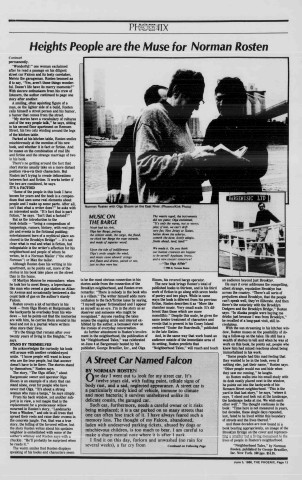
P H 'S %u201d ?-fIXHeights People are the Muse for Norman RostenContinuedpermanently.%u201cWonderful!%u201d one woman exclaimed after he read a passage on his diligent street car Falcon and its testy caretaker, Melvin the garageman. Rosten beamed as if to say, %u201cYes, aren%u2019t those things wonderful. Doesn%u2019t life have its merry moments?%u201d With sincere enthusiasm from his crew of listeners, the author continued to page one story after another.A smiling, often squinting figure of a man, on the lighter side of a build, Rosten calls himself a street person and his humor, a humor that comes from the street.%u201cMy stories have a vocabulary of cultures and of the way people talk,%u201d he says, sitting in his second floor apartment on Remsen Street, his two cats winding around the legs of the kitchen table.Parked at his kitchen table, Rosten smiles mischievously at the mention of his new book, and whether it is fact or fiction. And he muses on the combination of real life and fiction and the strange marriage of two in his book.There%u2019s no getting around the fact that short stories usually take on a more distant position vis-a-vis their characters. But Rosten isn%u2019t trying to create delineations between fact and fiction. It works better if the two are combined, he says.IT%u2019S A FACTOID%u201cSome of the people in this book I have known for years and the book is a compendium that uses some real elements about people and I make up some parts. After all, isn%u2019t that what a writer does?%u201d he asks with an interested smile. %u201cIt%u2019s fact that is part fiction,%u201d he says. %u201cIsn%u2019t that a factoid?%u201dBut as the introduction to the book details %u2014 %u201cbeing a compendium of happenings, rumors, history, with real people and events in the fictional pudding; entertainment bom of a mythical place anchored to the Brooklyn Bridge%u201d %u2014 it%u2019s not clear what is real and what is fiction, but indisputable is the writer%u2019s affection for his neighborhood and people of whom he writes, be it a Norman Mailer (%u201cthe other Norman%u201d ) or Max the tailor.Although Rosten does his writing in his apartment, as he points out, more of the stories in his book take place on the street than in the home.Of Marilyn Monroe he remembers when he took her to meet Benny, a leprechaunlike man who owned a gas station on Atlantic Avenue and occasionally bestowed a discount tank of gas on the author%u2019s sturdy Falcon.Rosten covers a lot of territory in his book %u2014 from Olga Bloom at Bargemusic to the backyards he overlooks from his windows %u2014 but he points out that the memories are with him, he carries them around in his head and not in a journal where writers often store their lives.%u201cIt%u2019s the things that remain after over twenty years of living in the Heights,%u201d he says.STAND BY THEMSELVESHe acknowledges the curiosity his book will arouse with another crinkled-eyed smile. %u201cI know people will want to know who are the true people, but that answer doesn%u2019t have to be there. The stories stand by themselves,%u201d Rosten says.The story, %u201cThe Olga Affair,%u201d about Bargemusic owner and operator Olga Bloom is an example of a story that can stand alone, even for people who have never met Olga. %u201cIt%u2019s about a strong woman who runs a barge,%u201d he says simply.From his back window, yet another subject is in view, a red maple that is the replacement for a predecessor willow mourned in Rosten%u2019s story, %u201cLandmarks from a Window,%u201d and ode to all trees that spread their roots and raise their crowns in the concrete jungle. Yes, that was a true story, the felling of the favored willow, but the story Rosten writes about his upstairs neighbor is embellished with some of thea u t h n r ^ w h i m o v o n H R n o f o n o o v o m l f k *%u00bb ---- y ----------------------------. . . . %u2014 . . . V . t*chuckle: %u201cHe%u2019ll probably be surprised when he reads it.%u201dThe warm smiles that Rosten displays speaking of his books and characters seemMUSIC ONTHE BARGENnoh had his Ark,Olga her Barge; puttingthe context aside, the cargo, the flood,we think her Barge the truer miracle,and made of superior wood.The waters raged, the instrumentsdid not panic; Olga exclaimed,\play; if lost, we can't driftvery far; New Jersey or Staten,batten down the scherzo,cometh the dove, lovely adagio,finale ahead, land, land!\Upon the tide o f indifferenceOlga%u2019s smile caught the wind,and music came aboard: stringsand flutes and drums, paired or not,just so they were hot.We made it. Do you thinkour human creatures are happierto be saved? Applause, bravo,and a new concert tomorrow!- %u201c The Olga A ffa ir%u201d%u00a9 IW 6b%u00bb Norman Roomto be the most obvious connection in his stories aside from the connection of the Brooklyn neighborhood, and Rosten even remarks: %u201cThere is nobody in the book who is a villain.%u201d The writer himself adds more confusion to the fact/fiction issue by saying, %u201cI myself appear fictionalized and I appear as myself as an eye. I%u2019m in the story as an observer and someone who might be recognized.%u201d Anyone reading the tales senses the ongoing smile and interest exhibited by the author, a bemused view on the ironies of everyday conversation.As further attestment to Rosten%u2019s involvement in the neighborhood, the publication of his %u201cNeighborhood Tales,%u201d was celebrated on June 4 at Bargemusic hosted by his publisher, George Braziller, Inc., and OlgaBloom, his revered barge operator.The new book brings Rosten%u2019s total of published books to thirteen, and is his third work of fiction to go along with seven books of poetry and two plays. While in some ways the book is diferent from his previous fiction, Rosten describes it as %u201cMore like chamber music. Very small scale. It%u2019s different than those which are more monolithic.%u201d Despite this scale, he gives the same tender treatment of characters and events that is present in his Coney Island centered %u201cUnder the Boardwalk,%u201d published in the late Sixties.And, in the same way that work found an audience outside of the immediate area of its setting, Rosten predicts that %u201cNeighborhood Tales,%u201d will reach and touchA Street Car Named FalconB Y N O R M A N R O S T E NOn e d ay I w en t o u t to lo o k for m y street car. It%u2019stw elve years o ld , w ith fad in g p ain t, telltale signs o fb o d y rust, an d a sad , n eglected ap p earan ce. A street car isa particu larly sturdy kin d o f veh icle, im m u n e to clim atean d m ost bacteria; it survives u n sh eltered u n lik e itsd elicate co u sin , th e garaged car.S u ch car, fu rth erm ore, n eed s a carefu l ow ner or it risksb ein g m isp laced; it is a car parked o n so m any streets thato n e can o fte n lo se track o f it. I have alw ays feared such am em ory lo ss. T h e th ou gh t o f m y F a lco n , ab a n d o n ed ,lad en w ith undeserved parking tick ets, abused b y d o g s orm isch ievou s ch ildren , is to o m uch to bear. I am carefu l tom ak e a sh a re m ental n ote w here it is after I nark - %u00bbI fin d it on this d ay, forlorn and unw ashed (n o rain forS ev eral W eeks), a fa r Cry f ro m Continued on Following Pagean audience beyond just Brooklyn.He says it even addresses the compelling, albeit strange, reputation Brooklyn has across the country. %u201cThere%u2019s all sorts of prejudices about Brooklyn, that the people can%u2019t speak well, they%u2019re illiterate. And then there%u2019s the notoriety with the Brooklyn Dodgers and the Brooklyn Bridge,%u201d Rosten says. %u201cIn Alaska people were buying me drinks just because I was from Brooklyn,%u201d he recalled of a long-past visit, still incredulous.With the sun streaming in his kitchen window, Rosten muses on the possibility of doing a follow-up on the tales. He still has a wealth of stories to tell and when he was at work on this book, he points out, people who knew him had mixed reactions about being immortalized in his work.%u201cSome people had this mad feeling that they wanted to be in the book, even if nothing else, just their name,%u201d Rosten says. %u201cOther people would run and hide when they saw me coming,%u201d he laughs.As Rosten walks into his small study with its desk neatly placed next to the window, he points out into the backyards of his Remsen Street neighborhood. %u201cThis is the yard in that last story,%u201d he says, %u201cwhere it says, %u2018I stand and look out at the landscape, the landscape looks at me. We wish each other well%u2019.%u201d The thought continues in the book: %u201cTime here is not measured in years, but decades, these single days repeated, lost, fated to be lived within this boundary of streets and the lives thereof.%u201dAnd those decades are now bound in a book bearing appropriately, an image of the Brooklyn Bridge on the cover and represen--------------- 11%u2014 i%u2014 a - i : . . : %u2014 . ------------------------- 1. a i_ _ VU Ig C%u00ab O U U lU V t MUb u u v u i g i i t v u u u i c m W MIClives of people in Rosten%u2019s neighborhood.%u201cNeighborhood Tales,%u201d by Norman Rosten, published by George Braziller, Inc. New York. 160 pps. $14.95.June 5, 1986, TH E P H O E N IX , Page 13


