


Page 601 - Demo
P. 601
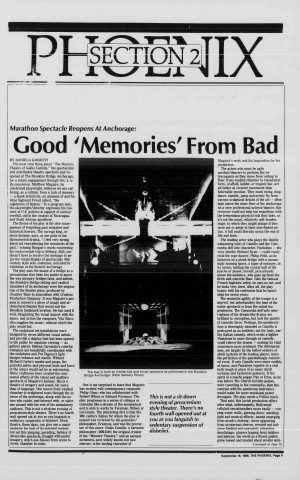
Marathon Spectacle Reopens At Anchorage:Good 'Memories' From BadBY DANIELA GIOSEFFIThe most vital thing about %u201c The Memory Theatre of Guilio Camillo,%u201d the spectacular and unorthodox theatre spectacle just reopened at The Brooklyn Bridge Anchorage, for a return engagement through Oct. 5, is its conscience. Matthew Maguire, its celebrated playwright, believes we are suffering, as a culture, from a lack of memory %u2014 a blank historicity, an amnesia of and for ; what Sigmund Freud called, %u201c the nightmare of history.\the playwright/director expresses his concern at U.S. policies in support of nuclear overkill, aid to the contras of Nicaragua, and South African apartheid.The theme of his play is the dire consequences of forgetting past mistakes and historical horrors. The corrupt king, or stock dictator, says, at one point in the disconnected drama, %u201c I feel very strong about not reawakening the memories of the past,%u201d echoing Reagan%u2019s words concerning his controversial trip to Bitburg. Still, one doesn%u2019t have to receive the message to enjoy the visual display of spectacular 16th century style sets, costumes, and interior exhibition at the historic anchorage.The play uses the image of a bridge as a phenomenon that links two points in space the way memory bridges time, and indeed, the Brooklyn Bridge setting and vaulted chambers of its anchorage were the inspiration of the theatre piece, produced by Creative Time in association with Creation Production Company. It was Maguire%u2019s purpose to conceive a piece of image and architectural theatre that would suit the Brooklyn landmark location. He has used it well, integrating the visual impact with the space, and so has the composer, Vito Ricci, who supplies the music, without which the play would fail.The sculptural set installations were designed by seven different visual artists and provide a display that has been opened to the public for separate viewing %u2014 as gallery pieces. Helena Carratala%u2019s colorful costumes are beautifully coordinated with the sculptures and Pat Dignan%u2019s light designs enhance and startle. Without Richard Curtis%u2019s masks and props, the graceful antics and physical feats and farce of the actors would not be so entrancing. Many craftsmen have created the communal effects of the visual and auditory spectacle of Maguire%u2019s fantasy. His is a theatre of imagery and sound, far more than of language. One moves from vaulted chamber to sculptured room through the interior of the anchorage, along with the actors who cajole, and interact with, or usher one around with the rest of the ambulatory audience. This is not a sit-down evening of proscenium-style theatre. There%u2019s no fourth wall opened out at you as you languish in sedentary suspension of disbelief. Much theatre, these days, can give one a numb Dosterior for lack of its cerebral content.| but not this jumping, parading, fantasy of dream-like spectacle, fraught with poetic imagery, which one follows from scene to scene, chamber to room.T he p la y is b o th an in te lle c tu a l a n d v is u a l s p e c ta c le as p e rfo rm e d in th e B ro o k ly n B rid g e A n c h o ra g e . (P e te r B e lla m y P h o to )One is not surprised to learn that Maguire has worked with contemporary composer, Philip Glass, who has collaborated with Robert Wilson or Richard Foreman. The play progresses in a series of collages or charades like a stream of the unconscious and is akin to works by Foreman, Wilson or LeCompte. The interesting fact is that the 16th century Italian for whom the play is named was reviewed by the geometer/ philosopher, Erasmus, and was the precursor of this genre. Giulio Camillo, a hermetic philosopher (1480-1544) the original creator of the %u201c Memory Theatre,%u201d and an earnest alchemist, once widely known but now obscure, is the leading character ofThis is not a sit-downevening of prosceniumstyle theater. There's nofourth wall opened out atyou as you languish insedentary suspension ofdisbeiief.Maguire%u2019s work and the inspiration for his production.The actors who must be agile acrobat/dancers to perform the extravaganza as they move from ceiling to floor, from vaulted chamber to raised platform, scaffold, ladder, or trapeze bar, are all better at creative movement than believable emotion. They must swing, leap, dance, tumble, jump and nearly fly from various sculptural details of the set %u2014 often high above the stone floor of the anchorage. As a once professional actress/dancer, this reviewer could not help but empathize with the tremendous physical risk they take, as it%u2019s not the usual, relatively soft wooden stage, to which they might plunge if they were not so adept at their sure-footed antics. A fall could literally mean the end of life and limb.The leading actor who plays the doubly exhausting roles of Camillo and the Cornmedia dell%u2019arte character, Pantalone %u2014 the very slender Michael Ryan %u2014 could easily rival the rope dancer, Philip Petit, as he balances on a plank bridge with a menacingly missing space, a lapse of memory, in its center, holding the crystal ball of the psyche or planet, herself, precariously above the audience, who gaze up from the brick and concrete floor. Like the famous French highwire artist, he uses no net, and he looks very tired. After all, the play begins with his confession that he hasn%u2019t slept for seven years.The ensemble agility of the troupe is a marvel, but unfortunately the tone of the entire spectacle is from the outset too ponderous. The Commedia dell%u2019arte interruptions of the dream-like drama are brilliant in conception, but lack the quality of comedic farce. Perhaps, the ponderous tone is thoroughly intended as Camillo is portrayed as an aesthete, but the lusty, earthy Italian comedy, which needs a lighter Pantalone to come through as comedy, could relieve the drama %u2014 making its vital conscience more profound. The directorial tone, set largely by the hollow oratory or shrill hysteria of the leading player, mars the perfection of the painstakingly conceived event. If only Camillo were more earthly at times, and Pantalone capable of a real belly laugh in place of so many shrill screams and hysterical gestures. If the spirit of a macho pagan Pan or Eros, as he was before The Church fed him poison, were cavorting in the commedia, then the contrast with the ponderous histrionics would make for more emotional power througout. The play needs a Fellini touch.That said, this lavish production offers alive what, unfortunately, Hollywood celluloid sensationalizes more easily %u2014 running water walls; glowing discs; startling light and musical effects; beasts emerging from monk%u2019s clothing; claws appearing from mysterious sleeves, erected red codnlivB fnnHIpH anH parfratoH %u2022 attractivedecollatage; players leaping from ladders and lattices; the world as a literal golden globe tossed and banded about amidst smilContinued on Page 10Septem ber 18,1986, THE PHOENIX, Page 9


