


Page 647 - Demo
P. 647
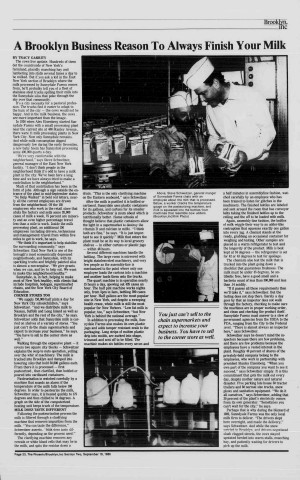
Brooklyn, in ca half minutes in assemblyline fashion, watched carefully by an employee who hasbeen trained to listen for glitches in themachinery. The finished bottles are labeledand sent around the room that has conveyorbelts taking the finished bottles up to theceiling and the off to be loaded with milk.Again, assembly-line fashion, the bottlesof milk wiggle their way to an udder-likecontraption that squeezes exactly one galloninto every jug. A chemist stands at theready, grabbing an occasional container forweighing and testing. Other samples areplaced in a warm refrigerator to test andthe longevity of the product. Milk is bestkept at 34 degrees %u2014 the refrigerator is setfor 42 or 43 degrees to test for spoilage.The chemists also test the milk that istrucked into the plant going down achecklist that guarantees freshness. Themilk must be under 45 degrees, be antibiotic free, have a good smell and abacteria count of less than 300,000 and lessthan .14 acidity.%u201cIf it passes all those requirements thenwe%u2019ll take it,%u201d says Schweitzer. But thetesting does not stop there. Barely a daygoes by that an inspector does not walkthrough the factory, checking to make surethe machines are in proper working order,and clean and checking the product itself.Sunnydale Farms must answer to a slew ofgovernment agencies from the USDA to theFDA, ranging from the City to the Federallevel. %u201cThere is almost always an inspectorhere,%u201d says Schweitzer.Schweitzer says he doesn%u2019t mind the inspectors because there are few problems,and there are few problems because theemployees have a vested interest in theplant. Roughly 49 percent of shares of theprivately-held company belong to theemployees, who work in partnership withpresident Stanley Eisenberg. %u201cWhen youown part of the company you want to see itsucceed,%u201d says Schweitzer simply. It is thiscommitment that gets the milk out everyday, despite mother nature and naturaldisaster. Five parking lots house 50 tractortrailers and 50 normal size trucks, snowplows and sanitation equipment. %u201cWe do itall ourselves,%u201d says Schweitzer, adding that30 percent of the plant%u2019s electricity comesfrom its own generator. %u201cSometimes youcan%u2019t wait for the city,%u201d he says.Perhaps that is why during the blizzard of1982, Sunndyale Farms was the only localmilk firm to deliver. %u201cThe drivers slepthere overnight, and made the delivery,%u201dsays Schweitzer. And while the snowe u n rlo H ' n R r n n k lv n a n d d r iv e r s n e g o tia te dslush clogged streets, the cows stayedupstated herded into warm stalls, munchinghay, and patiently waiting for drivers topick up the milk.BY TRACY GARRITYThe cows live upstate. Hundreds of themdot the countryside of New York%u2019sfarmland, placidly munching hay andlumbering into stalls several times a day tobe milked. But if you ask a kid in the EastNew York section of Brooklyn where themilk processed by Sunnydale Farms comesfrom, he%u2019ll probably tell you of a fleet ofstainless steel trucks spilling their milk intothe Sunnydale silos that poke through thesky over that community.It%u2019s a city necessity for a pastoral profession. The trucks find it easier to adapt tothe hum of the city %u2014 the cows would not behappy. And in the milk business, the cowsare more important than the image.In 1926 when Alex Eisenberg started Sunnydale Farms with a small processing plantnear the current site at 400 Stanley Avenue,there were 11 milk processing plants in NewYork City. Now only Sunnydale remains.And while milk consumption dippeddangerously low during the early Seventies,a new baby boom has Sunnydale processingsome 400.000 quarts a day.%u201cWe%u2019re very comfortable with theneighborhood,%u201d says Steve Schweitzer,general manager of the East New Yorkfacility. %u201cI don%u2019t think people in theneighborhood think it%u2019s odd to have a milkplant in the city. We%u2019ve been here a longtime and we have always tried to make acontribution to the neighborhood.%u201dMuch of that contribution has been in theform of jobs. Although a sign outside the entrance of the plant in mid-September states%u201cNo Help Wanted%u201d in bold red letters, nearly all the current employees are drawnfrom the neighborhood. Of the 105employees who work in the retail store thatabuts the factory and sells some 20,000cases of milk a week, 75 percent are minority and an even higher percentage travelless than a mile to work. Inside the milkprocessing plant, an additional 150employees (including drivers, techniciansand management) travel from within fivemiles to get to work, he says.%u201cWe think it%u2019s important to help stabilizethe surrounding community,%u201d saysSchweitzer. East New York is one of theborough%u2019s most economically depressedneighborhoods, and Sunnydale, with itssparkling trucks and brightly painted silosis almost a non-sequitur. %u201cWe give grantswhen we can, and try to help out. We wantto make this neighborhood healthy.%u201dSunnydale, is, in fact, helping to makemost of New York healthy, with clients thatinclude hospitals, bodegas, supermarketchains, and the New York City Board ofEducation.CORNER STORES TOO%u201cWe supply 150,000 half pints a day forNew York City schoolchildren,%u201d saysSchweitzer. %u201cAnd we distribute milk toNassau, Suffolk and Long Island as well asBrooklyn and the rest of the city,%u201d he says.Schweitzer adds that Sunnydale milk is carried on shelves of a variety of stores. %u201cYoujust can%u2019t do the chain supermarkets andexpect to increase your business,%u201d he says.%u201cYou have to sell to the corner store aswell.%u201dWalking through the expansive plant %u2014 itcovers two square city blocks %u2014 Schweitzerexplains the soup to nuts operation, yellingover the whir of machinery. The milk istrucked into Brooklyn and dumped intotowering silos that hold 50,000 gallons each.From there it is processed %u2014 firstpasteurized , then clarified, then bottled orpoured into cardboard containers.Pasteurization is watched carefully by amachine that sounds an alarm if thetemperature of the milk falls below 160degrees. In order to pasteurize the milk,Schweitzer says, it is heated quickly to 175degrees and then chilled to 34 degrees. Agraph on the side of the computerizedheating unit keeps track of the temperature.MILK DOES TASTE DIFFERENTFollowing the pasteurization process themilk is filtered through a clarifyingmachine that removes impurities from themilk. %u201cYou can taste the difference,%u201dSchweitzer asserts. Miik does iasie differently, depending on the process used.%u201dThe clarifying machine removes anycereals or white blood cells that may be inthe milk, and spits the residue down adrain. %u201cThis is the only clarifying machineon the Eastern seaboard,%u201d says Schweitzer.After the milk is purified it is bottled orcartoned. Sunnydale uses plastic containersfor its gallons, and cartons for its smallerproducts. Schweitzer is mum about which isnutritionally better. (Some schools ofthought believe that plastic containers allowthe light in a supermarket to destroy thevitamin D and calcium in milk). %u201cI thinkboth are fine,%u201d he says. %u201cIt is just important to see it quickly.%u201d Milk that enters theplant must be on its way to local groceryshelves %u2014 in either cartons or plastic jugs%u2014 within 48 hours.Several different machines handle thebottling. The large room is mirrored withbright stainless-steel machinery, and veryfew people as the assembly-line ismechanized to the point where only oneemployee loads the cartons into a machineand another loads them onto the trucks.The quart machine is in operation nearly15 hours a day, spewing out 425 cases anhour. The half pint machine works nightsonly, from 5pm to 2am, bottling 390 casesper hour. Half gallons are the most popularsize in New York, and despite a sweepinghealth craze, whole milk is still the mostpopular for New Yorkers. %u201cLow fat milk ispopular, too,%u201d says Schweitzer, %u201cbut NewYork is behind the national average.%u201dIn addition to processing the milk, Sunnydale Farms also makes its own plasticjugs and adds tamper resistant seals to thepackaging. Long strips of molten plasticdrip into molds, are sucked into shape,trimmed and sent off to be filled. Themachine makes six bottles every seven andAbove, Steve Schweitzer, general manger of Sunnydale Farms chats with an employee about the milk that is processed. Below, a worker checks the temperature gauge on the pasteurizing machine, and milk is squeezed into the bottles from machines that resemble cow udders. (Brooklyn,Inc/Kirk Photo)You ju st can V sell to thechain supermarkets andexpect to increase yourbusiness. You have to sellto the corner store as wellA Brooklyn Business Reason To Always Finish Your MilkPage 23, The Phoenix/Brooklyn.inc Section Two, September 18,1986


