


Page 64 - Pharmaceutics III_ 02-06-01304_Fall 2025_ Pharm D_Electronic book
P. 64
• Opacifiers prevent light degradation.

Solvents in Coating:
    • Aqueous system (safer, eco-friendly).
    • Non-aqueous (ethanol, isopropanol, acetone) for moisture-sensitive drugs.

Coating Solution Preparation:
    1. Dissolve polymer in solvent.
    2. Add plasticizer and color.
    3. Filter through sieve (100 mesh).
    4. Maintain solid content 10–20 %.

Drying of Coated Tablets:
    • Remove residual solvent without defects.
    • Temperature and airflow carefully controlled.
    • Residual solvent limit per ICH guidelines (e.g., < 5000 ppm for ethanol).

Core–Coat Interaction Studies:
Evaluate potential migration of moisture or solvent into core; important for moisture-sensitive
drugs.

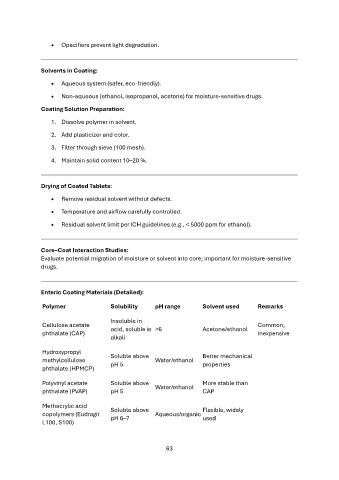
Enteric Coating Materials (Detailed):

Polymer               Solubility       pH range         Solvent used             Remarks

Cellulose acetate     Insoluble in                      Acetone/ethanol          Common,
phthalate (CAP)       acid, soluble in >6                                        inexpensive
                      alkali

Hydroxypropyl         Soluble above    Water/ethanol    Better mechanical
methylcellulose       pH 5                              properties
phthalate (HPMCP)

Polyvinyl acetate     Soluble above    Water/ethanol    More stable than
phthalate (PVAP)      pH 5                              CAP

Methacrylic acid      Soluble above    Aqueous/organic  Flexible,  widely
copolymers (Eudragit  pH 6–7                            used
L100, S100)

                                           63

