


Page 37 - phytotherapy_ EBOOK_2025
P. 37
Aloe

Definition
Aloe is the dried juice of the leaves of Aloe vera (L.) Burm. f. or of A. ferox Mill. and its
hybrids with A. africana Mill. and A. spicata Baker (Liliaceae).

Aloe Vera
Plant material of interest:
The active principles are obtained from an exudate, or latex or from a gel.
liquid gel
Aloe Vera Gel is not to be confused with the juice.
The gel derived from the leaf parenchyma after elimination of the more superficial tissues.
Juice
The bitter yellow exudate originating from the bundle sheath cells of the leaf.
Chemical Composition (The latex)
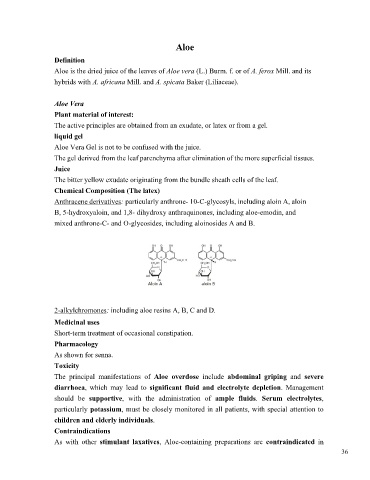
Anthracene derivatives: particularly anthrone- 10-C-glycosyls, including aloin A, aloin
B, 5-hydroxyaloin, and 1,8- dihydroxy anthraquinones, including aloe-emodin, and
mixed anthrone-C- and O-glycosides, including aloinosides A and B.

2-alkylchromones: including aloe resins A, B, C and D.

Medicinal uses
Short-term treatment of occasional constipation.
Pharmacology
As shown for senna.
Toxicity
The principal manifestations of Aloe overdose include abdominal griping and severe
diarrhoea, which may lead to significant fluid and electrolyte depletion. Management
should be supportive, with the administration of ample fluids. Serum electrolytes,
particularly potassium, must be closely monitored in all patients, with special attention to
children and elderly individuals.
Contraindications
As with other stimulant laxatives, Aloe-containing preparations are contraindicated in

                                                                                               36

