


Page 40 - phytotherapy_ EBOOK_2025
P. 40
It is contraindicated in breastfeeding mothers. Ricinoleic acid is absorbed into the
bloodstream and is excreted into human breast milk.
In suckling infants it has a purgative effect.
Children
It should not be used in children under the age of 12 years.
Warnings
As a cathartic: intake of cathartic drugs for more than a few days may lead to a worsening
of intestinal hypomotility. Overdose may lead to nausea, vomiting, painful abdominal
cramps and severe diarrhoea with loss of water and electrolytes.

Drug interactions
Concomitant use of castor oil with cardiac glycosides, antiarrhythmic drugs, diuretics,
cortisol, liquorice, antihistamines and fat-soluble vitamins may reduce the efficacy of these
drugs or, in the case of cardiac glycosides,
may increase the risk of adverse events due to fluid and electrolyte losses.

                                Psyllium seed

Definition
Semen Plantaginis is the dried, ripe seed of Plantago afra L., P. indica L., P. ovata Forsk.,
or P. asiatica L. (Plantaginaceae).
Chemical constituents
10–30% mucilaginous hydrocolloid, which is localized in the outer seed-coat (husk) and is
the major, active principle.
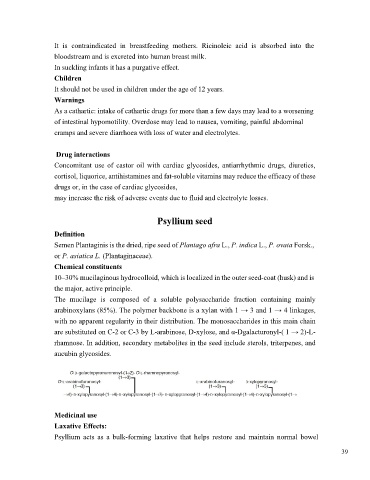
The mucilage is composed of a soluble polysaccharide fraction containing mainly
arabinoxylans (85%). The polymer backbone is a xylan with 1 → 3 and 1 → 4 linkages,
with no apparent regularity in their distribution. The monosaccharides in this main chain
are substituted on C-2 or C-3 by L-arabinose, D-xylose, and α-Dgalacturonyl-( 1 → 2)-L-
rhamnose. In addition, secondary metabolites in the seed include sterols, triterpenes, and
aucubin glycosides.

Medicinal use
Laxative Effects:
Psyllium acts as a bulk-forming laxative that helps restore and maintain normal bowel

                                                                                               39

