


Page 43 - phytotherapy_ EBOOK_2025
P. 43
Ipeca

Definition
It consists of the dried roots and rhizomes of Cephaelis ipecacuanha (Brot.) A. Rich., of
C. acuminata (Benth.) Karst. (Rubiaceae), or of a mixture of both species.
Chemical constituents
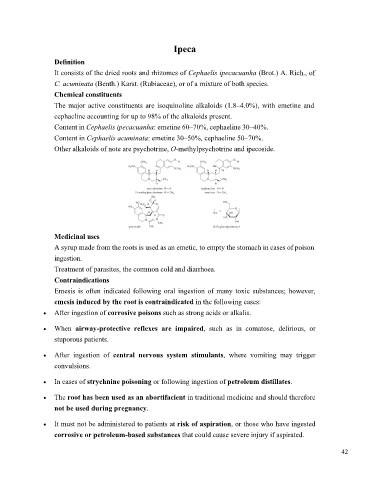
The major active constituents are isoquinoline alkaloids (1.8–4.0%), with emetine and
cephaeline accounting for up to 98% of the alkaloids present.
Content in Cephaelis ipecacuanha: emetine 60–70%, cephaeline 30–40%.
Content in Cephaelis acuminata: emetine 30–50%, cephaeline 50–70%.
Other alkaloids of note are psychotrine, O-methylpsychotrine and ipecoside.

    Medicinal uses
    A syrup made from the roots is used as an emetic, to empty the stomach in cases of poison
    ingestion.
    Treatment of parasites, the common cold and diarrhoea.
    Contraindications
    Emesis is often indicated following oral ingestion of many toxic substances; however,
    emesis induced by the root is contraindicated in the following cases:
• After ingestion of corrosive poisons such as strong acids or alkalis.

• When airway-protective reflexes are impaired, such as in comatose, delirious, or
    stuporous patients.

• After ingestion of central nervous system stimulants, where vomiting may trigger
    convulsions.

• In cases of strychnine poisoning or following ingestion of petroleum distillates.

• The root has been used as an abortifacient in traditional medicine and should therefore
    not be used during pregnancy.

• It must not be administered to patients at risk of aspiration, or those who have ingested
    corrosive or petroleum-based substances that could cause severe injury if aspirated.

                                                                                               42

