


Page 172 - Pharm.Org.Chem-I 02-06-05-101
P. 172
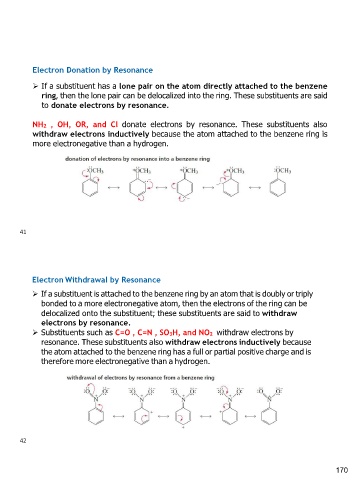
Electron Donation by Resonance
    ➢ If a substituent has a lone pair on the atom directly attached to the benzene

        ring, then the lone pair can be delocalized into the ring. These substituents are said
        to donate electrons by resonance.
    NH2 , OH, OR, and Cl donate electrons by resonance. These substituents also
    withdraw electrons inductively because the atom attached to the benzene ring is
    more electronegative than a hydrogen.

41

    Electron Withdrawal by Resonance
    ➢ If a substituent is attached to the benzene ring by an atom that is doubly or triply

        bonded to a more electronegative atom, then the electrons of the ring can be
        delocalized onto the substituent; these substituents are said to withdraw
        electrons by resonance.
    ➢ Substituents such as C=O , C=N , SO3H, and NO2 withdraw electrons by
        resonance. These substituents also withdraw electrons inductively because
        the atom attached to the benzene ring has a full or partial positive charge and is
        therefore more electronegative than a hydrogen.

42

                                                                                                                                  170

