


Page 219 - Atlas Sea Birds Ver1
P. 219
continued  to breed at the site until at least 2017, with a
                  maximum number of 44 pairs recorded in 1983. Although
                  White-breasted Cormorants have been recorded breeding
                  in all months of the year, there is a pronounced seasonal
                  pattern with the highest incidence of nesting from February
                  to July (Crawford et al. 2013).
                     Cape  Cormorants  were  first  recorded  breeding  at  the
                  site in 1995 when a single pair bred but the species only
                  sporadically breeds at the site with a maximum of six pairs
                  observed  in 2000.  During  winter the species  roosts on
                  the  cliffs  in  large  numbers  after feeding  in  coastal  lakes
                  during the day (Crawford et al. 2016).
                     Kelp  Gulls  were  first  recorded  breeding  at  the  site
                  in 1995 when four pairs were counted. The species has
                  consistently bred at the site since then with a maximum of
                  seven pairs in 2017.
                     A single Kelp Gull nest was seen at Sedgefield from van-
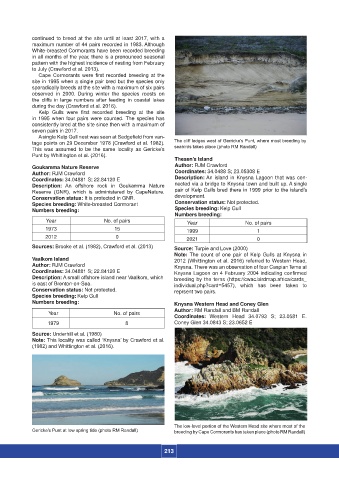
                  tage points on 29 December 1978 (Crawford et al. 1982).   The cliff ledges west of Gerricke’s Punt, where most breeding by
                  This was assumed  to  be the same locality  as Gericke’s   seabirds takes place (photo RM Randall)
                  Punt by Whittington et al. (2016).
                                                                    Thesen’s Island
                  Goukamma Nature Reserve                           Author: RJM Crawford
                  Author: RJM Crawford                              Coordinates: 34.0488 S; 23.05308 E
                  Coordinates: 34.04881 S; 22.84120 E               Description: An island  in Knysna Lagoon  that was con-
                  Description:  An  offshore  rock  in  Goukamma  Nature   nected via a bridge to Knysna town and built up. A single
                  Reserve  (GNR),  which  is  administered  by  CapeNature.   pair of Kelp Gulls bred there in 1999 prior to the island’s
                  Conservation status: It is protected in GNR.      development.
                  Species breeding: White-breasted Cormorant        Conservation status: Not protected.
                  Numbers breeding:                                 Species breeding: Kelp Gull
                                                                    Numbers breeding:
                       Year                 No. of pairs                 Year                No. of pairs
                       1973                    15                       1999                     1
                       2012                     0                       2021                     0
                  Sources: Brooke et al. (1982), Crawford et al. (2013)  Source: Turpie and Love (2000)
                                                                    Note:  The count of  one pair of  Kelp Gulls at  Knysna in
                  Vaalkom Island                                    2012 (Whittington et al. 2016) referred to Western Head,
                  Author: RJM Crawford                              Knysna. There was an observation of four Caspian Terns at
                  Coordinates: 34.04881 S; 22.84120 E               Knysna Lagoon on 4 February 2004 indicating confirmed
                  Description: A small offshore island near Vaalkom, which  breeding  by the terns (https://cwac.birdmap.africa/cards_
                  is east of Brenton-on-Sea.                        individual.php?card=5457),  which  has  been  taken  to
                  Conservation status: Not protected.               reprsent two pairs.
                  Species breeding: Kelp Gull
                  Numbers breeding:                                 Knysna Western Head and Coney Glen
                                                                    Author: RM Randall and BM Randall
                        Year                   No. of pairs
                                                                    Coordinates:  Western Head 34.0793 S;  23.0581 E.
                        1979                       8                Coney Glen 34.0843 S; 23.0652 E
                  Source: Underhill et al. (1980)
                  Note: This locality was called ‘Knysna’ by Crawford et al.
                  (1982) and Whittington et al. (2016).


                                                                    The low-level portion of the Western Head site where most of the
                  Gericke’s Punt at low spring tide (photo RM Randall)  breeding by Cape Cormorants has taken place (photo RM Randall)


                                                                 213

