


Page 302 - Atlas Sea Birds Ver1
P. 302
Northern Cape – (Diamond Coast Colonies)
                  1.   Buchu Twins
                  Coordinates: 28.756 S; 16.557 E
                  Status: Breeding
                  Description: This colony, the northernmost in South Africa,
                  is on the mainland of Alexander Bay. It was discovered in
                  the 1970s (Shaughnessy 1982) and the first aerial survey of
                  it was conducted in 1984. It was named after a nearby pair
                  of inselbergs, which are the major topographical features of
                  the adjacent Namaqua coast (Desmet and Cowling 1999).
                  The colony falls within a Critical Biodiversity Area (Harris
                  et al. 2022) and is situated on a steep and predominantly
                  rocky stretch of coast. Pupping occurs on the slope and on
                  adjacent coastal boulders. Surveys conducted soon after
                  discovery of the colony indicated that it was then mostly
                  used by immature seals (Oosthuizen and David 1988). It
                  is now a fully-fledged breeding colony stretching c. 1.4 km
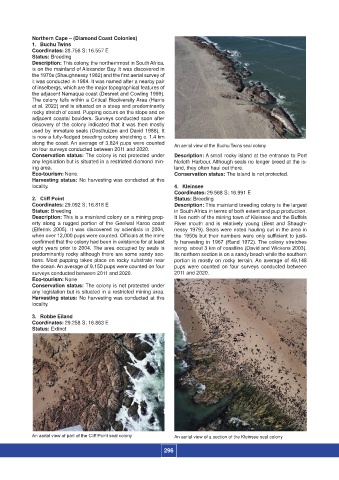
                  along the coast. An average of 3,824 pups were counted   An aerial view of the Buchu Twins seal colony
                  on four surveys conducted between 2011 and 2020.
                  Conservation status: The colony is not protected under   Description: A small rocky island at the entrance to Port
                  any legislation but is situated in a restricted diamond min-   Nolloth Harbour. Although seals no longer breed at the is-
                  ing area.                                         land, they often haul out there.
                  Eco-tourism: None.                                Conservation status: The island is not protected.
                  Harvesting status: No harvesting was conducted at this
                  locality.                                         4.   Kleinsee
                                                                    Coordinates: 29.568 S; 16.991 E
                  2.   Cliff Point                                  Status: Breeding
                  Coordinates: 29.092 S; 16.818 E                   Description: This mainland breeding colony is the largest
                  Status: Breeding                                  in South Africa in terms of both extent and pup production.
                  Description: This is a mainland colony on a mining prop-   It lies north of the mining town of Kleinsee and the Buffels
                  erty  along a rugged portion of  the Geelwal Karoo coast   River mouth and is relatively young (Best and Shaugh-
                  (Elferink  2005).  It  was  discovered  by  scientists  in  2004,   nessy 1979). Seals were noted hauling out in the area in
                  when over 12,000 pups were counted. Officials at the mine   the 1950s but their numbers were only sufficient to justi-
                  confirmed that the colony had been in existence for at least   fy harvesting in 1967 (Rand 1972). The colony stretches
                  eight years prior to 2004. The area occupied by seals is   along  about 3 km of coastline (David and Wickens 2003).
                  predominantly rocky although there are some sandy sec-   Its northern section is on a sandy beach while the southern
                  tions. Most pupping takes place on rocky substrate near   portion  is mostly on rocky terrain. An average  of 49,148
                  the ocean. An average of 9,150 pups were counted on four   pups  were  counted  on four surveys conducted  between
                  surveys conducted between 2011 and 2020.          2011 and 2020.
                  Eco-tourism: None
                  Conservation status: The colony is not protected under
                  any legislation but is situated in a restricted mining area.
                  Harvesting status: No harvesting was conducted at this
                  locality.
                  3.   Robbe Eiland
                  Coordinates: 29.258 S; 16.863 E
                  Status: Extinct


                  An aerial view of part of the Cliff Point seal colony  An aerial view of a section of the Kleinsee seal colony


                                                                 296

