


Page 305 - Atlas Sea Birds Ver1
P. 305
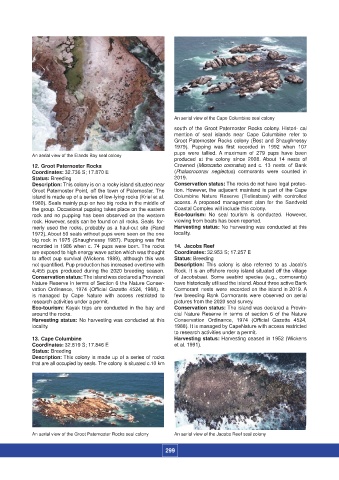
An aerial view of the Cape Columbine seal colony
                                                                    south of the Groot Paternoster Rocks colony. Histori- cal
                                                                    mention of  seal islands near Cape Columbine  refer to
                                                                    Groot Paternoster Rocks colony (Best and Shaughnessy
                                                                    1979).  Pupping  was  first  recorded  in  1992  when  107
                                                                    pups  were tallied. A  maximum  of 279 pups have been
                  An aerial view of the Elands Bay seal colony
                                                                    produced  at the colony  since 2008. About  14 nests of
                  12.  Groot Paternoster Rocks                      Crowned (Microcarbo coronatus) and c.  13  nests  of  Bank
                  Coordinates: 32.736 S; 17.870 E                   (Phalacrocorax neglectus)  cormorants  were  counted  in
                  Status: Breeding                                  2019.
                  Description: This colony is on a rocky island situated near   Conservation status: The rocks do not have legal protec-
                  Groot Paternoster Point, off the town of Paternoster. The   tion. However, the adjacent mainland is part of the Cape
                  island is made up of a series of low-lying rocks (Kriel et al.  Columbine  Nature  Reserve  (Tietiesbaai)  with  controlled
                  1980). Seals mainly pup on two big rocks in the middle of   access. A proposed management plan for the Sandveld
                  the group. Occasional pupping takes place on the eastern   Coastal Complex will include this colony.
                  rock and no pupping has been observed on the western   Eco-tourism:  No  seal  tourism is conducted.  However,
                  rock. However, seals can be found on all rocks. Seals  for-   viewing from boats has been reported.
                  merly used the rocks, probably as a haul-out site (Rand  Harvesting status: No harvesting was conducted at this
                  1972). About 50 seals without pups were seen on the one  locality.
                  big rock in 1975 (Shaughnessy 1987). Pupping was first
                  recorded in 1986 when c. 74 pups were born. The rocks   14.  Jacobs Reef
                  are exposed to high energy wave action which was thought   Coordinates: 32.953 S; 17.257 E
                  to affect pup survival (Wickens 1989), although this was   Status: Breeding
                  not quantified. Pup production has increased overtime with  Description: This colony is also referred to as Jacob’s
                  4,455 pups produced during the 2020 breeding  season.   Rock. It is an offshore rocky island situated off the village
                  Conservation status: The island was declared a Provincial   of  Jacobsbaai.  Some  seabird  species  (e.g.,  cormorants)
                  Nature Reserve in terms of Section 6 the Nature Conser-   have historically utilised the island. About three active Bank
                  vation  Ordinance,  1974  (Official  Gazette  4524,  1988).  It   Cormorant  nests  were  recorded on the island in 2019. A
                  is  managed  by  Cape Nature with access restricted to   few  breeding  Bank  Cormorants were observed on aerial
                  research activities under a permit.               pictures from the 2020 seal survey.
                  Eco-tourism: Kayak trips are conducted  in the bay and   Conservation status: The island was declared a Provin-
                  around the rocks.                                 cial Nature Reserve in terms of section 6 of the Nature
                  Harvesting status: No harvesting was conducted at this   Conservation  Ordinance,  1974  (Official  Gazette  4524,
                  locality.                                         1988). It is managed by CapeNature with access restricted
                                                                    to research activities under a permit.
                  13.  Cape Columbine                               Harvesting status: Harvesting ceased in 1952 (Wickens
                  Coordinates: 32.819 S; 17.846 E                   et al. 1991).
                  Status: Breeding
                  Description: This colony is made up of a series of rocks
                  that are all occupied by seals. The colony is situated c.10 km


                  An aerial view of the Groot Paternoster Rocks seal colony  An aerial view of the Jacobs Reef seal colony


                                                                 299

