


Page 310 - Atlas Sea Birds Ver1
P. 310
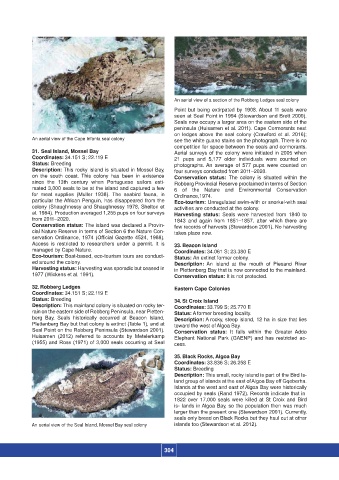
An aerial view of a section of the Robberg Ledges seal colony
                                                                    Point but being extirpated by 1908. About 11 seals were
                                                                    seen at Seal Point in 1994 (Stewardson and Brett 2000).
                                                                    Seals now occupy a larger area on the eastern side of the
                                                                    peninsula (Huisamen et al. 2011). Cape Cormorants nest
                                                                    on ledges above the seal colony (Crawford et al. 2016);
                  An aerial view of the Cape Infanta seal colony    see the white guano stains on the photograph. There is no
                                                                    competition for space between the seals and cormorants.
                  31.  Seal Island, Mossel Bay                      Aerial surveys of the colony were initiated in 2005 when
                  Coordinates: 34.151 S; 22.119 E                   21 pups and 5,177 older individuals  were counted on
                  Status: Breeding                                  photographs. An average  of 577 pups  were  counted  on
                  Description: This rocky island is situated in Mossel Bay,   four surveys conducted from 2011–2020.
                  on the south coast.  This colony has been in existence  Conservation status:  The colony is situated within  the
                  since  the  13th  century  when  Portuguese  sailors  esti-   Robberg Provincial Reserve proclaimed in terms of Section
                  mated 3,000 seals to be at the island and captured a few   6 of the Nature and  Environmental  Conservation
                  for  meat  supplies  (Muller  1938).  The  seabird  fauna,  in   Ordinance,1974.
                  particular the African Penguin, has disappeared from the   Eco-tourism: Unregulated swim-with or snorkel-with seal
                  colony (Shaughnessy and Shaughnessy 1978, Shelton et   activities are conducted at the colony.
                  al. 1984). Production averaged 1,255 pups on four surveys   Harvesting status:  Seals were harvested from 1840 to
                  from 2011–2020.                                   1843 and  again  from  1851–1857,  after  which there are
                  Conservation status: The island was declared a Provin-   few records of harvests (Stewardson 2001). No harvesting
                  cial Nature Reserve in terms of Section 6 the Nature Con-   takes place now.
                  servation Ordinance, 1974 (Official Gazette 4524, 1988).
                  Access is restricted to  researchers under a permit. It  is   33. Beacon Island
                  managed by Cape Nature.                           Coordinates: 34.061 S; 23.380 E
                  Eco-tourism: Boat-based, eco-tourism tours are conduct-   Status: An extinct former colony.
                  ed around the colony.                             Description:  An island  at the mouth of Piesand  River
                  Harvesting status: Harvesting was sporadic but ceased in  in Plettenberg Bay that is now connected to the mainland.
                  1977 (Wickens et al. 1991).                       Conservation status: It is not protected.

                  32. Robberg Ledges                                Eastern Cape Colonies
                  Coordinates: 34.151 S; 22.119 E
                  Status: Breeding                                  34. St Croix Island
                  Description: This mainland colony is situated on rocky ter-   Coordinates: 33.799 S; 25.770 E
                  rain on the eastern side of Robberg Peninsula, near Pletten-   Status: A former breeding locality.
                  berg  Bay. Seals  historically  occurred  at Beacon  Island,   Description: A rocky, steep island, 12 ha in size that lies
                  Plettenberg Bay but that colony is extinct (Table 1), and at   toward the west of Algoa Bay.
                  Seal Point on the Robberg Peninsula (Stewardson 2001).   Conservation status:  It  falls within the Greater  Addo
                  Huisamen  (2012)  referred  to  accounts  by  Metelerkamp   Elephant  National  Park  (GAENP) and  has  restricted  ac-
                  (1955) and Ross (1971) of 3,000 seals occurring at Seal   cess.

                                                                    35. Black Rocks, Algoa Bay
                                                                    Coordinates: 33.836 S; 26.258 E
                                                                    Status: Breeding
                                                                    Description: This small, rocky island is part of the Bird Is-
                                                                    land group of islands at the east of Algoa Bay off Gqeberha.
                                                                    Islands at the west and east of Algoa Bay were historically
                                                                    occupied by seals (Rand 1972). Records indicate that in
                                                                    1822 over 17,000 seals were killed at St Croix and Bird
                                                                    is-  lands in Algoa Bay, so the population then was much
                                                                    larger than the present one (Stewardson 2001). Currently,
                                                                    seals only breed on Black Rocks but they haul out at other
                  An aerial view of the Seal Island, Mossel Bay seal colony  islands too (Stewardson et al. 2012).


                                                                 304

