


Page 306 - Atlas Sea Birds Ver1
P. 306
Guano operations ceased in 1963 when staff were with-
                                                                    drawn from the island (Shelton et al. 1984). Seals recently
                                                                    recolonised the island following years of exclusion from it
                                                                    (Seakamela et al. 2016). Thirteen seals were spotted in
                                                                    1991, over 1,000 seals were recorded in 2003 and 10 pups
                                                                    were seen in 2004. The colony has since grown  rapidly
                                                                    and is now the second largest in South Africa in terms of
                                                                    pup production, after Kleinsee. An average of 20,688 pups
                                                                    were counted  on four surveys conducted  between  2011
                                                                    and 2020.
                                                                    Conservation status: The island was declared a Provin-
                                                                    cial Nature Reserve in terms of Section 6 the Nature Con-
                                                                    servation Ordinance, 1974 (Official Gazette 4524, 1988).
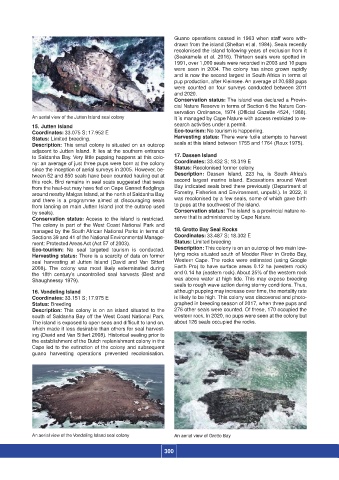
                  An aerial view of the Jutten Island seal colony   It is managed by Cape Nature with access restricted to re-
                  15.  Jutten Island                                search activities under a permit.
                  Coordinates: 33.075 S; 17.952 E                   Eco-tourism: No tourism is happening.
                  Status: Limited breeding.                         Harvesting status: There were futile attempts to harvest
                  Description: This small colony is situated on an outcrop   seals at this island between 1755 and 1764 (Roux 1975).
                  adjacent to Jutten Island. It lies at the southern entrance
                  to Saldanha Bay. Very little pupping happens at this colo-   17. Dassen Island
                  ny: an average of just three pups were born at the colony   Coordinates: 33.432 S; 18.319 E
                  since the inception of aerial surveys in 2005. However, be-   Status: Recolonised former colony.
                  tween 52 and 850 seals have been counted hauling out at   Description:  Dassen Island, 223 ha, is South  Africa’s
                  this rock. Bird remains in seal scats suggested that seals   second  largest marine island. Excavations around West
                  from the haul-out may have fed on Cape Gannet fledglings   Bay indicated seals bred there previously (Department of
                  around nearby Malgas Island, at the north of Saldanha Bay,   Forestry, Fisheries and Environment, unpubl.). In 2022, it
                  and there is a programme  aimed at  discouraging  seals   was recolonised by a few seals, some of which gave birth
                  from landing on main Jutten Island (not the outcrop used   to pups at the southwest of the island.
                  by seals).                                        Conservation status: The island is a provincial nature re-
                  Conservation status: Access to  the island  is restricted.   serve that is administered by Cape Nature.
                  The  colony  is  part  of the  West Coast National Park  and
                  managed by the South African National Parks in terms of   18. Grotto Bay Seal Rocks
                  Sections 39 and 41 of the National Environmental Manage-   Coordinates: 33.487 S; 18.302 E
                  ment: Protected Areas Act (Act 57 of 2003).       Status: Limited breeding
                  Eco-tourism:  No seal  targeted tourism  is conducted.   Description: This colony is on an outcrop of two main low-
                  Harvesting status: There is a scarcity of data on former   lying rocks situated south of Modder River in Grotto Bay,
                  seal harvesting at Jutten Island (David and Van Sittert  Western Cape. The rocks were estimated (using Google
                  2008).  The  colony  was  most  likely  exterminated  during   Earth Pro) to have surface areas 0.12 ha (western rock)
                  the  18th  century’s  uncontrolled  seal harvests (Best  and   and 0.14 ha (eastern rock). About 25% of the western rock
                  Shaughnessy 1979).                                was above water at high tide. This may expose breeding
                                                                    seals to rough wave action during stormy conditions. Thus,
                  16. Vondeling Island                              although pupping may increase over time, the mortality rate
                  Coordinates: 33.151 S; 17.975 E                   is likely to be high. This colony was discovered and photo-
                  Status: Breeding                                  graphed in breeding season of 2017, when three pups and
                  Description: This colony  is on an island  situated to  the   276 other seals were counted. Of these, 170 occupied the
                  south of Saldanha Bay off the West Coast National Park.   western rock. In 2020, no pups were seen at the colony but
                  The island is exposed to open seas and difficult to land on,   about 126 seals occupied the rocks.
                  which made it less desirable than others for seal harvest-
                  ing (David and Van Sittert 2008). Historical sealing prior to
                  the establishment of the Dutch replenishment colony in the
                  Cape led to the extinction of the colony and subsequent
                  guano harvesting operations prevented recolonisation.


                  An aerial view of the Vondeling Island seal colony  An aerial view of Grotto Bay


                                                                 300

