


Page 303 - Atlas Sea Birds Ver1
P. 303
Conservation status: The colony is not protected under
                  any legislation but is situated in a restricted mining area.
                  However, mining effort has significantly reduced, which led
                  to an increase in illegal activity in the vicinity of the colony
                  (Dyk 2021), including poaching.
                  Eco-tourism: The colony was visited as part of the Dia-
                  mond Route tourism operation when De  Beers  still con-
                  ducted mining operations. Although no tourism activity now
                  takes place, efforts are underway to resuscitate seal tour-
                  ism to this colony.
                  Harvesting status: Harvesting ceased in 1989 (Wickens
                  et al. 1991).

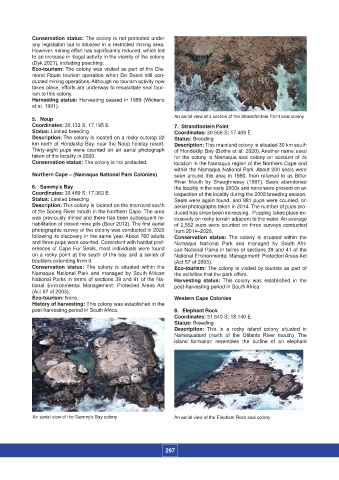
                  5.   Noup                                         An aerial view of a section of the Strandfontein Point seal colony
                  Coordinates: 30.133 S; 17.195 E                   7.  Strandfontein Point
                  Status: Limited breeding                          Coordinates: 30.556 S; 17.409 E
                  Description: The colony is located on a rocky outcrop 22   Status: Breeding
                  km north of Hondeklip Bay, near the Noup holiday resort.   Description: This mainland colony is situated 30 km south
                  Thirty-eight  pups were  counted  on an aerial  photograph   of Hondeklip Bay (Botha et al. 2020). Another name used
                  taken of the locality in 2020.                    for the colony is Namaqua seal colony on account of its
                  Conservation status: The colony is not protected.  location in the Namaqua region of the Northern Cape and
                                                                    within the Namaqua National Park. About 200 seals were
                  Northern Cape – (Namaqua National Park Colonies)  seen around this area in 1980, then referred to as Bitter
                                                                    River  Mouth  by  Shaughnessy  (1987).  Seals  abandoned
                  6.   Sammy’s Bay                                  the locality in the early 2000s and none were present on an
                  Coordinates: 30.489 S; 17.363 E                   inspection of the locality during the 2008 breeding season.
                  Status: Limited breeding                          Seals were again found, and 981 pups were counted, on
                  Description: This colony is located on the mainland south   aerial photographs taken in 2014. The number of pups pro-
                  of the Spoeg River mouth in the Northern Cape. The area   duced has since been increasing.  Pupping takes place ex-
                  was previously mined and there has been subsequent re-   clusively on rocky terrain adjacent to the water. An average
                  habilitation of closed mine pits (Beer 2012). The first aerial   of 2,552 pups were counted on three surveys conducted
                  photographic survey of the colony was conducted in 2020   from 2014–2020.
                  following its discovery in the same year. About 760 adults   Conservation status:  The colony is situated  within  the
                  and three pups were counted. Consistent with habitat pref-   Namaqua National Park  and managed by  South  Afri-
                  erences of Cape Fur Seals, most individuals were found   can National Parks in terms of sections 39 and 41 of the
                  on a rocky point at the south of the bay and a series of   National Environmental Management: Protected Areas Act
                  boulders extending from it.                       (Act 57 of 2003).
                  Conservation status:  The colony is situated  within  the   Eco-tourism: The colony is visited by tourists as part of
                  Namaqua  National  Park and  managed  by South African   the activities that the park offers.
                  National Parks in terms of sections 39 and 41 of the Na-   Harvesting status:  This colony was established  in the
                  tional Environmental Management:  Protected  Areas  Act   post-harvesting period in South Africa.
                  (Act 57 of 2003).
                  Eco-tourism: None.                                Western Cape Colonies
                  History of harvesting: This colony was established in the
                  post-harvesting period in South Africa.           8.   Elephant Rock
                                                                    Coordinates: 31.640 S; 18.140 E
                                                                    Status: Breeding
                                                                    Description:  This is a rocky island  colony  situated in
                                                                    Namaqualand  (north  of  the  Olifants  River  mouth).  The
                                                                    island  formation resembles  the outline  of  an elephant


                  An aerial view of the Sammy’s Bay colony          An aerial view of the Elephant Rock seal colony


                                                                 297

