


Page 304 - Atlas Sea Birds Ver1
P. 304
facing  north  when  viewed  from  the  west  (Brooke,  1986).   the shore of Lambert’s Bay but was artificially joined to the
                  Seals have bred at this locality since at least 1828 (Best   mainland  by  a  causway  (Jarvis  and  Cram  1971).  It  was
                  and  Shaughnessy  1979)  and  have  historically  coexisted   historically  a  seabird  breeding  island  (hence  the  name)
                  with  seabirds  there. Cape  (Phalacrocorax  capensis)  and   that was occasionally used by seals (Rand 1972). About
                  Crowned  (Microcarbo  coronatus)  cormorants  bred  at the   17 seals  without  pups were seen in 1974  but  pupping
                  island and guano harvesting was conducted there (Zeed-   commenced  in  the  1980s  (Oosthuizen  and  David  1988),
                  erberg, 1924; Brooke, 1986). In the past, a cable car sys-   through the natural immigration  of  seals. A  disturbance
                  tem allowed access to the island during harvesting, but this   program was conducted outside the seal breeding season
                  has since become unserviceable  and has disintegrated.   to discourage  their settlement but was unsuccessful.
                  The locality is now predominantly a seal breeding colony,   However, the seals have been prevented from encroaching
                  although some cormorants can be seen roosting. An aver-   on  the  main breeding  areas of  Cape Gannets (Morus
                  age of 3,492 pups were counted on four surveys conducted   capensis) and cormorants.
                  between 2011 and 2020.                            Conservation status:  The island forms part of  the Bird
                  Conservation status: The island was declared a Provin-   Island Nature Reserve. It was declared as such in terms
                  cial Nature Reserve in terms  of  Section 6 the Nature     of section 6 of the Nature Conservation Ordinance, 1974
                  Con-  servation  Ordinance,  1974  (Official  Gazette  4524,   (Official Gazette 4524, 1988). There is controlled access
                  1988).  The  adjacent  mainland  is  a  mining  area  with   to the island, but visitors are not allowed to approach the
                  restricted access.                                seal colony closely.
                  Eco-tourism: None.                                Eco-tourism: The island is open to the public for viewing
                  Harvesting status: Harvesting ceased in 1976 (Wickens  of Cape Gannets from a purpose-built vantage point. This
                  et al. 1991).                                     facility reduces disturbance to the fauna.
                                                                    Harvesting status:  No harvesting  has been  conducted
                  9.   Cape Donkin                                  at this locality.
                  Coordinates: 31.913 S; 18.274 E
                  Status: Limited breeding                          11.  Elands Bay
                  Description: This mainland, rocky colony was discovered   Coordinates: 32.309 S 18.309 E
                  and photographed in December 2020. It is situated on the   Status: Limited breeding
                  south point of Donkin’s Bay, north of Lambert’s Bay in the   Description: This rocky haul-out  site is situated on the
                  Western Cape Province of South Africa. It has large boul-   south  point  (Cape  Deseada)  of  Eland’s  Bay.  The  colo-
                  ders  and  crevices  that provide  shaded  areas  for seals   ny lies opposite a gravel road that connects the town of
                  to rest in. Higher  boulders  had discolouration  consistent   Elands Bay with others to the south. The town’s residents
                  with the  effect  of  seabird  guano  droppings. About  1,064   are heavily dependent on fishing, which has led to seal-
                  seals and 10 pups were counted on aerial photos taken   human  conflicts  and  regular  disturbance  of  the  colony.
                  in  2020.  However,  there were more seals than those   Consequently, it is mostly occupied by adult seals. Aerial
                  captured on the images. Seals reacted to the helicopter and   surveys of the colony since 2008 indicated that between
                  entered the sea as the pilot was lining up for a better angle.   246 and 496 adult seals used the area during the breeding
                  Conservation status: Limited access and activities as it   season. Production has not surpassed 45 pups since the
                  falls within an isolated, privately owned area.   commencement of surveys in 2008.
                  Eco-tourism: None.                                Conservation status: There is unrestricted access to the
                  Harvesting status:  This colony was established  in the  colony due to its vicinity to the road into the town. Tourists
                  post-harvesting period in South Africa.           may approach the colony and it has also been subjected to
                                                                    deliberate disturbance due to perceived competition with
                  10.  Lambert’s Bay (Bird Island)                  local fisheries. Breeding is unlikely to be sustained unless
                                                                    the area is fenced off.
                  Coordinates: 32.088 S; 18.301 E                   Eco-tourism: Opportunistic tourism.
                  Status: Breeding
                  Description: This locality was an island about 100 m off   Harvesting status:  This colony was established  in the
                                                                    post-harvesting period in South Africa.


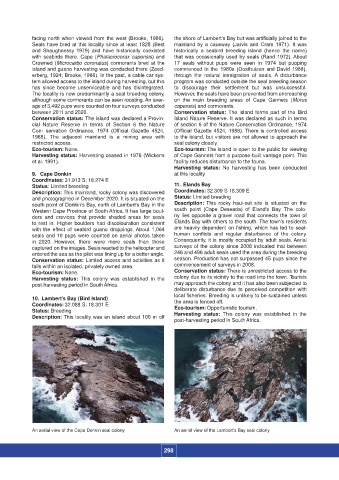
                  An aerial view of the Cape Donkin seal colony     An aerial view of the Lambert’s Bay seal colony


                                                                 298

