


Page 309 - Atlas Sea Birds Ver1
P. 309
Eco-tourism: Boat-based, eco-tourism tours are conduct-
                                                                    ed around Dyer and Geyser islands.
                                                                    Harvesting status: Harvesting ceased in 1984 (Wickens
                                                                    et al. 1991).

                                                                    29. Quoin Rock
                                                                    Coordinates: 34.786 S; 19.668 E
                                                                    Status: Breeding
                                                                    Description: This rocky island is situated east  of  Quoin
                  An aerial view of the Seal Island, False Bay seal colony  Point in the Bredasdorp district on the south coast. Pupping
                  Ecotourism: Regulated shark cage diving operations are   was observed in the early 1900s, when seals displaced
                                                                    a  colony  of  Great  White  Pelicans  (Rand  1963).  Guano
                  conducted around the island and tourists are given a tour   harvesting  was conducted  at this island.  On average,
                  around the colony. Direct seal tourism has also been con-
                  ducted.                                           1,807  pups were born  on four surveys from 2011–2014.
                  Harvesting status: Harvesting ceased in 1984 (Wickens  Conservation status:  The island was declared  a
                  et al. 1991).                                     Provincial  Nature Reserve  in terms of Section  6 of the
                                                                    Nature  Conservation  Ordinance,  1974  (Official  Gazette
                                                                    4524, 1988). Access is  restricted  to  researchers  under  a
                  27. Romans Bay                                    permit. It is managed by Cape Nature.
                  Coordinates: 34.687 S; 19.408 E                   Eco-tourism: No eco-tourism is currently conducted at or
                  Status: Limited breeding                          around the colony.
                  Description:  A  bay on the north of  Danger Point.   Harvesting status: Harvesting ceased in 1984 (Wickens
                  A  few pups were observed on rocks at the site in 2022.   et al. 1991).
                  Conservation status: It is not protected.
                                                                    30. Cape Infanta
                  28. Geyser Rock                                   Coordinates: 34.459 S; 20.868 E
                  Coordinates: 34.687 S; 19.408 E                   Status: Limited breeding
                  Status: Breeding                                  Description: This mainland colony is situated to the east
                  Description:  This  rocky  island  is  situated  off  the  south   of the Cape Infanta lighthouse on the south coast. It was
                  coast near Gansbaai. It lies adjacent to Dyer Island, which   discovered in 2015 but surveyed for the first time in 2019,
                  is predominantly a seabird island. The two are separated by   when about 170 seals and two pups were counted on aerial
                  a shallow channel that is 230 m wide and called Shark Alley   pictures. In 2020, about 218 seals were counted on pic-
                  (Johnson et al. 2009). The proximity of the two islands has   tures, but no pups were seen.
                  led to adverse interactions between seals and seabirds in   Conservation status: The colony is situated within the De
                  the water (Makhado et al. 2013). On the island itself, seals   Hoop Nature Reserve which was proclaimed as a Provin-
                  have outcompeted seabirds  such as  African Penguins   cial Nature Reserve in 1976 by Proclamation No. 409/1976.
                  (Spheniscus demersus) (Crawford et al. 2011) and White-   The boundary of the nature reserve was extended in 1990
                  breasted Cormorants (Crawford 2007) for breeding space.   by way of Proclamation No. 29 of 1990 in terms of the Na-
                  A few Bank Cormorants  still breed  at  the island.  Guano   ture and Environmental  Conservation Ordinance,  1974
                  was harvested at the island, suggesting that a substantial   (Ordinance 19 of 1974) (CapeNature 2016). It is managed
                  number  of guano-producing  birds previously  bred on it.   by Cape Nature.
                  However, since the 1950s the island was predominantly a   Eco-tourism:  No seal-targeted tourism is conducted.
                  seal colony (Rand 1963, Shelton et al. 1984). Pup produc-   Harvesting status:  This colony was established  in the
                  tion at the colony was stable from 2011–2014, averaging   post-harvesting period in South Africa
                  9,821 pups for four surveys conducted in this period.
                  Conservation status: The island was declared a Provin-
                  cial Nature Reserve in terms of Section 6 of the Nature
                  Conservation  Ordinance,  1974  (Official  Gazette  4524,
                  1988). Access is restricted to researchers under a permit.
                  It  is managed by Cape Nature.


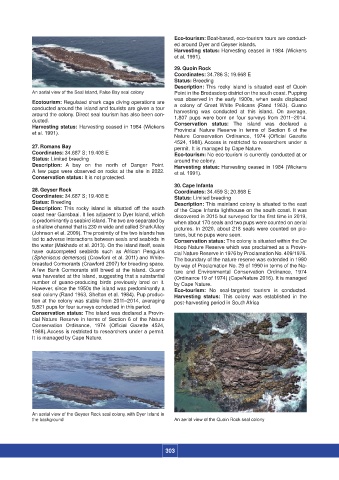
                  An aerial view of the Geyser Rock seal colony, with Dyer Island in
                  the background                                    An aerial view of the Quoin Rock seal colony


                                                                 303

