


Page 551 - Atlas Sea Birds Ver1
P. 551
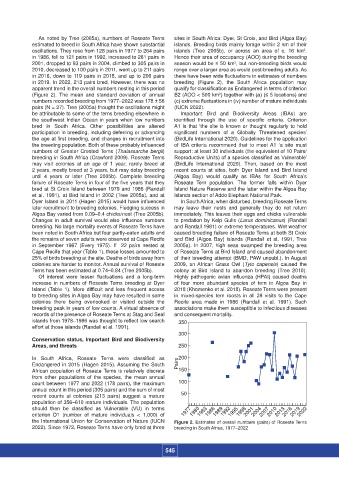
As noted by Tree (2005a), numbers of Roseate Terns   sites in South Africa: Dyer, St Croix, and Bird (Algoa Bay)
                  estimated to breed in South Africa have shown substantial   islands. Breeding birds mainly forage within 2 km of their
                  oscillations. They rose from 128 pairs in 1977 to 264 pairs   islands (Tree 2005b), or across  an area of  c.  16 km .
                                                                                                                  2
                  in 1986, fell to 121 pairs in 1992, increased to 261 pairs in   Hence their area of occupancy (AOO) during the breeding
                  2001, dropped to 93 pairs in 2004, climbed to 305 pairs in   season would be ≤ 50 km , but non-breeding birds would
                                                                                         2
                  2010, decreased to 100 pairs in 2011, went up to 211 pairs   range over a larger area as would post-breeding adults. As
                  in 2016, down to 119 pairs in 2018, and up to 206 pairs   there have been wide fluctuations in estimates of numbers
                  in 2019. In 2022, 213 pairs bred. However, there was no   breeding  (Figure 2), the South  Africa population  may
                  apparent trend in the overall numbers nesting in this period   qualify for classification as Endangered in terms of criterion
                  (Figure 2).  The mean and standard deviation  of annual   B2 (AOO < 500 km ) together with (a) (≤ 5 locations) and
                                                                                    2
                  numbers recorded breeding from 1977–2022 was 178 ± 56   (c) extreme fluctuations in (iv) number of mature individuals
                  pairs (N = 27). Tree (2005a) thought the oscillations might   (IUCN 2022).
                  be attributable to some of the terns breeding elsewhere in   Important Bird and Biodiversity  Areas (IBAs) are
                  the southwest Indian Ocean in years when low numbers   identified  through  the  use  of  specific  criteria.  Criterion
                  bred  in South  Africa. Other possibilities  are altered   A1 is that ‘the site is known or thought regularly to hold
                  participation in breeding, including deferring or advancing   significant  numbers  of  a  Globally  Threatened  species’
                  the age at first breeding, and changes in recruitment into   (BirdLife International 2020). Guidelines for the application
                  the breeding population. Both of these probably influenced   of IBA criteria  recommend  that to meet A1 ‘a site must
                  numbers of Greater Crested Terns (Thalassarche  bergii)   support: at least 30 individuals (the equivalent of 10 Pairs/
                  breeding in South Africa (Crawford 2009). Roseate Terns   Reproductive Units) of a species classified as Vulnerable’
                  may  visit  colonies  at  an age of  1  year,  rarely breed at    (BirdLife  International  2020).  Then, based  on the most
                  2 years, mostly breed at 3 years, but may delay breeding   recent counts at sites, both Dyer Island and Bird Island
                  until  4 years or later (Tree 2005b). Complete  breeding   (Algoa Bay) would  qualify as IBAs for South  Africa’s
                  failure of Roseate Terns in four of the five years that they   Roseate  Tern population.  The former falls within Dyer
                  bred at St Croix Island between 1979 and 1986 (Randall   Island Nature Reserve and the latter within the Algoa Bay
                  et al. 1991), at Bird Island in 2002 (Tree 2005a), and at   Islands section of Addo Elephant National Park.
                  Dyer Island in 2011 (Hagen 2015) would have influenced   In South Africa, when disturbed, breeding Roseate Terns
                  later recruitment to breeding colonies. Fledging success in   may leave their nests and generally they do not return
                  Algoa Bay varied from 0.09–0.4 chicks/nest (Tree 2005b).   immediately. This leaves their eggs and chicks vulnerable
                  Changes  in  adult  survival  would  also  influence  numbers   to predation by Kelp Gulls (Larus dominicanus) (Randall
                  breeding. No large mortality events of Roseate Terns have   and Randall 1981) or extreme temperatures. Wet weather
                  been noted in South Africa but four partly-eaten adults and   caused breeding failure of Roseate Terns at both St Croix
                  the remains of seven adults were observed at Cape Recife   and Bird (Algoa  Bay) islands  (Randall  et al. 1991,  Tree
                  in September 1967 (Every 1975). If   22 pairs nested at   2005a). In 2007, high seas swamped the breeding  area
                  Cape Recife that year (Table 1), these losses amounted to   of Roseate Terns at Bird Island and caused abandonment
                  25% of birds breeding at the site. Deaths of birds away from   of their breeding attempt (BMD, PAW unpubl.). In August
                  colonies are harder to monitor. Annual survival of Roseate   2009, an African Grass  Owl (Tyto  capensis)  caused the
                  Terns has been estimated at 0.74–0.84 (Tree 2005b).  colony  at Bird Island  to abandon  breeding  (Tree 2010).
                     Of  interest  were  lesser  fluctuations  and  a  long-term   Highly  pathogenic  avian  influenza  (HPAI)  caused  deaths
                  increase in numbers of  Roseate Terns breeding at  Dyer   of four more abundant  species of tern in  Algoa  Bay in
                  Island  (Table  1).  More  difficult  and  less  frequent  access   2018 (Khomenko et al. 2018). Roseate Terns were present
                  to breeding sites in Algoa Bay may have resulted in some   in  mixed-species  tern  roosts  in  all  28  visits  to  the  Cape
                  colonies  there being  overlooked or visited  outside  the   Recife area made in 1986 (Randall et al. 1991). Such
                  breeding peak in years of low counts. A virtual absence of   associations make them susceptible to infectious diseases
                  records of the presence of Roseate Terns at Stag and Seal   and consequent mortality.
                  islands from 1978–1986 was thought to reflect low search   350
                  effort at those islands (Randall et al. 1991).
                                                                      300
                  Conservation status, Important Bird and Biodiversity
                  Areas, and threats                                  250
                  In  South  Africa,  Roseate  Terns  were  classified  as   200
                  Endangered in 2015 (Hagen 2015). Assuming the South   Pairs
                  African population of Roseate Terns is relatively discrete   150
                  from other populations  of the species, the mean annual
                  count between 1977 and 2022 (178 pairs), the maximum   100
                  annual count in this period (305 pairs) and the sum of most
                  recent counts at colonies  (213 pairs) suggest a mature   50
                  population of 356–610 mature individuals. The population
                  should  then  be  classified  as  Vulnerable  (VU)  in  terms   1977  1980  1983  1986  1989  1992  1998  2019  2022
                  criterion D1 (number of mature individuals  < 1,000) of               1995  2001  2004  2007  2010  2013  2016
                  the International Union for Conservation of Nature (IUCN   Figure 2. Estimates of overall numbers (pairs) of Roseate Terns
                  2022). Since 1972, Roseate Terns have only bred at three   breeding in South Africa, 1977–2022


                                                                 545

