


Page 555 - Atlas Sea Birds Ver1
P. 555
3.16  Numbers,  trends, status, and conservation of Damara Tern
                           (Sternula balaenarum) in Namibia and Angola


                  Authors: RJ Braby,  RJM Crawford, S Braby, RE Simmons, and J Braby


                  Abstract:
                  Damara Terns (Sternula balaenarum), endemic to the Benguela ecosystem, are known to have bred at 57 localities in Namibia and one
                  in south Angola. They also bred in South Africa. The most up-to-date estimates at colonies suggested that in 2021/22 minima of 715 pairs
                  bred in Namibia and six pairs in Angola, or c. 92% and c. 1% of the species’ population, derived from colony counts, respectively. This
                  number was 23% lower than minima of 930 pairs in Namibia and six pairs in Angola derived from colony counts 11 years earlier in 2010.
                  Generation length (G) for Damara Terns was 12.33 years, so the 23% decrease equates to 77% in 3G. A comparison of the minimum
                  numbers of adults estimated to occur in Namibia in1991 and 2021/22 (a period of 30 years) suggested that it decreased by 52%, equivalent
                  to 64% in 3G. Both results support a re-classification of Damara Terns in Namibia and Angola as Endangered (EN) in terms of International
                  Union for Conservation of Nature Red List criteria. In the 1990s, it was estimated from stratified, random sampling along 95% of the ~1,570
                  km coast that about 14,000 Damara Terns occurred in the region, of which 63% bred. Hence, colony counts may only cover c. 60% of the
                  population. However, since no repeat random sampling has been conducted, nest counts at colonies and estimates of minimum numbers
                  of adults breeding are the best gauges of population trends. The most recent estimates of numbers at colonies suggested that 31 breeding
                  localities in Namibia and one in Angola held ≥ 5 pairs and so met that criterion for an Important Bird Area for an EN species.The largest
                  colony was at Caution Reef, Namibia, which had 147 pairs or c. 19% of the colony-derived population. Damara Terns have a relatively late
                  age at maturity, so factors influencing survival, such as anthropogenic threats, may cause population decreases. Reproductive success
                  decreased between 1991 and 2010, when it was thought to be insufficient to maintain the population. This parameter is influenced by loss
                  of habitat to development, disturbance at colonies, attraction of predators to colonies, and tidal flooding of breeding areas.

                  Introduction:
                  Damara Terns (Sternula balaenarum) are a breeding endemic to southern Africa, where they breed around the coast from the Baia dos
                  Tigres, in southern Angola to the Alexandria Dunefields, in South Africa’s Eastern Cape Province (Figure 1). About 98% of the population
                  nests in Namibia (Crawford and Simmons 1997, Braby 2011). After breeding, the majority leave the area for their non-breeding grounds
                  farther north in Africa, mostly in West Africa (Simmons 2005).
                     This chapter collates information on numbers of Damara Terns at different localities in Angola and Namibia to examine trends in
                  species abundance. It re-assesses the Red List status of, identifies Important Bird and Biodiversity Areas (IBAs) for, and summarises
                  threats to this species in the northern Benguela ecosystem.
                  Numbers of birds and breeders

                  The  overall  population  of  Damara  Terns  is  difficult  to
                  estimate on account of its widely  dispersed  breeding
                  colonies  in largely  inaccessible  habitat, especially  in
                  Namibia (Braby et al. 1992). Estimates of numbers have
                  been derived from counts of individuals (Braby et al. 1992,
                  Simmons 2010),  counts of  pairs or  nests  at  all known
                  colonies (Braby 2011), and from stratified, random sampling
                  (Simmons 1993, Simmons et al. 1998). A flock of at least
                  5,068 Damara Terns was counted on photographs taken
                  about 178 km south of the Cunene River in March 1991
                  (Braby et al. 1992). After accounting for birds observed in
                  two separate flocks farther south, the proportion of birds
                  in immature plumage in flocks (c. 20%, distinguished from
                  dark-headed adults by their white foreheads and browner
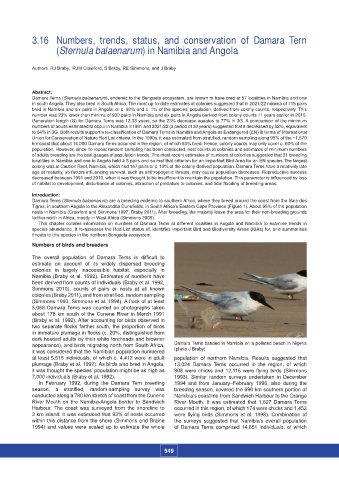
                  appearance), and birds migrating north from South Africa,   Damara Terns banded in Namibia on a polluted beach in Nigeria
                  it was considered that the Namibian population numbered   (photo J Braby)
                  at least 5,515 individuals, of which c. 4,412 were in adult   population  of northern  Namibia.  Results suggested  that
                  plumage (Braby et al. 1992). As birds also bred in Angola,   13,024 Damara  Terns occurred in the region, of which
                  it was thought the species’ population might be as high as   908 were chicks and 12,116 were flying birds (Simmons
                  7,000 individuals (Braby et al. 1992).            1993). Similar random surveys undertaken  in December
                     In  February  1992,  during  the  Damara  Tern  breeding   1994  and  from  January–February  1996,  also  during  the
                  season,  a  stratified,  random-sampling  survey  was   breeding season, covered the 690 km southern portion of
                  conducted along a 780 km stretch of coast from the Cunene   Namibia’s coastline from Sandwich Harbour to the Orange
                  River  Mouth  on  the  Namibia-Angola  border  to  Sandwich   River  Mouth.  It  was  estimated  that  1,627  Damara  Terns
                  Harbour.  The coast was  surveyed  from the shoreline  to   occurred in this region, of which 174 were chicks and 1,453
                  3 km inland. It was estimated that 93% of nests occurred   were  flying  birds  (Simmons  et  al.  1998).  Combination  of
                  within this distance from the shore (Simmons and Braine   the surveys suggested that  Namibia’s overall population
                  1994)  and values  were scaled  up to estimate the whole   of  Damara Terns comprised 14,651 individuals,  of  which


                                                                 549

