


Page 557 - Atlas Sea Birds Ver1
P. 557
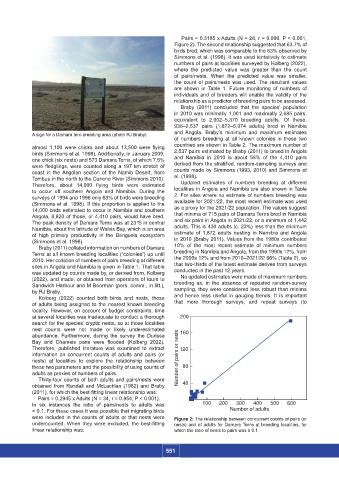
Pairs = 0.3185 x Adults (N = 28, r = 0.990, P < 0.001,
                                                                    Figure 2). The second relationship suggested that 63.7% of
                                                                    birds bred, which was comparable to the 63% observed by
                                                                    Simmons et al. (1998). It was used tentatively to estimate
                                                                    numbers of pairs at localities surveyed by Kolberg (2022),
                                                                    where the predicted  value was greater than the count
                                                                    of pairs/nests. When the predicted value was smaller,
                                                                    the count of pairs/nests was used.  The resultant  values
                                                                    are  shown  in  Table  1.  Future  monitoring  of  numbers  of
                                                                    individuals and of breeders will enable the validity of the
                                                                    relationship as a predictor of breeding pairs to be assessed.
                                                                      Braby (2011) concluded  that the species’ population
                                                                    in 2010 was minimally 1,001 and maximally 2,685 pairs,
                                                                    equivalent  to 2,002–5,370  breeding  adults. Of these,
                                                                    936–2,537  pairs  (1,872–5,074  adults)  bred  in  Namibia
                  A sign for a Damara tern breeding area (photo RJ Braby)  and  Angola.  Braby’s minimum  and  maximum  estimates
                                                                    of  numbers breeding at  all known colonies in these two
                  almost  1,100  were  chicks  and  about  13,500  were  flying   countries are shown in Table 2. The maximum number of
                  birds (Simmons et al. 1998). Additionally, in January 2009,   2,537 pairs estimated by Braby (2011) to breed in Angola
                  one chick (six nests) and 573 Damara Terns, of which 7.5%   and  Namibia  in  2010  is  about  58%  of  the  4,410  pairs
                  were fledglings, were counted along a 197 km stretch of   derived from the stratified, random-sampling surveys and
                  coast in the Angolan  section of the Namib Desert, from   counts made by Simmons (1993, 2010) and Simmons et
                  Tombua in the north to the Cunene River (Simmons 2010).   al. (1998).
                  Therefore,  about  14,000  flying  birds  were  estimated   Updated  estimates  of  numbers  breeding  at  different
                  to  occur  off  southern  Angola  and  Namibia.  During  the   localities in Angola and Namibia are also shown in Table
                  surveys of 1994 and 1996 only 63% of birds were breeding   2. For sites where no estimate of numbers breeding was
                  (Simmons et al. 1998). If this proportion is applied to the   available for 2021/22, the most recent estimate was used
                  14,000 birds estimated to occur in Namibia and southern   as a proxy for the 2021/22 population. The values suggest
                  Angola, 8,820 of those, or 4,410 pairs, would have bred.   that minima of 715 pairs of Damara Terns bred in Namibia
                  The peak density of Damara Terns was at 23°S in central   and six pairs in Angola in 2021/22, or a minimum of 1,442
                  Namibia, about the latitude of Walvis Bay, which is an area   adults. This is 430 adults (c. 23%) less than the minimum
                  of  high primary productivity in the  Benguela ecosystem   estimate  of  1,872  adults  nesting  in  Namibia  and Angola
                  (Simmons et al. 1998).                            in 2010 (Braby 2011). Values from the 1980s contributed
                     Braby (2011) collated information on numbers of Damara   10% of the most recent estimate of minimum  numbers
                  Terns at all known breeding localities (“colonies”) up until   breeding in Namibia and Angola, from the 1990s 12%, from
                  2010. Her collation of numbers of pairs breeding at different   the 2000s 12% and from 2010–2021/22 66% (Table 2), so
                  sites in Angola and Namibia is given in Table 1. That table   that two-thirds of the latest estimate derives from surveys
                  was updated by counts made by, or derived from, Kolberg   conducted in the past 12 years.
                  (2022), and made, or obtained from operators of tours to   No updated estimates were made of maximum numbers
                  Sandwich Harbour and M Boorman (pers. comm., in litt.),   breeding  as, in  the absence  of repeated  random-survey
                  by RJ Braby.                                      sampling, they were considered less robust than minima
                     Kolberg  (2022)  counted  both birds  and  nests, those   and  hence  less  useful  in  gauging  trends.  It  is  important
                  of  adults being assigned to  the nearest known breeding   that more thorough surveys, and repeat surveys (to
                  locality. However, on account of budget constraints, time
                  at several localities was inadequate to conduct a thorough   200
                  search for the species’ cryptic nests, so at those localities
                  nest counts were not made or likely underestimated
                  abundance.  Furthermore,  during  the  survey  the  Durissa   160
                  Bay  and  Chameis  pans  were  flooded  (Kolberg  2022).
                  Therefore, published  literature was examined to  extract   120
                  information  on concurrent  counts of adults and pairs (or
                  nests) at  localities to  explore the relationship  between   Number of pairs or nests
                  these two parameters and the possibility of using counts of   80
                  adults as proxies of numbers of pairs.
                     Thirty-four counts of both adults and pairs/nests were
                  obtained from Randall and McLachlan (1982) and Braby   40
                  (2011), for which the best-fitting linear relationship was:
                      Pairs = 0.2945 x Adults (N = 34, r = 0.954, P < 0.001).
                  In  six  instances  the  ratio  of  pairs/nests  to  adults  was    100  200  300  400  500  600
                  < 0.1. For these cases it was possible that migrating birds           Number of adults
                  were included in the counts of adults or that nests were   Figure 2: The relationship between concurrent counts of pairs (or
                  undercounted. When they were excluded, the best-fitting   nests) and of adults for Damara Terns at breeding localities, for
                  linear relationship was:                          which the ratio of nests to pairs was ≥ 0.1


                                                                 551

