


Page 865 - Atlas of Creation Volume 1
P. 865
Harun Yahya


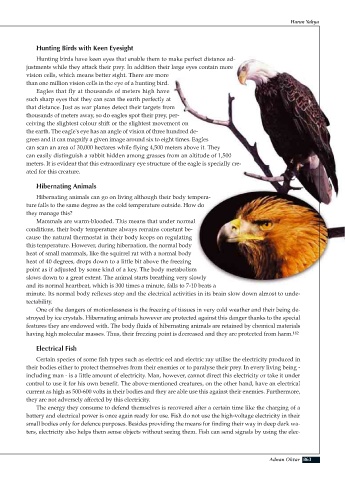
                 Hunting Birds with Keen Eyesight


                 Hunting birds have keen eyes that enable them to make perfect distance ad-
             justments while they attack their prey. In addition their large eyes contain more
             vision cells, which means better sight. There are more

             than one million vision cells in the eye of a hunting bird.
                 Eagles that fly at thousands of meters high have
             such sharp eyes that they can scan the earth perfectly at
             that distance. Just as war planes detect their targets from

             thousands of meters away, so do eagles spot their prey, per-
             ceiving the slightest colour shift or the slightest movement on
             the earth. The eagle's eye has an angle of vision of three hundred de-
             grees and it can magnify a given image around six to eight times. Eagles

             can scan an area of 30,000 hectares while flying 4,500 meters above it. They
             can easily distinguish a rabbit hidden among grasses from an altitude of 1,500
             meters. It is evident that this extraordinary eye structure of the eagle is specially cre-
             ated for this creature.


                 Hibernating Animals

                 Hibernating animals can go on living although their body tempera-

             ture falls to the same degree as the cold temperature outside. How do
             they manage this?
                 Mammals are warm-blooded. This means that under normal

             conditions, their body temperature always remains constant be-
             cause the natural thermostat in their body keeps on regulating
             this temperature. However, during hibernation, the normal body
             heat of small mammals, like the squirrel rat with a normal body
             heat of 40 degrees, drops down to a little bit above the freezing

             point as if adjusted by some kind of a key. The body metabolism
             slows down to a great extent. The animal starts breathing very slowly
             and its normal heartbeat, which is 300 times a minute, falls to 7-10 beats a

             minute. Its normal body reflexes stop and the electrical activities in its brain slow down almost to unde-
             tectability.
                 One of the dangers of motionlessness is the freezing of tissues in very cold weather and their being de-
             stroyed by ice crystals. Hibernating animals however are protected against this danger thanks to the special
             features they are endowed with. The body fluids of hibernating animals are retained by chemical materials

             having high molecular masses. Thus, their freezing point is decreased and they are protected from harm.                182

                 Electrical Fish


                 Certain species of some fish types such as electric eel and electric ray utilise the electricity produced in
             their bodies either to protect themselves from their enemies or to paralyse their prey. In every living being -
             including man - is a little amount of electricity. Man, however, cannot direct this electricity or take it under

             control to use it for his own benefit. The above-mentioned creatures, on the other hand, have an electrical
             current as high as 500-600 volts in their bodies and they are able use this against their enemies. Furthermore,
             they are not adversely affected by this electricity.
                 The energy they consume to defend themselves is recovered after a certain time like the charging of a

             battery and electrical power is once again ready for use. Fish do not use the high-voltage electricity in their
             small bodies only for defence purposes. Besides providing the means for finding their way in deep dark wa-
             ters, electricity also helps them sense objects without seeing them. Fish can send signals by using the elec-


                                                                                                                          Adnan Oktar    863

