


Page 870 - Atlas of Creation Volume 1
P. 870
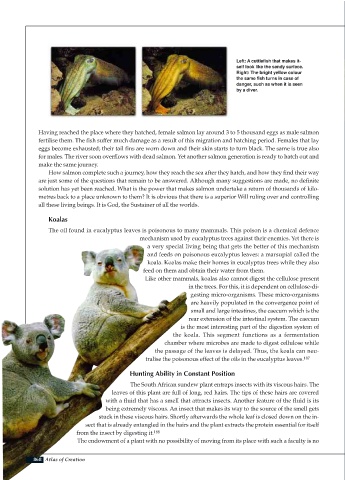
Left: A cuttlefish that makes it-
                                                                                                           self look like the sandy surface.
                                                                                                           Right: The bright yellow colour
                                                                                                           the same fish turns in case of
                                                                                                           danger, such as when it is seen
                                                                                                           by a diver.


                  Having reached the place where they hatched, female salmon lay around 3 to 5 thousand eggs as male salmon

                  fertilise them. The fish suffer much damage as a result of this migration and hatching period. Females that lay
                  eggs become exhausted; their tail fins are worn down and their skin starts to turn black. The same is true also
                  for males. The river soon overflows with dead salmon. Yet another salmon generation is ready to hatch out and
                  make the same journey.

                       How salmon complete such a journey, how they reach the sea after they hatch, and how they find their way
                  are just some of the questions that remain to be answered. Although many suggestions are made, no definite
                  solution has yet been reached. What is the power that makes salmon undertake a return of thousands of kilo-
                  metres back to a place unknown to them? It is obvious that there is a superior Will ruling over and controlling

                  all these living beings. It is God, the Sustainer of all the worlds.

                       Koalas


                       The oil found in eucalyptus leaves is poisonous to many mammals. This poison is a chemical defence
                                                                mechanism used by eucalyptus trees against their enemies. Yet there is
                                                                   a very special living being that gets the better of this mechanism
                                                                   and feeds on poisonous eucalyptus leaves: a marsupial called the

                                                                   koala. Koalas make their homes in eucalyptus trees while they also
                                                                 feed on them and obtain their water from them.
                                                                  Like other mammals, koalas also cannot digest the cellulose present

                                                                                      in the trees. For this, it is dependent on cellulose-di-
                                                                                       gesting micro-organisms. These micro-organisms
                                                                                       are heavily populated in the convergence point of
                                                                                       small and large intestines, the caecum which is the
                                                                                      rear extension of the intestinal system. The caecum

                                                                                  is the most interesting part of the digestion system of
                                                                               the koala. This segment functions as a fermentation
                                                                           chamber where microbes are made to digest cellulose while

                                                                       the passage of the leaves is delayed. Thus, the koala can neu-
                                                                  tralise the poisonous effect of the oils in the eucalyptus leaves.     187


                                                           Hunting Ability in Constant Position

                                                            The South African sundew plant entraps insects with its viscous hairs. The
                                                   leaves of this plant are full of long, red hairs. The tips of these hairs are covered
                                                with a fluid that has a smell that attracts insects. Another feature of the fluid is its

                                                being extremely viscous. An insect that makes its way to the source of the smell gets
                                             stuck in these viscous hairs. Shortly afterwards the whole leaf is closed down on the in-
                                       sect that is already entangled in the hairs and the plant extracts the protein essential for itself
                                   from the insect by digesting it.   188

                                    The endowment of a plant with no possibility of moving from its place with such a faculty is no


                868 Atlas of Creation

