


Page 866 - Atlas of Creation Volume 1
P. 866
The Thr ead of the Spider


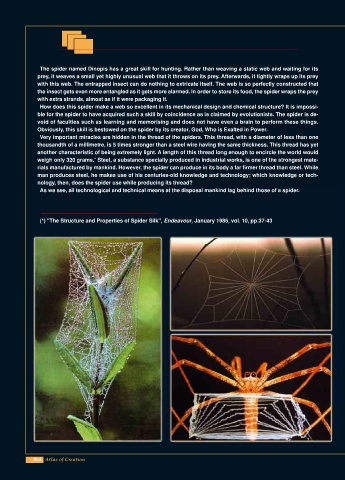
                   The spider named Dinopis has a great skill for hunting. Rather than weaving a static web and waiting for its

                  prey, it weaves a small yet highly unusual web that it throws on its prey. Afterwards, it tightly wraps up its prey
                  with this web. The entrapped insect can do nothing to extricate itself. The web is so perfectly constructed that
                  the insect gets even more entangled as it gets more alarmed. In order to store its food, the spider wraps the prey
                  with extra strands, almost as if it were packaging it.
                   How does this spider make a web so excellent in its mechanical design and chemical structure? It is impossi-
                  ble for the spider to have acquired such a skill by coincidence as is claimed by evolutionists. The spider is de-
                  void of faculties such as learning and memorising and does not have even a brain to perform these things.

                  Obviously, this skill is bestowed on the spider by its creator, God, Who is Exalted in Power.
                   Very important miracles are hidden in the thread of the spiders. This thread, with a diameter of less than one
                  thousandth of a millimetre, is 5 times stronger than a steel wire having the same thickness. This thread has yet
                  another characteristic of being extremely light. A length of this thread long enough to encircle the world would
                  weigh only 320 grams. Steel, a substance specially produced in industrial works, is one of the strongest mate-
                                           *
                  rials manufactured by mankind. However, the spider can produce in its body a far firmer thread than steel. While
                  man produces steel, he makes use of his centuries-old knowledge and technology; which knowledge or tech-
                  nology, then, does the spider use while producing its thread?
                   As we see, all technological and technical means at the disposal mankind lag behind those of a spider.


                   (*) "The Structure and Properties of Spider Silk", Endeavour, January 1986, vol. 10, pp.37-43


                864 Atlas of Creation

