


Page 869 - Atlas of Creation Volume 1
P. 869
Harun Yahya


             cell membrane of the frog is highly permeable to glucose so that
             glucose finds easy access to cells. The high level of glucose in the
             body reduces the freezing temperature causing only a very small

             amount of the animal's inner body liquid to turn to ice in the cold.
             Research has showed that glucose can feed frozen cells as well.
             During this period, besides being the natural fuel of the body, glu-
             cose also stops many metabolic reactions like urea synthesis and thus
             prevents different food sources of the cell from being exhausted.

                 How does such a high amount of glucose in the frog's body come about all of a sudden? The answer is
             quite interesting: this living being is equipped with a very special system in charge of this task. As soon as ice
             appears on the skin, a message travels to the liver making the liver convert some of its stored glycogen into

             glucose. The nature of this message travelling to the liver is still unknown. Five minutes after the message is
             received, the sugar level in the blood steadily starts to increase.     185
                 Unquestionably the animal's being equipped with a system that entirely changes its metabolism to meet
             all of its needs just when it is required can only be possible through the flawless plan of the All-Mighty
             Creator. No coincidence can generate such a perfect and complex system.


                 Albatrosses


                 Migratory birds minimise energy consumption by using different "flight techniques". Albatrosses are
             also observed to have such a flight style. These birds, which spend 92% of their lives on the sea, have wing
             spans of up to 3,5 meters. The most important characteristic of albatrosses is their flight style: they can fly for
             hours without beating their wings at all. To do so, they glide along in the air keeping their wings constant by

             making use of the wind.
                 It requires a great deal of energy to keep wings with a wing span of 3.5 meters constantly open.
             Albatrosses, however, can stay in this position for hours. This is due to the special anatomical system they
             are bestowed with from the moment of their birth. During flight, the wings of the albatross are blocked.

             Therefore, it does not need to use any muscular power. Wings are lifted only by muscle layers. This greatly
             helps the bird during its flight. This system reduces the energy consumed by the bird during flight. The al-
             batross does not use energy because it does not beat its wings or waste energy to keep its wings outstretched.
             Flying for hours by making exclusive use of wind provides an un-

             limited energy source for it. For instance, a 10-kilo-albatross loses
             only 1% of its body weight while it travels for 1,000 kms. This is in-
             deed a very small rate. Men have manufactured gliders taking al-
             batrosses as a model and by making use of their fascinating flight

             technique.  186

                 An Arduous Migration


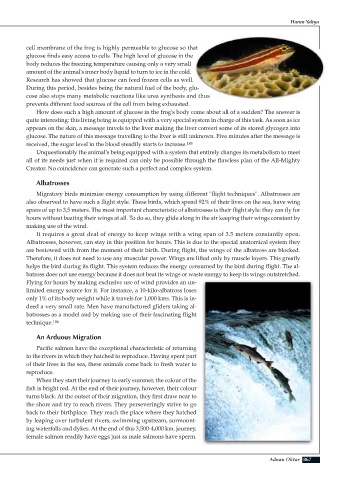
                 Pacific salmon have the exceptional characteristic of returning
             to the rivers in which they hatched to reproduce. Having spent part
             of their lives in the sea, these animals come back to fresh water to

             reproduce.
                 When they start their journey in early summer, the colour of the
             fish is bright red. At the end of their journey, however, their colour
             turns black. At the outset of their migration, they first draw near to
             the shore and try to reach rivers. They perseveringly strive to go

             back to their birthplace. They reach the place where they hatched
             by leaping over turbulent rivers, swimming upstream, surmount-
             ing waterfalls and dykes. At the end of this 3,500-4,000 km. journey,

             female salmon readily have eggs just as male salmons have sperm.


                                                                                                                          Adnan Oktar    867

