


Page 872 - Atlas of Creation Volume 1
P. 872
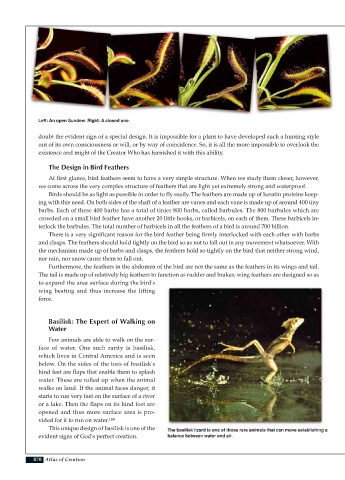
Left: An open Sundew. Right: A closed one.


                  doubt the evident sign of a special design. It is impossible for a plant to have developed such a hunting style
                  out of its own consciousness or will, or by way of coincidence. So, it is all the more impossible to overlook the
                  existence and might of the Creator Who has furnished it with this ability.


                       The Design in Bird Feathers

                       At first glance, bird feathers seem to have a very simple structure. When we study them closer, however,

                  we come across the very complex structure of feathers that are light yet extremely strong and waterproof.
                       Birds should be as light as possible in order to fly easily. The feathers are made up of keratin proteins keep-
                  ing with this need. On both sides of the shaft of a feather are vanes and each vane is made up of around 400 tiny
                  barbs. Each of these 400 barbs has a total of tinier 800 barbs, called barbules. The 800 barbules which are
                  crowded on a small bird feather have another 20 little hooks, or barbicels, on each of them. These barbicels in-

                  terlock the barbules. The total number of barbicels in all the feathers of a bird is around 700 billion.
                       There is a very significant reason for the bird feather being firmly interlocked with each other with barbs
                  and clasps. The feathers should hold tightly on the bird so as not to fall out in any movement whatsoever. With

                  the mechanism made up of barbs and clasps, the feathers hold so tightly on the bird that neither strong wind,
                  nor rain, nor snow cause them to fall out.
                       Furthermore, the feathers in the abdomen of the bird are not the same as the feathers in its wings and tail.
                  The tail is made up of relatively big feathers to function as rudder and brakes; wing feathers are designed so as
                  to expand the area surface during the bird's

                  wing beating and thus increase the lifting
                  force.


                       Basilisk: The Expert of Walking on
                       Water

                       Few animals are able to walk on the sur-

                  face of water. One such rarity is basilisk,
                  which lives in Central America and is seen
                  below. On the sides of the toes of basilisk's
                  hind feet are flaps that enable them to splash

                  water. These are rolled up when the animal
                  walks on land. If the animal faces danger, it
                  starts to run very fast on the surface of a river
                  or a lake. Then the flaps on its hind feet are

                  opened and thus more surface area is pro-
                  vided for it to run on water.   189
                       This unique design of basilisk is one of the         The basilisk lizard is one of those rare animals that can move establishing a
                  evident signs of God's perfect creation.                  balance between water and air.


                870 Atlas of Creation

