


Page 871 - Atlas of Creation Volume 1
P. 871
The Design in Bird Feathers


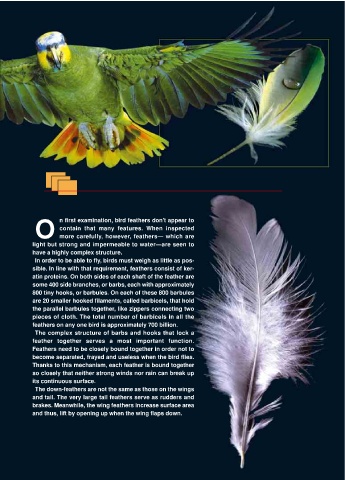
                            n first examination, bird feathers don't appear to
                            contain that many features. When inspected
                 O more carefully, however, feathers— which are

                light but strong and impermeable to water—are seen to
                have a highly complex structure.
                 In order to be able to fly, birds must weigh as little as pos-
                sible. In line with that requirement, feathers consist of ker-

                atin proteins. On both sides of each shaft of the feather are
                some 400 side branches, or barbs, each with approximately
                800 tiny hooks, or barbules. On each of these 800 barbules
                are 20 smaller hooked filaments, called barbicels, that hold

                the parallel barbules together, like zippers connecting two
                pieces of cloth. The total number of barbicels in all the
                feathers on any one bird is approximately 700 billion.
                 The complex structure of barbs and hooks that lock a

                feather together serves a most important function.
                Feathers need to be closely bound together in order not to
                become separated, frayed and useless when the bird flies.
                Thanks to this mechanism, each feather is bound together

                so closely that neither strong winds nor rain can break up
                its continuous surface.
                 The down-feathers are not the same as those on the wings
                and tail. The very large tail feathers serve as rudders and

                brakes. Meanwhile, the wing feathers increase surface area
                and thus, lift by opening up when the wing flaps down.

