


Page 868 - Atlas of Creation Volume 1
P. 868
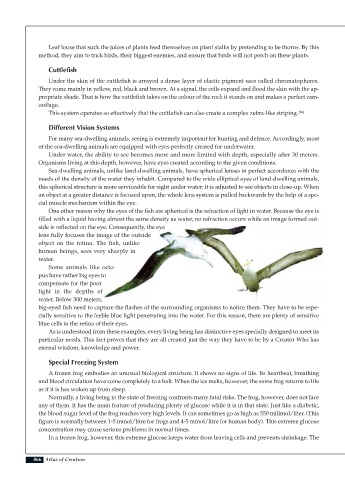
Leaf louse that suck the juices of plants feed themselves on plant stalks by pretending to be thorns. By this
                  method, they aim to trick birds, their biggest enemies, and ensure that birds will not perch on these plants.


                       Cuttlefish

                       Under the skin of the cuttlefish is arrayed a dense layer of elastic pigment sacs called chromatophores.
                  They come mainly in yellow, red, black and brown. At a signal, the cells expand and flood the skin with the ap-
                  propriate shade. That is how the cuttlefish takes on the colour of the rock it stands on and makes a perfect cam-

                  ouflage.
                       This system operates so effectively that the cuttlefish can also create a complex zebra-like striping.          184


                       Different Vision Systems

                       For many sea-dwelling animals, seeing is extremely important for hunting and defence. Accordingly, most
                  of the sea-dwelling animals are equipped with eyes perfectly created for underwater.

                       Under water, the ability to see becomes more and more limited with depth, especially after 30 meters.
                  Organisms living at this depth, however, have eyes created according to the given conditions.
                       Sea-dwelling animals, unlike land-dwelling animals, have spherical lenses in perfect accordance with the
                  needs of the density of the water they inhabit. Compared to the wide elliptical eyes of land-dwelling animals,

                  this spherical structure is more serviceable for sight under water; it is adjusted to see objects in close-up. When
                  an object at a greater distance is focused upon, the whole lens system is pulled backwards by the help of a spe-
                  cial muscle mechanism within the eye.
                       One other reason why the eyes of the fish are spherical is the refraction of light in water. Because the eye is

                  filled with a liquid having almost the same density as water, no refraction occurs while an image formed out-
                  side is reflected on the eye. Consequently, the eye
                  lens fully focuses the image of the outside
                  object on the retina. The fish, unlike

                  human beings, sees very sharply in
                  water.
                       Some animals like octo-
                  pus have rather big eyes to

                  compensate for the poor
                  light in the depths of
                  water. Below 300 meters,
                  big-eyed fish need to capture the flashes of the surrounding organisms to notice them. They have to be espe-

                  cially sensitive to the feeble blue light penetrating into the water. For this reason, there are plenty of sensitive
                  blue cells in the retina of their eyes.
                       As is understood from these examples, every living being has distinctive eyes specially designed to meet its
                  particular needs. This fact proves that they are all created just the way they have to be by a Creator Who has

                  eternal wisdom, knowledge and power.

                       Special Freezing System


                       A frozen frog embodies an unusual biological structure. It shows no signs of life. Its heartbeat, breathing
                  and blood circulation have come completely to a halt. When the ice melts, however, the same frog returns to life
                  as if it is has woken up from sleep.
                       Normally, a living being in the state of freezing confronts many fatal risks. The frog, however, does not face

                  any of them. It has the main feature of producing plenty of glucose while it is in that state. Just like a diabetic,
                  the blood sugar level of the frog reaches very high levels. It can sometimes go as high as 550 milimol/liter. (This
                  figure is normally between 1-5 mmol/litre for frogs and 4-5 mmol/litre for human body). This extreme glucose

                  concentration may cause serious problems in normal times.
                       In a frozen frog, however, this extreme glucose keeps water from leaving cells and prevents shrinkage. The


                866 Atlas of Creation

