


Page 248 - Corporate Finance PDF Final new link
P. 248
248 Corporate Finance BRILLIANT’S
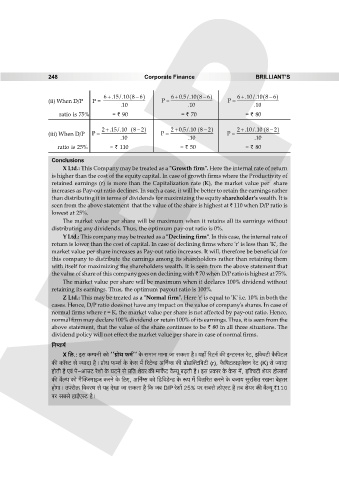
6 .15/.10 8 6 6 0.5/.10 8 6 6 .10/.10 8 6
(ii) When D/P P = P P
.10 .10 .10
ratio is 75% = ` 90 = ` 70 = ` 80
2 .15/.10 8 2 2 0.5/.10 8 2 2 .10/.10 8 2
(iii) When D/P P P P
.10 .10 .10
ratio is 25% = ` 110 = ` 50 = ` 80
Conclusions
X Ltd.: This Company may be treated as a "Growth firm". Here the internal rate of return
is higher than the cost of the equity capital. In case of growth firms where the Productivity of
retained earnings (r) is more than the Capitalization rate (K), the market value per share
increases as Pay-out ratio declines. In such a case, it will be better to retain the earnings rather
than distributing it in terms of dividends for maximizing the equity shareholder’s wealth. It is
seen from the above statement that the value of the share is highest at ` 110 when D/P ratio is
lowest at 25%. NPP
The market value per share will be maximum when it retains all its earnings without
distributing any dividends. Thus, the optimum pay-out ratio is 0%.
Y Ltd.: This company may be treated as a "Declining firm". In this case, the internal rate of
return is lower than the cost of capital. In case of declining firms where 'r' is less than 'K', the
market value per share increases as Pay-out ratio increases. It will, therefore be beneficial for
this company to distribute the earnings among its shareholders rather than retaining them
with itself for maximizing the shareholders wealth. It is seen from the above statement that
the value of share of this company goes on declining with ` 70 when D/P ratio is highest at 75%.
The market value per share will be maximum when it declares 100% dividend without
retaining its earnings. Thus, the optimum payout ratio is 100%.
Z Ltd.: This may be treated as a "Normal firm". Here 'r' is equal to 'K' i.e. 10% in both the
cases. Hence, D/P ratio does not have any impact on the value of company's shares. In case of
normal firms where r = K, the market value per share is not affected by pay-out ratio. Hence,
normal firm may declare 100% dividend or retain 100% of its earnings. Thus, it is seen from the
above statement, that the value of the share continues to be ` 80 in all three situations. The
dividend policy will not effect the market value per share in case of normal firms.
{ZîH$f©
X {c.: Bg H$ånZr H$mo ""J«moW \$_©"" Ho$ g_mZ _mZm Om gH$Vm h¡Ÿ& `hm± [aQ>Z© H$s BÝQ>aZc aoQ>, B{ŠdQ>r H¡${nQ>c
H$s H$m°ñQ> go Á`mXm h¡Ÿ& J«moW \$åg© Ho$ Ho$g _| [aQ>oÝS> A{Zª½g H$s n«moS>pŠQ>{dQ>r (r), H¡${nQ>cmBOoeZ aoQ> (K) go Á`mXm
hmoVr h¡ Ed§ no-AmCQ> aoemo Ho$ KQ>Zo go à{V eo`a H$s _mH}$Q> d¡ë`y ~‹T>Vr h¡Ÿ& Bg àH$ma Ho$ Ho$g _|, B{ŠdQ>r eo`a hmoëS>g©
H$s d¡ëW H$mo _¡pŠO_mBO H$aZo Ho$ {cE, A{Zª½g H$mo {S>{dS>oÝS> Ho$ ê$n _| {dV[aV H$aZo Ho$ ~Om` gwa{jV aIZm ~ohVa
hmoJmŸ& Cnamoº$ {ddaU go `h XoIm Om gH$Vm h¡ {H$ O~ D/P aoem| 25% na g~go cmoEñQ> h¡ V~ eo`a H$s d¡ë`y `110
na g~go hmB©EñQ> h¡Ÿ&

