


Page 29 - Process_book_Carla Ann_Lloren
P. 29
Chapter 4 Ideation


                                                                                                                      Ideation Process & Techniques


                   3. Developing Ideas


                   Coming from the ideation session, the next step in the process was to take the ideas with potential and further develop them into more concrete
                   concepts that can answer the design issues at hand. This stage birthed three (3) proposed solutions. All solutions intended to create pockets of
                   purpose in the neighbourhood.
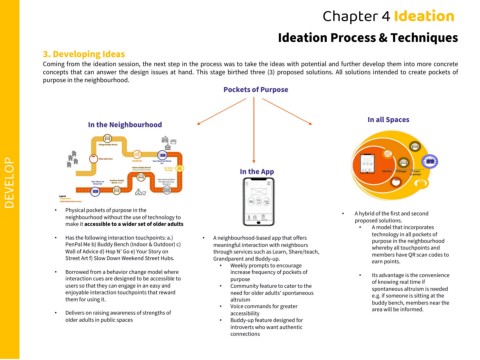
                                                                                               Pockets of Purpose


                                                                                                                                                           In all Spaces
                                      In the Neighbourhood


      DEVELOP                                                                                         In the App                                                                      A R T


                        •   Physical pockets of purpose in the                                                                                   •    A hybrid of the first and second
                            neighbourhood without the use of technology to                                                                            proposed solutions.
                            make it accessible to a wider set of older adults
                                                                                                                                                        •    A model that incorporates
                                                                                                                                                             technology in all pockets of
                        •   Has the following interaction touchpoints: a.)            •    A neighbourhood-based app that offers                             purpose in the neighbourhood
                            PenPal Me b) Buddy Bench (Indoor & Outdoor) c)                 meaningful interaction with neighbours                            whereby all touchpoints and
                            Wall of Advice d) Hop N’ Go e) Your Story on                   through services such as Learn, Share/teach,                      members have QR scan codes to
                            Street Art f) Slow Down Weekend Street Hubs.                   Grandparent and Buddy-up.                                         earn points.
                                                                                             •    Weekly prompts to encourage
                        •   Borrowed from a behavior change model where                           increase frequency of pockets of                      •    Its advantage is the convenience
                            interaction cues are designed to be accessible to                     purpose                                                    of knowing real time if
                            users so that they can engage in an easy and                     •    Community feature to cater to the                          spontaneous altruism is needed
                            enjoyable interaction touchpoints that reward                         need for older adults’ spontaneous                         e.g. if someone is sitting at the
                            them for using it.                                                    altruism                                                   buddy bench, members near the
                                                                                             •    Voice commands for greater                                 area will be informed.
                        •   Delivers on raising awareness of strengths of                         accessibility
                            older adults in public spaces                                    •    Buddy-up feature designed for
                                                                                                  introverts who want authentic
                                                                                                  connections

