


Page 206 - Handout Computer Network.
P. 206
• Operational security. Almost all organizations (companies, universities, and so on)
                            today have networks that are attached to the public Internet.


                            These networks therefore can potentially be compromised. Attackers can attempt
                            to deposit worms into the hosts in the network, obtain corporate secrets, map the
                            internal network configurations, and launch DoS attacks.


                            We’ll  see  in  Section  8.9  that  operational  device  such  as  firewalls  and  intrusion
                            detection systems are used to counter attacks against an organization’s network.

                            A  firewall  sits  between  the  organization’s  network  and  the  public  network,
                            controlling packet access to and from the network.

                            An  intrusion  detection  system  performs  “deep  packet  inspection,”  alerting  the
                            network administrators about suspicious activity. Having established what we mean
                            by network security, let’s next consider exactly what information an intruder may
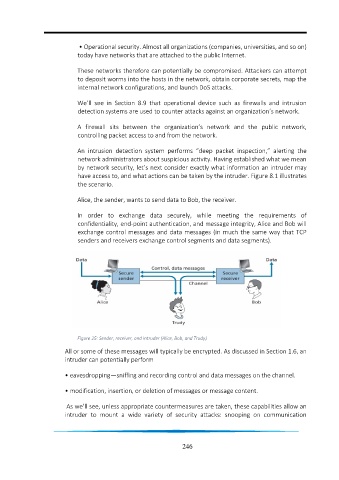
                            have access to, and what actions can be taken by the intruder. Figure 8.1 illustrates
                            the scenario.

                            Alice, the sender, wants to send data to Bob, the receiver.

                            In  order  to  exchange  data  securely,  while  meeting  the  requirements  of
                            confidentiality, end-point authentication, and message integrity, Alice and Bob will
                            exchange control messages and data messages (in much the same way that TCP
                            senders and receivers exchange control segments and data segments).


                            Figure 25: Sender, receiver, and intruder (Alice, Bob, and Trudy)

                        All or some of these messages will typically be encrypted. As discussed in Section 1.6, an
                        intruder can potentially perform


                        • eavesdropping—sniffing and recording control and data messages on the channel.

                        • modification, insertion, or deletion of messages or message content.

                         As we’ll see, unless appropriate countermeasures are taken, these capabilities allow an
                        intruder  to  mount  a  wide  variety  of  security  attacks:  snooping  on  communication


                                                                 246

