


Page 208 - Handout Computer Network.
P. 208
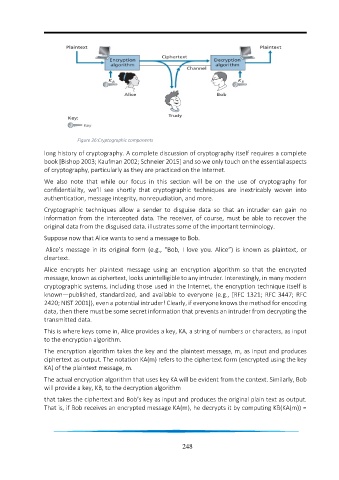
Figure 26:Cryptographic components

                 long history of cryptography. A complete discussion of cryptography itself requires a complete
                 book [Bishop 2003; Kaufman 2002; Schneier 2015] and so we only touch on the essential aspects
                 of cryptography, particularly as they are practiced on the Internet.
                 We  also  note  that  while  our  focus  in  this  section  will  be  on  the  use  of  cryptography  for
                 confidentiality,  we’ll  see  shortly  that  cryptographic  techniques  are  inextricably  woven  into
                 authentication, message integrity, nonrepudiation, and more.
                 Cryptographic  techniques  allow  a  sender  to  disguise  data  so  that  an  intruder  can  gain  no
                 information from the intercepted data. The receiver, of course, must be able to recover the
                 original data from the disguised data. illustrates some of the important terminology.

                 Suppose now that Alice wants to send a message to Bob.
                  Alice’s  message  in  its  original  form  (e.g.,  “Bob,  I  love  you.  Alice”)  is  known  as  plaintext,  or
                 cleartext.
                 Alice  encrypts  her  plaintext  message  using  an  encryption  algorithm  so  that  the  encrypted
                 message, known as ciphertext, looks unintelligible to any intruder. Interestingly, in many modern
                 cryptographic systems, including those used in the Internet, the encryption technique itself is
                 known—published, standardized,  and  available  to  everyone  (e.g.,  [RFC  1321;  RFC  3447;  RFC
                 2420; NIST 2001]), even a potential intruder! Clearly, if everyone knows the method for encoding
                 data, then there must be some secret information that prevents an intruder from decrypting the
                 transmitted data.

                 This is where keys come in, Alice provides a key, KA, a string of numbers or characters, as input
                 to the encryption algorithm.
                 The encryption algorithm takes the key and the plaintext message, m, as input and produces
                 ciphertext as output. The notation KA(m) refers to the ciphertext form (encrypted using the key
                 KA) of the plaintext message, m.
                 The actual encryption algorithm that uses key KA will be evident from the context. Similarly, Bob
                 will provide a key, KB, to the decryption algorithm

                 that takes the ciphertext and Bob’s key as input and produces the original plain text as output.
                 That is, if Bob receives an encrypted message KA(m), he decrypts it by computing KB(KA(m)) =


                                                                 248

