


Page 211 - Handout Computer Network.
P. 211
Computer Network                                                             2026


            the fifth using C2. The pattern then repeats, with the sixth letter being encoded using C1, the
            seventh with C2, and so on.

            The plaintext message “bob, i love you.” is thus encrypted “ghu, n etox dhz.” Note that the first
            b in the plaintext message is encrypted using C1, while the second b is encrypted using C2. In this
            example, the encryption and decryption “key” is the knowledge of the two Caesar keys (k = 5, k
            = 19) and the pattern C1, C2, C2, C1, C2. Block Ciphers Let us now move forward to modern times
            and examine how symmetric key encryption is done today.

            We focus on block ciphers, which are used in many secure Internet protocols, including PGP (for
            secure e-mail), TLS (for securing TCP connections), and IPsec (for securing the network-layer
            transport).
            In a block cipher, the message to be encrypted is processed in blocks of k bits.

            For example, if k = 64, then the message is broken into 64-bit blocks, and each block is encrypted
            independently. To encode a block, the cipher uses a one-to-one map ping to map the k-bit block
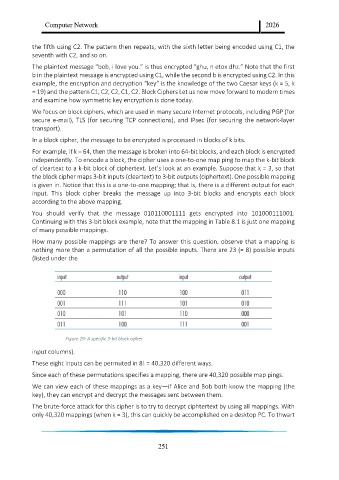
            of cleartext to a k-bit block of ciphertext. Let’s look at an example. Suppose that k = 3️, so that
            the block cipher maps 3-bit inputs (cleartext) to 3-bit outputs (ciphertext). One possible mapping
            is given in. Notice that this is a one-to-one mapping; that is, there is a different output for each
            input.  This  block  cipher  breaks  the  message  up  into  3-bit  blocks  and  encrypts  each  block
            according to the above mapping.
            You  should  verify  that  the  message  010110001111  gets  encrypted  into  101000111001.
            Continuing with this 3-bit block example, note that the mapping in Table 8.1 is just one mapping
            of many possible mappings.
            How many possible mappings are there? To answer this question, observe that a mapping is
            nothing more than a permutation of all the possible inputs. There are 23 (= 8) possible inputs
            (listed under the


                        Figure 29: A specific 3-bit block cipher
            input columns).

            These eight inputs can be permuted in 8! = 40,320 different ways.

            Since each of these permutations specifies a mapping, there are 40,320 possible map pings.
            We can view each of these mappings as a key—if Alice and Bob both know the mapping (the
            key), they can encrypt and decrypt the messages sent between them.
            The brute-force attack for this cipher is to try to decrypt ciphtertext by using all mappings. With
            only 40,320 mappings (when k = 3), this can quickly be accomplished on a desktop PC. To thwart


                                                         251

