


Page 212 - Handout Computer Network.
P. 212
brute-force attacks, block ciphers typically use much larger blocks, consisting of k = 64 bits or
                 even larger. Note that the number of possible mappings for a general k-block cipher is 2k! which
                 is astronomical for even moderate values of k (such as k = 64). Although full-table block ciphers,
                 as  just  described,  with  moderate  values  of  k  can  produce  robust  symmetric  key  encryption
                 schemes, they are unfortunately difficult to implement. For k = 64 and for a given mapping, Alice
                 and  Bob  would  need  to  maintain  a  table  with  264  input  values,  which  is  an  infeasible  task.
                 Moreover, if Alice and Bob were to change keys, they would have to each regenerate the table.
                 Thus,  a  full-table  block  cipher,  providing  predetermined  mappings  between  all  inputs  and
                 outputs (as in the example above), is simply out of the question. Instead, block ciphers typically
                 use functions that simulate randomly permuted tables.

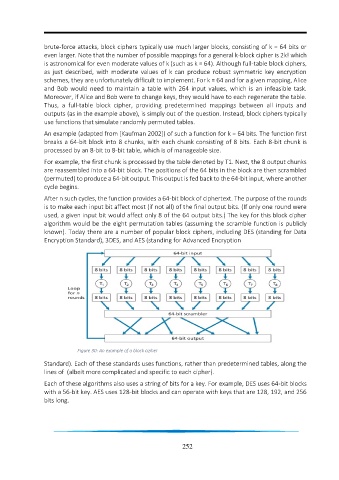
                 An example (adapted from [Kaufman 2002]) of such a function for k = 64 bits. The function first
                 breaks a 64-bit block into 8 chunks, with each chunk consisting of 8 bits. Each 8-bit chunk is
                 processed by an 8-bit to 8-bit table, which is of manageable size.

                 For example, the first chunk is processed by the table denoted by T1. Next, the 8 output chunks
                 are reassembled into a 64-bit block. The positions of the 64 bits in the block are then scrambled
                 (permuted) to produce a 64-bit output. This output is fed back to the 64-bit input, where another
                 cycle begins.

                 After n such cycles, the function provides a 64-bit block of ciphertext. The purpose of the rounds
                 is to make each input bit affect most (if not all) of the final output bits. (If only one round were
                 used, a given input bit would affect only 8 of the 64 output bits.) The key for this block cipher
                 algorithm would be the eight permutation tables (assuming the scramble function is publicly
                 known). Today there are a number of popular block ciphers, including DES (standing for Data
                 Encryption Standard), 3DES, and AES (standing for Advanced Encryption


                            Figure 30: An example of a block cipher

                 Standard). Each of these standards uses functions, rather than predetermined tables, along the
                 lines of  (albeit more complicated and specific to each cipher).

                 Each of these algorithms also uses a string of bits for a key. For example, DES uses 64-bit blocks
                 with a 56-bit key. AES uses 128-bit blocks and can operate with keys that are 128, 192, and 256
                 bits long.


                                                                 252

