


Page 217 - Handout Computer Network.
P. 217
Computer Network                                                             2026


            5. The public key that Bob makes available to the world, K+ B, is the pair of numbers (n, e); his
            private key, K-B, is the pair of numbers (n, d). The encryption by Alice and the decryption by Bob
            are done as follows:

             • Suppose Alice wants to send Bob a bit pattern represented by the integer number m (with m
            6  n).  To  encode,  Alice  performs  the  exponentiation  me,  and  then  computes  the  integer
            remainder when me is divided by n. In other words, the encrypted value, c, of Alice’s plaintext
            message, m, is c = me mod n The bit pattern corresponding to this ciphertext c is sent to Bob.

            • To decrypt the received ciphertext message, c, Bob computes m = cd mod n which requires the
            use of his private key (n, d).
            As a simple example of RSA, suppose Bob chooses p = 5 and q = 7. (Admittedly, these values are
            far too small to be secure.) Then n = 35 and z = 24. Bob chooses e = 5, since 5 and 24 have no
            common factors. Finally, Bob chooses d = 29, since 5 # 29- 1 (that is, ed - 1) is exactly divisible by
            24.
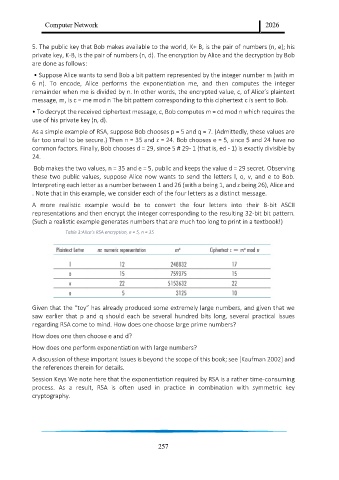
             Bob makes the two values, n = 35 and e = 5, public and keeps the value d = 29 secret. Observing
            these  two  public  values,  suppose  Alice  now wants  to  send the  letters  l, o,  v,  and  e  to  Bob.
            Interpreting each letter as a number between 1 and 26 (with a being 1, and z being 26), Alice and
            . Note that in this example, we consider each of the four letters as a distinct message.
            A  more  realistic  example  would  be  to  convert  the  four  letters  into  their  8-bit  ASCII
            representations and then encrypt the integer corresponding to the resulting 32-bit bit pattern.
            (Such a realistic example generates numbers that are much too long to print in a textbook!)
                        Table 3:Alice’s RSA encryption, e = 5, n = 35


            Given that the “toy” has already produced some extremely large numbers, and given that we
            saw  earlier  that  p  and  q  should  each  be  several  hundred  bits  long,  several  practical  issues
            regarding RSA come to mind. How does one choose large prime numbers?

            How does one then choose e and d?

            How does one perform exponentiation with large numbers?
            A discussion of these important issues is beyond the scope of this book; see [Kaufman 2002] and
            the references therein for details.
            Session Keys We note here that the exponentiation required by RSA is a rather time-consuming
            process.  As  a  result,  RSA  is  often  used  in  practice  in  combination  with  symmetric  key
            cryptography.


                                                         257

