


Page 220 - Handout Computer Network.
P. 220
Thus, the need for message integrity—when router B receives a link-state message from router
                 A, router B should verify that router A actually created the message and, further, that no one
                 tampered with the message in transit.

                 In this section, we describe a popular message integrity technique that is used by many secure
                 networking  protocols.  But  before  doing  so,  we  need  to  cover  another  important  topic  in
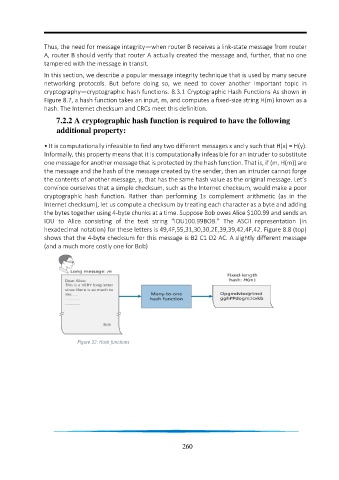
                 cryptography—cryptographic hash functions. 8.3.1 Cryptographic Hash Functions As shown in
                 Figure 8.7, a hash function takes an input, m, and computes a fixed-size string H(m) known as a
                 hash. The Internet checksum and CRCs meet this definition.

                     7.2.2 A cryptographic hash function is required to have the following
                     additional property:

                 • It is computationally infeasible to find any two different messages x and y such that H(x) = H(y).
                 Informally, this property means that it is computationally infeasible for an intruder to substitute
                 one message for another message that is protected by the hash function. That is, if (m, H(m)) are
                 the message and the hash of the message created by the sender, then an intruder cannot forge
                 the contents of another message, y, that has the same hash value as the original message. Let’s
                 convince ourselves that a simple checksum, such as the Internet checksum, would make a poor
                 cryptographic  hash  function.  Rather  than  performing  1s  complement  arithmetic  (as  in  the
                 Internet checksum), let us compute a checksum by treating each character as a byte and adding
                 the bytes together using 4-byte chunks at a time. Suppose Bob owes Alice $100.99 and sends an
                 IOU  to  Alice  consisting  of  the  text  string  “IOU100.99BOB.”  The  ASCII  representation  (in
                 hexadecimal notation) for these letters is 49,4F,55,31,30,30,2E,39,39,42,4F,42. Figure 8.8 (top)
                 shows that the 4-byte checksum for this message is B2 C1 D2 AC. A slightly different message
                 (and a much more costly one for Bob)


                            Figure 32: Hash functions


                                                                 260

