


Page 223 - Handout Computer Network.
P. 223
Computer Network                                                             2026


                  7.3.3 Digital Signatures


            Think of the number of the times you’ve signed your name to a piece of paper during the last
            week. You sign checks, credit card receipts, legal documents, and letters. Your signature attests
            to the fact that you (as opposed to someone else) have acknowledged and/or agreed with the
            document’s contents. In a digital world, one often wants to indicate the owner or creator of a
            document, or to signify one’s agreement with a document’s content.

            A digital signature is a cryptographic technique for achieving these goals in a digital world. Just
            as with handwritten signatures, digital signing should be done in a way that is verifiable and no
            forgeable.
             That is, it must be possible to prove that a document signed by an individual was indeed signed
            by that individual (the signature must be verifiable) and that only that individual could have
            signed the document (the signa ture cannot be forged).
             Let’s now consider how we might design a digital signature scheme. Observe that when Bob
            signs a message, Bob must put something on the message that is unique to him. Bob could
            consider attaching a MAC for the signature, where the MAC is created by appending his key
            (unique to him) to the message, and then taking the hash. But for Alice to verify the signature,
            she must also have a copy of the key, in which case the key would not be unique to Bob. Thus,
            MACs are not going to get the job done here. Recall that with public-key cryptography, Bob has
            both a public and private key, with both of these keys being unique to Bob. Thus, public-key
            cryptography is an excellent candidate for providing digital signatures.

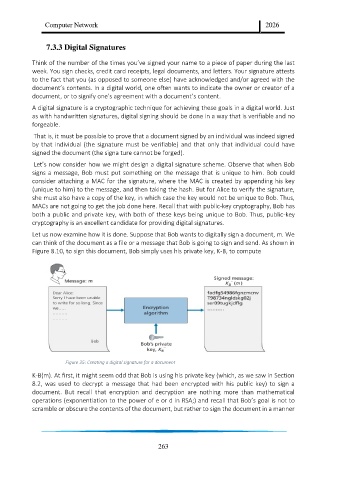
            Let us now examine how it is done. Suppose that Bob wants to digitally sign a document, m. We
            can think of the document as a file or a message that Bob is going to sign and send. As shown in
            Figure 8.10, to sign this document, Bob simply uses his private key, K-B, to compute


                        Figure 35: Creating a digital signature for a document

            K-B(m). At first, it might seem odd that Bob is using his private key (which, as we saw in Section
            8.2,  was  used  to  decrypt  a  message that  had  been  encrypted  with  his public  key)  to  sign  a
            document.  But  recall  that  encryption  and  decryption  are  nothing  more  than  mathematical
            operations (exponentiation to the power of e or d in RSA;) and recall that Bob’s goal is not to
            scramble or obscure the contents of the document, but rather to sign the document in a manner


                                                         263

