


Page 222 - Handout Computer Network.
P. 222
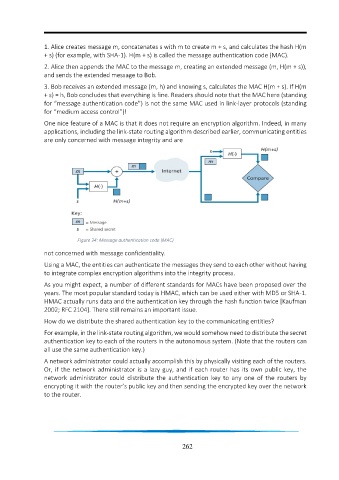
1. Alice creates message m, concatenates s with m to create m + s, and calculates the hash H(m
                 + s) (for example, with SHA-1). H(m + s) is called the message authentication code (MAC).

                 2. Alice then appends the MAC to the message m, creating an extended message (m, H(m + s)),
                 and sends the extended message to Bob.
                 3. Bob receives an extended message (m, h) and knowing s, calculates the MAC H(m + s). If H(m
                 + s) = h, Bob concludes that everything is fine. Readers should note that the MAC here (standing
                 for “message authentication code”) is not the same MAC used in link-layer protocols (standing
                 for “medium access control”)!
                 One nice feature of a MAC is that it does not require an encryption algorithm. Indeed, in many
                 applications, including the link-state routing algorithm described earlier, communicating entities
                 are only concerned with message integrity and are


                            Figure 34: Message authentication code (MAC)

                 not concerned with message confidentiality.
                 Using a MAC, the entities can authenticate the messages they send to each other without having
                 to integrate complex encryption algorithms into the integrity process.

                 As you might expect, a number of different standards for MACs have been proposed over the
                 years. The most popular standard today is HMAC, which can be used either with MD5 or SHA-1.
                 HMAC actually runs data and the authentication key through the hash function twice [Kaufman
                 2002; RFC 2104]. There still remains an important issue.

                 How do we distribute the shared authentication key to the communicating entities?
                 For example, in the link-state routing algorithm, we would somehow need to distribute the secret
                 authentication key to each of the routers in the autonomous system. (Note that the routers can
                 all use the same authentication key.)
                 A network administrator could actually accomplish this by physically visiting each of the routers.
                 Or, if the network administrator is a lazy guy, and if each router has its own public key, the
                 network  administrator  could  distribute  the  authentication  key  to  any  one  of  the  routers  by
                 encrypting it with the router’s public key and then sending the encrypted key over the network
                 to the router.


                                                                 262

