


Page 218 - Handout Computer Network.
P. 218
For example, if Alice wants to send Bob a large amount of encrypted data, she could do the
                 following. First Alice chooses a key that will be used to encode the data itself; this key is referred
                 to as a session key, and is denoted by KS.

                 Alice must inform Bob of the session key, since this is the shared symmetric key, they will use
                 with a symmetric key cipher (e.g., with DES or AES). Alice encrypts the session key using Bob’s
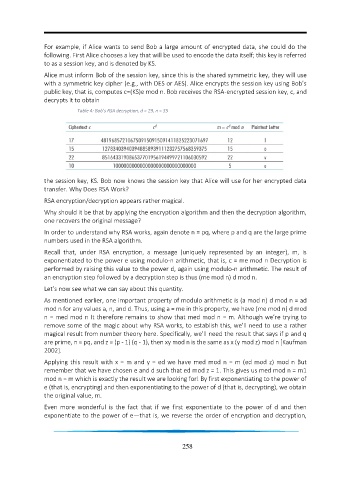
                 public key, that is, computes c=(KS)e mod n. Bob receives the RSA-encrypted session key, c, and
                 decrypts it to obtain

                            Table 4: Bob’s RSA decryption, d = 29, n = 35


                 the session key, KS. Bob now knows the session key that Alice will use for her encrypted data
                 transfer. Why Does RSA Work?
                 RSA encryption/decryption appears rather magical.

                 Why should it be that by applying the encryption algorithm and then the decryption algorithm,
                 one recovers the original message?
                 In order to understand why RSA works, again denote n = pq, where p and q are the large prime
                 numbers used in the RSA algorithm.

                 Recall  that,  under  RSA  encryption,  a  message  (uniquely  represented  by  an  integer),  m,  is
                 exponentiated to the power e using modulo-n arithmetic, that is, c = me mod n Decryption is
                 performed by raising this value to the power d, again using modulo-n arithmetic. The result of
                 an encryption step followed by a decryption step is thus (me mod n) d mod n.

                 Let’s now see what we can say about this quantity.
                 As mentioned earlier, one important property of modulo arithmetic is (a mod n) d mod n = ad
                 mod n for any values a, n, and d. Thus, using a = me in this property, we have (me mod n) d mod
                 n = med mod n It therefore remains to show that med mod n = m. Although we’re trying to
                 remove some of the magic about why RSA works, to establish this, we’ll need to use a rather
                 magical result from number theory here. Specifically, we’ll need the result that says if p and q
                 are prime, n = pq, and z = (p - 1) (q - 1), then xy mod n is the same as x (y mod z) mod n [Kaufman
                 2002].

                 Applying this result with x = m and y = ed we have med mod n = m (ed mod z) mod n But
                 remember that we have chosen e and d such that ed mod z = 1. This gives us med mod n = m1
                 mod n = m which is exactly the result we are looking for! By first exponentiating to the power of
                 e (that is, encrypting) and then exponentiating to the power of d (that is, decrypting), we obtain
                 the original value, m.

                 Even  more  wonderful  is  the  fact  that  if  we  first  exponentiate  to  the  power  of  d  and  then
                 exponentiate to the power of e—that is, we reverse the order of encryption and decryption,


                                                                 258

